
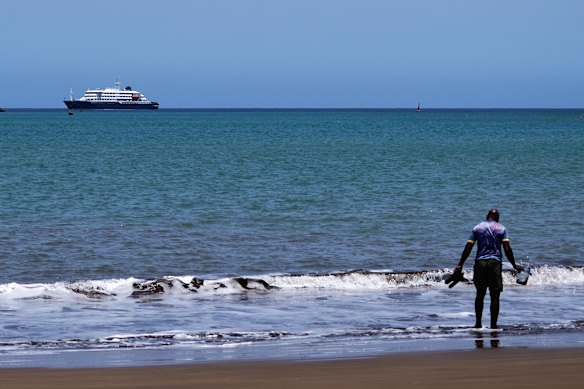
Four Australians are stranded on a luxury cruise ship being held off West Africa after three passengers died in a suspected outbreak of the deadly hantavirus.
The cruise operator confirmed the Australians were among 149 people on board, from 23 countries. The Dutch-flagged MV Hondius remains moored off the coast of Cape Verde in West Africa as local health authorities assess the situation.
Medics were working on Monday (Cape Verde time) to evacuate two people with symptoms of hantavirus. A Dutch couple and a German national have died, while others fell ill, including a Briton who left the vessel and was being treated in South Africa, authorities added.
The Netherlands’ National Institute for Public Health and the Environment (RIVM), which is assisting with the outbreak, said hantavirus had been confirmed in one of the patients showing symptoms.
A source briefed on the matter said that the Dutch woman who died had tested positive for the virus as well.
RIVM said it was still unclear if the other people with symptoms also had the virus, or if the other deaths were also caused by the virus.
Hantavirus, which can cause fatal respiratory illness, can be spread when particles from rodent droppings or urine become airborne. It does not transfer easily between humans.
There are no specific drugs to treat the disease, so treatment focuses on supportive care, including putting patients on ventilators in severe cases.
The World Health Organization said the risk to the wider public was low and there was no need for panic or travel restrictions. But authorities in the island nation of Cape Verde said they had not allowed the MV Hondius to dock as a precaution.
“We’re not just headlines: we’re people with families, with lives, with people waiting for us at home,” Jake Rosmarin, a US travel blogger, said in a tearful Instagram video post from the ship on Monday.
“There is a lot of uncertainty and that is the hardest part,” he said.
A spokesperson for the ship’s Netherlands-based operator, Oceanwide Expeditions, said that, as a precaution, all passengers were instructed to remain inside their cabins to prevent any potential spread of the virus. Although human-to-human transmission is rare, the incubation period can last several weeks, meaning some people may not yet be showing symptoms.
Oceanwide Expeditions was trying to arrange the repatriation of two crew members with symptoms of the disease – one British and one Dutch – along with the body of the German national and a “guest closely associated with the deceased” who does not have symptoms. The company said it was looking into whether passengers could be screened and disembarked on the islands of Las Palmas and Tenerife.
Spanish authorities said they had not yet received a request for the ship to dock and disembark passengers there. The Dutch Foreign Affairs Ministry, which Oceanwide Expeditions said would be the one making the request, did not immediately respond to a request for comment.
The Hondius left Ushuaia in southern Argentina in March, according to company documentation, on a voyage marketed as an Antarctic nature expedition, with berth prices ranging from 14,000 to 22,000 euros ($23,000-$36,000).
It travelled past mainland Antarctica, the Falklands, South Georgia, Nightingale Island, Tristan, St Helena, and Ascension before reaching Cape Verdean waters on May 3.
South Africa’s Health Department confirmed two of the dead were Dutch nationals: a 70-year-old man, who died on St Helena on April 11, and his wife, 69, who died in South Africa after collapsing at O.R. Tambo International Airport.
The British man being treated in a private clinic in Johannesburg became ill on April 27, while the German victim on the ship died on May 2, Oceanwide Expeditions said.
Hantavirus usually begins with flu-like symptoms, such as fatigue and fever, one to eight weeks after exposure. A spokesperson for the RIVM said the source of the outbreak was unclear.
“You could imagine, for example, that rats on board the ship transmitted the virus,” he said.
“But another possibility is that during a stop somewhere in South America, people were infected, for instance via mice, and became ill that way.”
Daniel Bausch, a visiting professor at the Geneva Graduate Institute in Switzerland, said there was some evidence of human-to-human transmission in the Andes Virus, a species of hantavirus found in Argentina and Chile.
“So it’s significant that this cruise ship started its journey in Argentina,” he said.
“The good news is … this is not going to be a big outbreak,” he said.
 Daniel Lo Surdo is a breaking news reporter for The Sydney Morning Herald. He previously helmed the national news live blog for The Sydney Morning Herald and The Age.Connect via email.
From our partners
Disclaimer : This story is auto aggregated by a computer programme and has not been created or edited by DOWNTHENEWS. Publisher: www.smh.com.au


