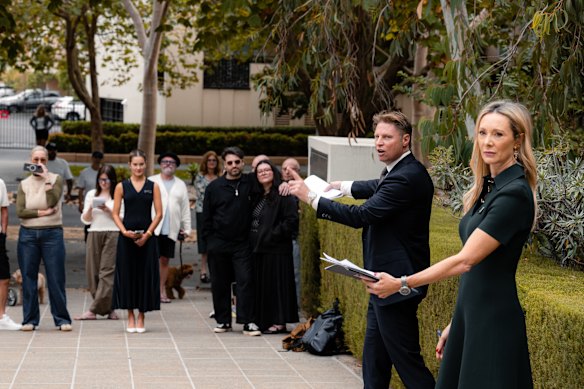
Potential home buyers and existing borrowers have become more cautious over the last two months, amid rising interest rates, spikes in petrol prices and the cost of living.
The Reserve Bank on Tuesday lifted the cash rate for the third consecutive time this year to 4.35 per cent, adding $76 a month to the cost of repayments on a $500,000 mortgage.
Mortgage broker Chris Foster-Ramsay of Foster Ramsay Finance said most of his buyers have become “super cautious” since about mid-March due to interest rate rises and rising fuel prices.
“There’s probably the most amount of caution that I’ve seen in most of my career,” he said.
“People have come in for the past five or 10 years and said, ‘Chris, tell me how much we can borrow based on how much we can earn and what the bank tests are, and we’ll shop to that.’
“[Now] people are coming in and saying, ‘How much can we borrow, but can you give us the number of the repayments now, and with one or two interest rate rises, and a full percentage point rise, and we will shop to that level.’”
Anthony Landahl, managing director at mortgage broker Equilibria Finance, said over the last couple of months he has been having conversations with existing customers about fixing their mortgage rate.
He has also been doing more frequent rate reviews for clients.
“Customers are having conversations around, ‘If these rates go up once or twice what are my repayments going to be? Am I going to be better on a fixed rate?’” he said.
“Not from everybody, but from a certain portion of clients, a lot more concern around, ‘If we get a rate rise and another one, I’m really going to start being stretched, should I be fixing for a couple of years, is there another provider?’”
He has also noticed more caution from potential buyers who are asking what their repayments would be if there are one or two rate hikes after they buy.
“People aren’t as willing to borrow to their maximum capacity, even with the 3 per cent buffer from [bank regulator] APRA, because of that concern or that caution around interest rates going up,” he said.
Canstar data insights director Sally Tindall said even before the rate hike, the war in the Middle East already “has had people on edge”, tanking consumer confidence.
“A lot of households are already responding to the uncertainty not just around rates, but also the war by cutting back on their spending,” Tindall said.
But it is a tale of two cities. While households on the brink of falling into the red are now furiously crunching numbers, Tindall said many Australians have “built up very impressive buffers over not just the last few months, but over the last five or six years since the start of Covid.”
“We have [people] who have continued to chip in money just in case they hit tougher times, and then there are people that are spending every dollar that they have to stay afloat,” she said.
For those planning their budgets, Tindall recommended taking one or two more rate hikes into consideration.
A household with a mortgage of $500,000 will face a $76 rise in their monthly repayments from the May rate hike, Canstar modelling shows. If there were to be further rises in June and August – which Westpac is the only major bank to predict – repayments would rise by $77 each time.
Melbourne interior architect Michael Welgus, 33, is paying a mortgage on a one-bedroom apartment. He deliberately bought a smaller home than he could afford about three years ago so he could pay down the mortgage faster.
He is now looking at buying an unrenovated terrace in the inner suburbs that he can transform, and accepts that will mean living for a time in a home in need of work.
He has calculated what the repayments would be on a larger loan and is paying that on his current loan, to train himself to live on that cash flow in future.
“I don’t ever want to over-mortgage myself,” he said.
He said Tuesday’s rate hike “would obviously mean that I can’t do what I want to do straight away”. But he felt having paid extra into his mortgage already meant he was in a position to consider buying again without being too stressed.
“It just means that I’m paying less of my principal which is annoying, but I’ve been quite considered in my approach to my investing to make sure that I’m not going above my means,” he said.
“I’m a bit of a stickler for safety.”
Tom Booth, a data consultant, and his wife own their townhouse in Sydney’s Five Dock outright and are now looking to upsize to get a bit more space.
But throwing up roadblocks is the “significant” price gap between their current home and that of a house or a villa, Booth said, as well as lower supply in their local area – where they hope to stay.
“It’s really difficult to find something a little bit bigger, even having paid off the place because to really go somewhere bigger, we need to borrow,” he said.
News of the rate rise on Tuesday meant he would have to ask his mortgage broker again how much he could borrow in a higher rate environment – the third such instance this year.
“It is a little disheartening from that perspective,” he said.
The couple have been considering how higher rates could affect their mortgage repayments.
“Because it’s such a large leap, any interest rate rise just significantly impacts somebody … that wants to borrow a large amount, and that’s where we’re at,” Booth, who is in his 40s, said.
“We would … happily consider spending less money on the next home that we have if it existed. And that’s the problem … that gap.”
Because the couple are upgrading, they may require bridging finance – a loan on a short-term basis that helps someone buy a new property before their current one sells.
“You’re basically holding two loans while you try and sell the place you’re in after you’ve purchased,” Booth said. “It adds a lot more stress … on the transaction.”
 Elizabeth Redman is the national property editor at The Age and The Sydney Morning Herald.Connect via X or email.
 Alice Uribe is the deputy property editor at The Sydney Morning Herald and The Age.Connect via email.
Property listings
From our partners
Disclaimer : This story is auto aggregated by a computer programme and has not been created or edited by DOWNTHENEWS. Publisher: www.smh.com.au