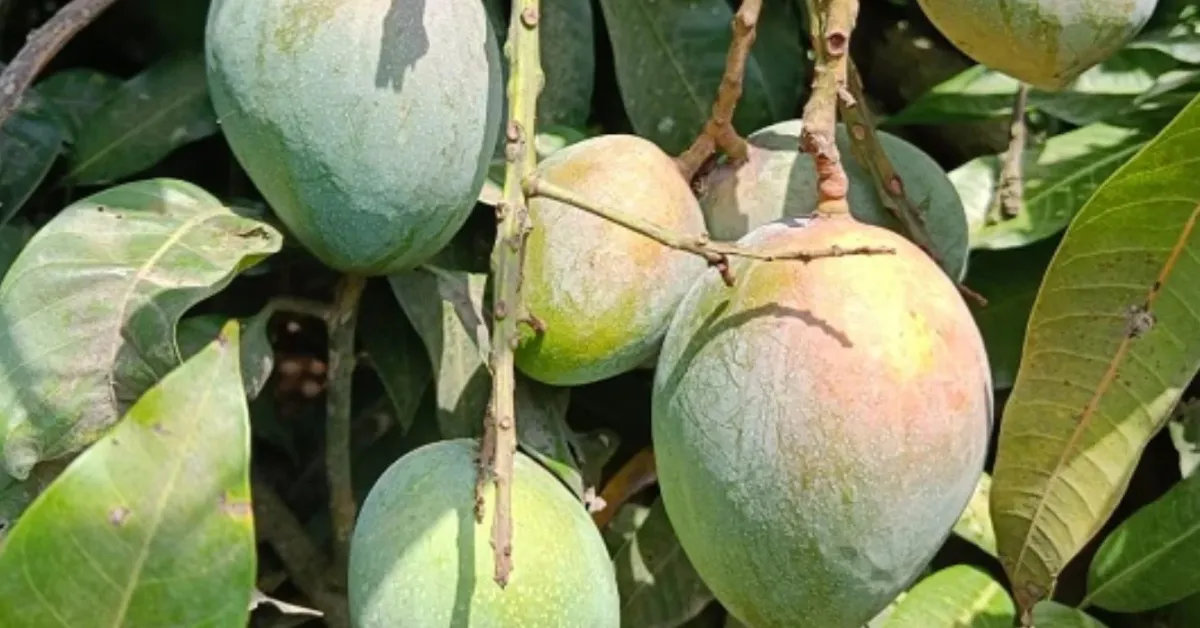
India’s mango diversity is among the highest in the world, with official horticultural records noting that the country grows over a thousand varieties of mangoes across different regions. Among these listed varieties is the Jehangir mango, mentioned alongside other traditional cultivars in India’s documented mango taxonomy.
This confirms that this variety is not a modern hybrid or imported fruit, but part of the country’s long-standing indigenous mango heritage.
When were the Jehangir mangoes valued?
Jehangir mangoes are an older Indian variety named in reference to Mughal-era cultural influence, as reflected in horticultural descriptions of the fruit’s origin and naming tradition. The mango itself is described as a monoembryonic variety with a distinctive pale flesh and rich, resinous flavour profile.
Historically, varieties like Jehangir were not grown for mass trade but for regional consumption and orchard diversity. India’s mango culture traditionally included hundreds of local varieties grown in mixed orchards rather than monoculture plantations. This is why such mangoes were once familiar within farming regions, even if they were never widely exported or commercially branded.
In simpler terms, these mangoes were ‘famous’ not in the modern retail sense, but within local orchard systems and traditional fruit-growing communities, where diversity mattered more than scale.
What made the Jehangir mango distinctive
The Jehangir mango is described in horticultural documentation as a medium-sized fruit that remains green even when ripe, with very pale, almost white flesh and a complex sweet flavour. It is also noted for being fibreless and having a compact tree structure.
These traits made it appreciated for taste rather than appearance. However, they also created a disadvantage in modern fruit markets, where visual ripeness and uniform colouring influence buyer choice.
/filters:format(webp)/english-betterindia/media/media_files/2026/04/30/jehangir-mango-variety-2026-04-30-08-32-16.png)
Why did it disappear from mainstream markets?
The decline of the Jehangir mangoes is closely tied to how mango farming in India changed over time.
India still has around 1,500 mango varieties, but only a small number are commercially dominant because they offer higher yield, easier transport, and consistent market demand.
This shift matters because Jehangir mango trees are:
- Slow-growing and less commercially productive
- Not widely cultivated in large orchards
- Not part of major export supply chains
- Difficult to scale compared to high-yield varieties
As mango farming moved towards commercial efficiency, farmers gradually replaced older varieties with those that guaranteed a stable income.
At the same time, India’s mango economy expanded into long-distance trade, where fruits needed to survive transport and storage. Only varieties that could handle this system stayed in circulation.
The role of market alteration
Modern mango distribution prioritises uniform appearance, predictable ripening, and bulk supply chains. Over time, this system naturally filters out niche or heritage varieties.
Jehangir mangoes, being limited in production and inconsistent in market supply, simply stopped fitting into this structure. Once they disappeared from wholesale demand, cultivation also reduced, creating a cycle of decline.
/filters:format(webp)/english-betterindia/media/media_files/2026/04/30/jehangir-mango-variety-2026-04-30-08-49-36.png)
This is a pattern seen across many traditional mango varieties in India, where commercialisation decreases diversity despite the country still being the world’s largest mango producer.
A heritage fruit that survives in fragments
Today, Jehangir mangoes are not entirely extinct, but they exist mostly in scattered orchards and private collections rather than in regular fruit markets.
Their story shows a larger agricultural shift in India, from a diverse, regionally grown fruit culture to standardised commercial production systems. What was once part of everyday orchard diversity has now become a rare seasonal memory, preserved more by tradition than trade.
Disclaimer : This story is auto aggregated by a computer programme and has not been created or edited by DOWNTHENEWS. Publisher: thebetterindia.com