

We are restarting our live coverage of the US-Israeli war on Iran. The US and Iran launched new attacks in the Gulf on Monday as they wrestled for control over the strait of Hormuz amid dual maritime blockades, taking the region back to the brink of full-scale war.
The fresh volleys of missiles and drones came after Donald Trump launched a new effort to get stranded tankers and other ships through the vital energy and trade route that has been virtually shut since the US-Israeli war against Iran began in late February.
On Monday, several merchant ships in the Gulf reported explosions or fires, the US said it had destroyed six small Iranian military boats – a claim Tehran denied – and Iran attacked the UAE with drones and missiles, setting the oil port of Fujairah on fire.
The US military’s Central Command (Centcom) said two US-flagged merchant vessels crossed through the strait of Hormuz on Monday as US navy destroyers operated in the Gulf. Shipping company Maersk later said one of its US-flagged commercial vessels had successfully exited the strait under US military escort.
In other key developments:
-
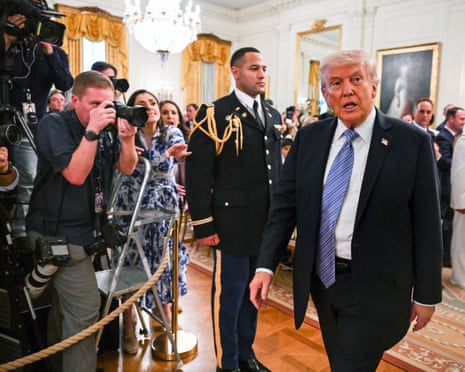
Trump warned that Iran’s forces would be “blown off the face of the earth” if they attacked US vessels trying to reopen a route through the strait. The president announced the US operation – called Project Freedom – on Monday to help hundreds of ships trapped in the Gulf.
-
Centcom chief Adm Brad Cooper declined to say whether he thought the ceasefire with Tehran that begun on 8 April remained in effect amid Iranian attacks in the region but acknowledged Iran’s Revolutionary Guards tried to “interfere” with Trump’s operation.
-
Iranian foreign minister Abbas Araqchi said Monday’s events showed there was no military solution to the crisis. He said peace talks were progressing with Pakistan’s mediation and warned the US and the UAE against being drawn into a “quagmire by ill-wishers”.
-
Iran’s Revolutionary Guards said on Monday that no commercial vessels had crossed the strait in the past few hours, and that US claims to the contrary were false. Iranian state media also denied reports the US had sunk Iranian vessels.
-
The UK and Saudi Arabia both called for de-escalation after Iran’s attacks on the UAE – the first on the US ally since Washington’s ceasefire with Tehran took effect about a month ago.
-
In Oman, two people were injured by an attack on a residential building in Bukha, on the Hormuz strait’s coastline, an Omani state news agency reported.
-
A fire on a South Korean-operated vessel that had an explosion in the Hormuz strait has been extinguished, ship operator HMM said. South Korea’s foreign ministry said all 24 crew on the HMM Namu – including six South Koreans – were unharmed. Trump blamed an Iranian attack.
-
International Monetary Fund chief Kristalina Georgieva warned that inflation was already picking up and the global economy could face a “much worse outcome” if the war dragged into 2027 and oil prices hit about $125 a barrel.
The Israeli military has issued more forced displacement orders for people in southern Lebanon – this time for those in the towns of Jabsheet and Sarafand.
In a statement on social media, the military’s Arabic-language spokesperson Avichay Adraee said these residents should evacuate their homes “immediately and move away from the villages and towns for a distance of at least 1000 metres to open areas”.
Signalling upcoming airstrikes, Adraee claimed the IDF are “compelled to act forcefully against” Hezbollah, which he said had violated the US-brokered ceasefire agreement between Israel and Lebanon that came into effect in mid April.
Hezbollah, which has been striking Israeli troops in Lebanon, says it will not cease its attacks on Israeli troops inside Lebanon and on towns in northern Israel as long as Israel continued its ceasefire violations.
Israel has been accused of violating the ceasefire agreement many times, with strikes killing civilians and homes continuing to be demolished despite the military saying it is only targeting Hezbollah sites.
Under the agreement’s terms, Israel was effectively given permission to continue its assault on Lebanon as it retained a “right to take all necessary measures in self-defence, at any time, against planned, imminent, or ongoing attacks”.
India’s ministry of external affairs said the attack on Fujairah in the UAE – which injured three Indian nationals – was “unacceptable” and called for an immediate end to the “targeting of civilian infrastructure and innocent civilians”.
Officials in Fujairah said yesterday that a fire broke out at the Fujairah Oil Industry Zone following what they described as a drone attack originating from Iran. Civil defence teams were deployed immediately to contain the blaze, Fujairah Media office said in a statement.
We are restarting our live coverage of the US-Israeli war on Iran. The US and Iran launched new attacks in the Gulf on Monday as they wrestled for control over the strait of Hormuz amid dual maritime blockades, taking the region back to the brink of full-scale war.
The fresh volleys of missiles and drones came after Donald Trump launched a new effort to get stranded tankers and other ships through the vital energy and trade route that has been virtually shut since the US-Israeli war against Iran began in late February.
On Monday, several merchant ships in the Gulf reported explosions or fires, the US said it had destroyed six small Iranian military boats – a claim Tehran denied – and Iran attacked the UAE with drones and missiles, setting the oil port of Fujairah on fire.
The US military’s Central Command (Centcom) said two US-flagged merchant vessels crossed through the strait of Hormuz on Monday as US navy destroyers operated in the Gulf. Shipping company Maersk later said one of its US-flagged commercial vessels had successfully exited the strait under US military escort.
In other key developments:
-
Trump warned that Iran’s forces would be “blown off the face of the earth” if they attacked US vessels trying to reopen a route through the strait. The president announced the US operation – called Project Freedom – on Monday to help hundreds of ships trapped in the Gulf.
-
Centcom chief Adm Brad Cooper declined to say whether he thought the ceasefire with Tehran that begun on 8 April remained in effect amid Iranian attacks in the region but acknowledged Iran’s Revolutionary Guards tried to “interfere” with Trump’s operation.
-
Iranian foreign minister Abbas Araqchi said Monday’s events showed there was no military solution to the crisis. He said peace talks were progressing with Pakistan’s mediation and warned the US and the UAE against being drawn into a “quagmire by ill-wishers”.
-
Iran’s Revolutionary Guards said on Monday that no commercial vessels had crossed the strait in the past few hours, and that US claims to the contrary were false. Iranian state media also denied reports the US had sunk Iranian vessels.
-
The UK and Saudi Arabia both called for de-escalation after Iran’s attacks on the UAE – the first on the US ally since Washington’s ceasefire with Tehran took effect about a month ago.
-
In Oman, two people were injured by an attack on a residential building in Bukha, on the Hormuz strait’s coastline, an Omani state news agency reported.
-
A fire on a South Korean-operated vessel that had an explosion in the Hormuz strait has been extinguished, ship operator HMM said. South Korea’s foreign ministry said all 24 crew on the HMM Namu – including six South Koreans – were unharmed. Trump blamed an Iranian attack.
-
International Monetary Fund chief Kristalina Georgieva warned that inflation was already picking up and the global economy could face a “much worse outcome” if the war dragged into 2027 and oil prices hit about $125 a barrel.
Disclaimer : This story is auto aggregated by a computer programme and has not been created or edited by DOWNTHENEWS. Publisher: theguardian.com









