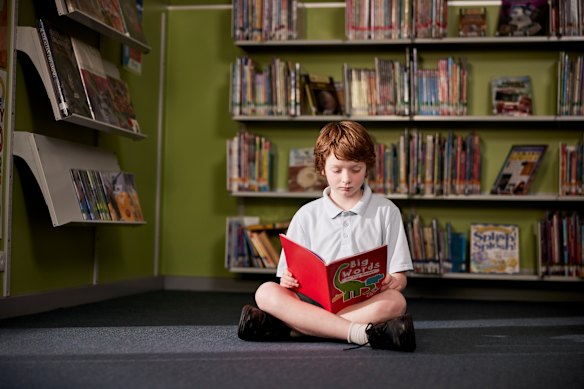
Do you remember your school library? Maybe you devoured a series introduced to you by the teacher librarian or found just the right books for your project. Perhaps it was a safe place to go at lunchtime, where new interests developed, or a place where you could let your imagination run wild. Hopefully you remember your school library as an important part of your education – a place of learning where curiosity, imagination and the joy of reading for pleasure were all made possible.
Many students today don’t have the opportunity to create such memories because in every state and territory in Australia, there is currently no legal requirement for a school to have a library. This includes infant, primary and secondary schools. It’s hard to believe, but it’s true. Any requirements that do exist are policy-based and not enforceable. For example, the NSW Department of Education has a school library policy, but it is not mandated in law, nor is compliance-tracked or enforced as far as we are aware.
The existence of a school library is largely dependent on the school system (Catholic, independent or government) followed by the school principal who has significant discretion over how the budget is allocated. There are schools that do have libraries but lack the benefit of qualified staff who have the specialised knowledge to address and fulfil the many purposes of the library including digital, media and AI literacy, which are essential for full participation in contemporary society.
So what is a modern school library? It is certainly not internet access, computers and piles of second-hand books in a cupboard. A school library is a combination of a physical and digital learning and wellbeing space with well-resourced collections and qualified staff who work with teachers, students and the school community to enhance all aspects of teaching and learning.
What you measure matters, and the most pressing issue is that there is currently no national data on school library provision in Australia. Even at the state level, departments of education are unable to provide data on the number of schools with a library and qualified staff because this is managed at the school level and reporting is not required.
Recent research paints a dire picture. For example, Dymocks Children’s Charities research found that large numbers of Queensland state schools had a $0 book budget and no librarians. Research by the Australian Council for Educational Research shows that students in schools with qualified teacher librarians achieve higher NAPLAN literacy outcomes and well-resourced, staffed libraries are linked to higher student achievement overall. The School Libraries in South Australia 2024 Census showed that only 15 per cent of all schools in the state now have a qualified teacher librarian, down from 23 per cent in 2019. We are going backwards, not forwards.
We are aware from our records that wealthier independent and Catholic schools are able to support well-resourced, often multi-campus school libraries and employ teams of qualified staff, including teacher librarians, librarians and library technicians. As government schools increasingly direct their limited resources elsewhere, the lack of school libraries contributes to a widening gap in academic and wellbeing outcomes with the independent schools. This wasn’t always the case – in the 1980s, all Australian state education departments had established centralised school library advisory and support services to assist those working in libraries in the areas of library management and curriculum. By the early 2010s all these services had ceased to exist.
Reports about declining literacy rates, increasing workloads for teachers and concerns around young people’s mental health have become a constant in recent years. Various reports have proposed solutions ranging from a whole-school curriculum approach to wellbeing frameworks and learning hubs. Each of these solutions can be directly fulfilled through increased investment in well-resourced school libraries with qualified staff.
The value of literacy initiatives focusing on reading for pleasure as a key driver of child and adult literacy have also become increasingly known and, once again, school libraries are the key to enabling such reading. For some students, a school library will be their only access to books. Research shows that when students have access to a school library, reading enjoyment increases, along with reading amount and frequency.
It seems so obvious that the proven solution to these issues is a school library with qualified library staff. We continue to advocate for school libraries, but government schools are being left behind. By investing in school libraries, Australia can build a better and fairer education system where all children have the opportunity to create memories of a special place where curiosity, imagination and the joy of reading for pleasure are made possible.
Cathie Warburton is the chief executive officer of the Australian Library and Information Association
Get a weekly wrap of views that will challenge, champion and inform your own. Sign up for our Opinion newsletter.
 Cathie Warburton – Chief Executive Officer, Australian Library & Information Association
From our partners
Disclaimer : This story is auto aggregated by a computer programme and has not been created or edited by DOWNTHENEWS. Publisher: www.smh.com.au