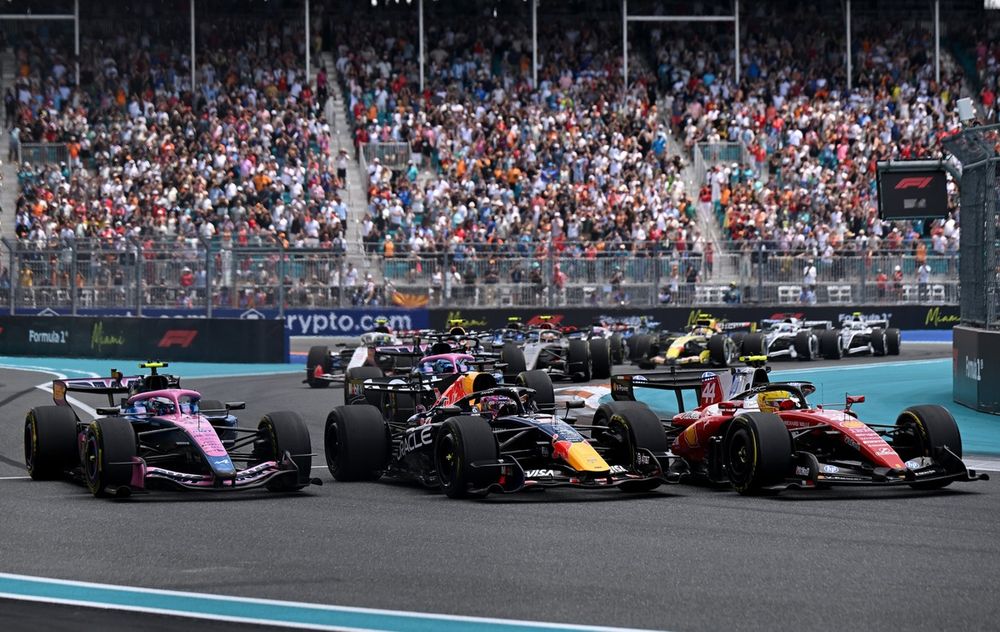
After a five-week break, the balance of power in Formula 1 appears to have shifted significantly. Although the winner in Miami – Kimi Antonelli – was the same as in Japan, a wave of updates and possible adjustments to battery usage may have reshuffled the competitive order in a lasting way.
A look at the season averages from the first three race weekends of 2026 shows that Mercedes was initially the dominant force. In qualifying, its advantage over the nearest rival stood at 0.56 seconds, while in race pace they were ahead by as much as 0.53s per lap.
In Miami, however, that margin shrank considerably. Antonelli’s pole lap yielded “only” a 0.35s advantage, and in the race Mercedes managed to outpace McLaren by a mere 0.02s per lap. Overall, the Silver Arrows lost around two tenths over a single lap and more than half a second in race pace compared to the start of the season.
The reasons behind Mercedes’ dip: Are updates the only factor?
One key factor is easy to identify: while Mercedes’ rivals introduced extensive upgrade packages in Miami, the Silver Arrows held back. The team brought only two minor changes – a rear-end optimisation to reduce drag and an update to the front brake cooling.
The competition took a far more aggressive approach: Ferrari introduced 11 new components, while Red Bull and McLaren each brought seven – with visible effect. Mercedes, meanwhile, is planning a larger upgrade package for the upcoming race in Canada.
However, the shift cannot be explained by updates alone. Two additional factors play a crucial role: track characteristics and regulatory adjustments.
Miami has traditionally not suited Mercedes. It wasn’t until 2025 that the team secured its first podium there. Historical data shows that Mercedes has, on average, been 0.22s per lap further off the pace in Miami compared to its season average – a significant contributor to the weaker performance.
As for regulatory changes, those involved do not consider them decisive. McLaren team principal Andrea Stella emphasised: “Already in Japan, I think we have made progress. And here we consolidated this progress. And this progress doesn’t have to do with the changes, they are just a better way of working together.”
Development race: Red Bull and McLaren close in rapidly
Among the chasing teams, a different picture emerges. Red Bull made the biggest leap, gaining 0.92s seconds per lap compared to the first three races of the season. Even after adjusting for track characteristics, the improvement still stands at 0.7s –a massive step forward.
McLaren also made significant gains, closing the gap by 0.80s. When accounting for track characteristics, the figure rises to 0.87s, though it’s worth noting that a clear upward trend had already been visible in Japan.
Comparing race pace with the second stint in Japan, McLaren was 0.51s per lap closer to Mercedes in Miami. After adjustments, the real gain is estimated at around 0.56s.
Ferrari: Many updates, limited impact?
Ferrari introduced the largest upgrade package with eleven new parts, yet the effect was underwhelming. In Miami, their race pace deficit stood at 0.46s per lap, compared to 0.53s over the earlier part of the season.
This represents an improvement of just 0.07s. However, since Miami is generally considered a favourable track for Ferrari, the adjusted figures actually suggest a decline of 0.18s per lap.
Whether this impression holds will only become clear in the coming races. The sprint format, with its limited practice time, may also have played a role. It’s possible Ferrari has yet to fully unlock the potential of its package.
Midfield: Shifts with caveats
There were also notable movements in the midfield. Williams made a significant step forward, gaining 0.8s per lap and scoring valuable points. However, once track characteristics are factored in, the upgrades may have been worth only around 0.23s.
Alpine introduced six new parts and improved by 0.24s, but after adjustment this translates into a slight regression of 0.02s – highlighting how intense the development race has become, with mid-sized updates often yielding little more than consolidation.
Audi & Haas: Minimal updates, clear losses
Haas and Audi suffered the most from a lack of development, bringing just three updates between them. Haas lost 0.45s per lap despite the track suiting them well, while Audi dropped by 0.16 seconds – equating to a substantial 0.91-second regression once adjusted for track effects.
Aston Martin, by contrast, delivered a surprisingly strong performance: despite no updates, the team improved by 0.44s, or 0.28s after adjustment.
The most negative result came from Racing Bulls: despite introducing six updates, the team lost 0.86s per lap – the largest regression in the field. Cadillac brought nine new parts but managed only a marginal gain of 0.02s, far below expectations.
The development race remains the decisive factor in 2026. While firm conclusions cannot be drawn from a single race, Canada may already reveal the next shift in the competitive order.
We want your opinion!
What would you like to see on Motorsport.com?
– The Motorsport.com Team
Disclaimer : This story is auto aggregated by a computer programme and has not been created or edited by DOWNTHENEWS. Publisher: motorsport.com