
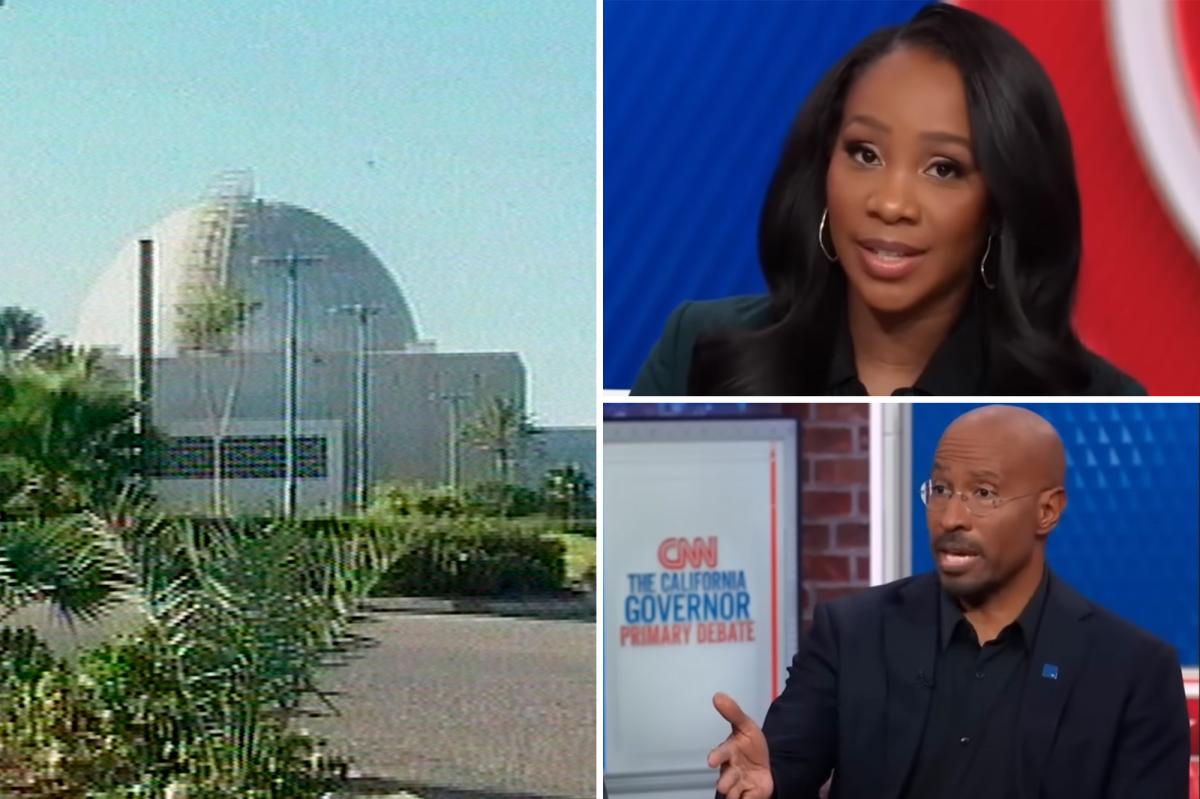
CNN’s Abby Phillip and Van Jones tangled Tuesday night over Democratic efforts to scrutinize Israel’s nuclear capabilities as the Jewish state battles Iran.
The tense exchange erupted during a segment on “CNN NewsNight” about a letter from Rep. Joaquin Castro (D-Texas) and other House Dems pressing the Trump administration to publicly disclose what it knows about Israel’s nuclear arsenal.
Phillip began by reading a series of questions lawmakers posed to Secretary of State Marco Rubio, including: “What nuclear weapons capability does Israel have?” and “Has the administration received any assurances from Israel that nuclear weapons will not be used?”
She also cited lawmakers asking whether Israel had communicated “any nuclear doctrine, red lines, or thresholds for nuclear use in the context of the current conflict with Iran” and whether the administration had assessed “what circumstances could lead Israel to consider nuclear use.”
Jones interrupted to ask: “I’m asking — honest question — why? Has there been some rumor that Israel is going to nuke Iran?”
Phillip shot back that the current regional conflict fundamentally changed the stakes.
“There is a war between the United States, Israel, and Iran that is going on right now in the Middle East, and under those circumstances, that is actually different from what we’ve been experiencing for the last, you know, 40, 50 years,” Phillip said.
“And so under those circumstances, there’s only one power in the Middle East that has a nuke, and it’s Israel.”
She continued: “So the question is, what are the circumstances? What are the boundaries? Are there any boundaries? They don’t acknowledge that they have them, people know that they do, but are there any boundaries? I think that seems like a fair question to ask.”
Jones was visibly dismissive during the exchange, repeatedly questioning why lawmakers were focused on Israel’s nuclear capabilities absent evidence it intended to use them.
The Post has sought comment from Phillip and Jones.
Roughly 30 House Democrats sent the letter to Rubio this week urging the administration to end what they called decades of “official silence” surrounding Israel’s program.
The lawmakers requested information about Israel’s warheads, delivery systems, fissile material production and nuclear doctrine, including whether US officials had assessed scenarios in which Israel could consider nuclear use during the conflict with Iran.
The issue also surfaced earlier this year when White House AI adviser David Sacks publicly speculated that Israel could use a nuclear weapon against Iran under extreme circumstances.
President Trump quickly distanced himself from the remarks, publicly rejecting Sacks’ comments.
Israel’s ambassador to the United Nations Danny Danon abruptly ended a press conference in March after being asked about the country’s undeclared nuclear arsenal.
Israel has never publicly acknowledged having nuclear bombs and remains outside the Treaty on the Non-Proliferation of Nuclear Weapons, the international pact designed to prevent the spread of nuclear weapons.
The policy, often described as “nuclear ambiguity” or “opacity,” dates back to the late 1960s and has long allowed both Israel and successive US administrations to avoid formally discussing the arsenal in public.
Independent estimates from groups including the Nuclear Threat Initiative and the Stockholm International Peace Research Institute place Israel’s stockpile at around 80 to 90 nuclear warheads, though some analysts believe the country possesses enough fissile material to produce significantly more.
The Israeli government has continued to adhere to its long-standing formula that it “will not be the first to introduce nuclear weapons into the Middle East,” language that neither confirms nor denies the existence of the arsenal.
The Post has sought comment from the Israeli government.
Disclaimer : This story is auto aggregated by a computer programme and has not been created or edited by DOWNTHENEWS. Publisher: nypost.com



