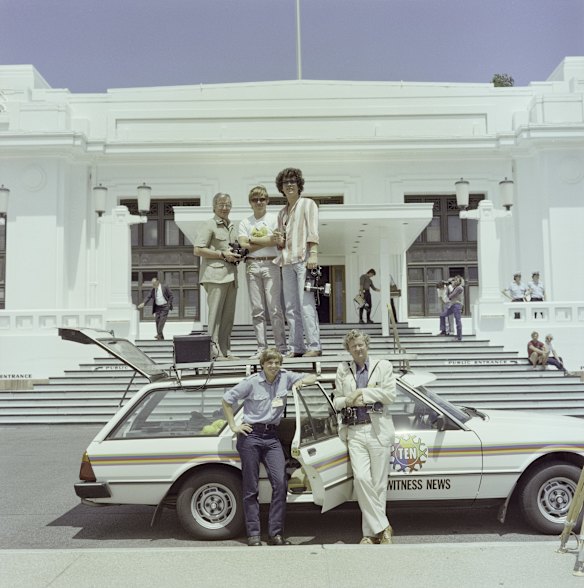

Spend a bit of time with an ageing former member of the federal press gallery and you’re likely to find yourself entertained – and possibly shocked – by stories from what was known as the Non-Members’ Bar at the Old Parliament House in Canberra.
The bar was the rollicking centre of social life. Journalists and politicians drank and caroused together. Inevitably, major political stories were leaked for all sorts of reasons.
“You’d hurry off and chase the typewriter around your desk to try to get the details down before you forgot them,” the late Peter Bowers, legendary chief political correspondent of The Sydney Morning Herald in the 1970s, once related.
There was misadventure, too.
One winter evening, a news correspondent named James P. Quirk and his wife weaved from the bar, climbed in their car and drove it into a hedge bordering the parliamentary rose garden. So deeply wedged was the vehicle that its doors could not be opened. Gallantly, the correspondent climbed through the vehicle’s sunroof, promising to summon help.
He promptly forgot his mission, went home and fell into a sodden slumber. The following morning, discovering his car was missing (and apparently failing to notice his wife was absent, too), he phoned the police to report a stolen vehicle. He was informed his car had been found in the rose garden’s hedge. A woman slumped inside was suffering hypothermia.
The press gallery subsequently launched the annual J.P. Quirk award for appalling behaviour, leading to a series of deranged stunts, the telling of which still occupies certain dinner parties.
And yet, masked by the tomfoolery that passed as high entertainment in the gallery was a serious depth of purpose in a highly competitive environment that produced many of the nation’s most celebrated political journalists.
The list is far too long to record here, though names like Laurie Oakes and Michelle Grattan come easily to mind. The author and columnist Niki Savva, who arrived in the gallery in 1974, speaks of her decades there as “my enduring love affair”.
Those in the federal press gallery worked extremely long hours – and still do – to deliver the first draft of the nation’s political history.
It has been this way for 125 years.
On May 9, 1901, about 30 journalists were permitted to sit in a gallery in Melbourne’s Royal Exhibition Building to witness the opening of the first Australian parliament.
The number of journalists peering down at the nation’s politicians (“like three rows of crows looking at a dead sheep,” Kim Beazley once remarked) has grown remarkably over the years.
The current gallery in Canberra has more than 250 members. In the early 1970s, when Grattan and Savva arrived, female press gallery members could be counted on the fingers of a hand. Their pioneering has led to women making up at least half of today’s gallery members.
The institution, which has no formal right to exist, has survived through three addresses: Melbourne, where the national parliament occupied Parliament House on Spring Street from 1901 to 1927; the so-called “provisional” Parliament House in Canberra from 1927 to 1988; and since then, the vast “new” Parliament House atop Canberra’s Capital Hill.
Perhaps sensibly, the Non-Members Bar at the new house closed in the mid-1990s. It became an aerobics centre before transforming into the parliamentary childcare centre. Seriously.
There are those who would say the absence of a freewheeling, booze-driven social hub suits the allegedly soulless nature of the great house on the hill, where politicians hide behind small armies of staff in luxurious offices. The unforgettable late writer Mungo McCallum refused to move up the hill in 1988, declaring the new place cold and pretentious.
Plenty of today’s gallery members, who still manage to break political stories just about every day, would disagree with Mungo’s judgment.
Still, the big house on the hill suits the times: the 24/7 demands of the internet mean there is little time for mad frivolity and besides, the new breed of journalists tend to value health.
The old place down the hill couldn’t be called healthy, exactly.
Journalists, photographers and TV crews worked hip to hip in a warren of tiny offices within a fug of cigarette smoke. The clacking of typewriters competed with shouted telephone conversations and radios tuned to news and parliamentary broadcasts.
And yet, so treasured are the memories from that time that the Museum of Australian Democracy – which operates within Old Parliament House – has preserved some of those tiny offices and their stories and will launch on Monday an exhibition entitled The Press Gallery.
The exhibition’s curator, Amy Lay, says the physical environment of Old Parliament House shaped the way journalism was practised.
“Journalists worked in cramped offices and studios, rushing between the chamber, their desks and around the building, sharing common areas and rubbing shoulders with politicians. That proximity to power produced a particular style of reporting that’s hard to replicate today,” Lay says.
The proximity – not to mention the socialising at the Non-Members’ Bar – meant that members of the press gallery gained extraordinary access to the nation’s decision makers.
Labor prime minister Ben Chifley in the years after World War II was in the habit of walking, often alone, from Parliament to the Kurrajong Hotel where he had a room (he felt The Lodge was too grand).
One frosty night, two journalists – Jack Allsop of Australian United Press and his offsider Les Teece – were about to climb into Teece’s car, a bull-nosed Morris, outside Parliament.
Chifley emerged from the side door of the building, and the journalists offered him a lift.
The late Rob Chalmers’ wonderful book Inside the Canberra Press Gallery: Life in the Wedding Cake of Old Parliament House, records that Chifley climbed aboard. But the car refused to start, no matter how hard the crank handle was turned.
Chifley took the driver’s seat, pushing in the clutch while the two journalists pushed the car.
“Let her out, Chif,” they yelled as they got up a bit of speed. Still no start. In the end, the prime minister and the two journalists pushed the car all the way to the Kurrajong.
There will never be a time like it again.
 Tony Wright is an associate editor and special writer for The Age and The Sydney Morning Herald.Connect via email.
From our partners
Disclaimer : This story is auto aggregated by a computer programme and has not been created or edited by DOWNTHENEWS. Publisher: www.smh.com.au