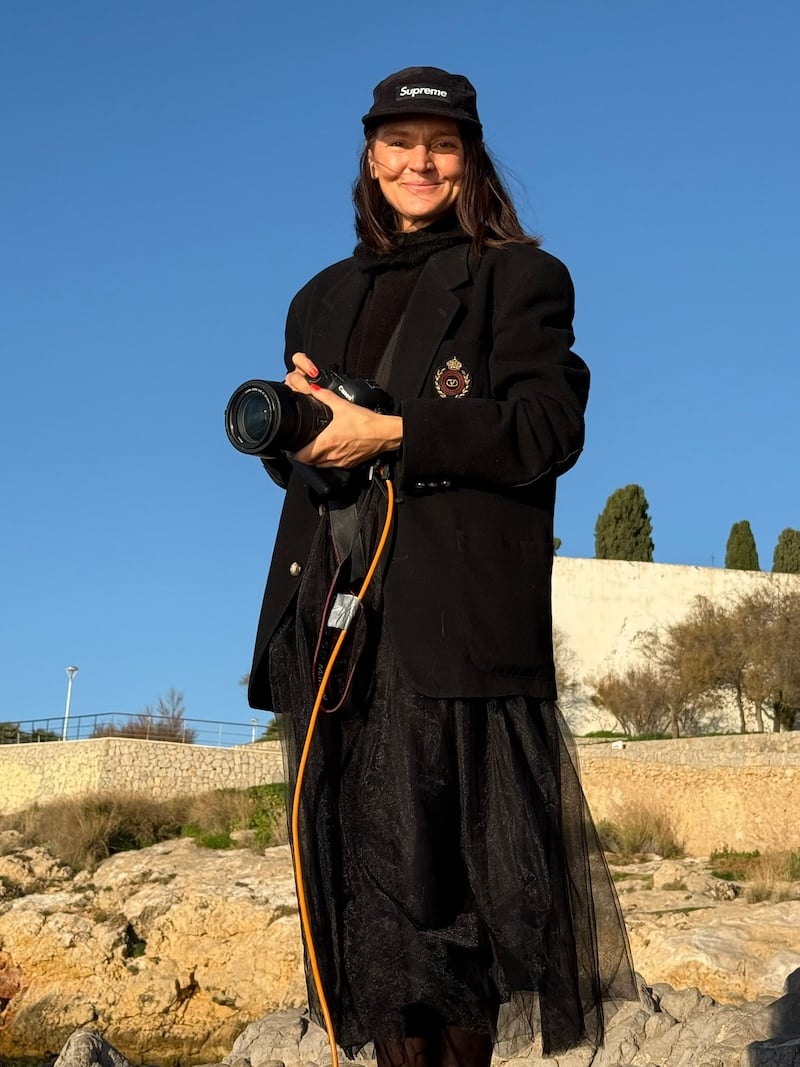
Sevda Albers, a fashion photographer with a background in technology, is using AI imagery to bridge the diversity gap and challenge the industry’s status quo. From navigating initial industry scepticism to advocating for female leadership in tech, the image-maker-turned-innovator is proving that the most essential tool in the age of AI remains a distinct perspective and the human eye.
While the fashion world was busy debating whether Al would destroy creativity, Sevda Albers was already using it to build an inclusive fashion narrative. As a veteran photographer and creative director who spent 25 years behind the lens and a coder before that, she doesn’t treat technology as a shortcut. Instead, her deep-rooted technical background provided the foundation for a pivot that was accelerated by the Covid pandemic lockdowns and the logistical shifts of Brexit.
Sevda Albers
Adding to the shift was a specific frustration, an industry problem that couldn’t or wouldn’t be fixed. Throughout her career, she struggled to find Turkish fashion models in Germany, where she currently resides. “I never had the opportunity to work with a Turkish fashion model, a topic close to my heart due to my own Turkish roots,” she notes. “So, I thought: if not now with AI, then when?”
This is the substance that sets her work apart. It isn’t about generating a “cool” image; it is about representation. When she first started, Midjourney wasn’t diversely trained. She spent weeks deep-diving to force the machine to see what she saw. It was a technical hurdle that required a photographer’s eye and a coder’s persistence. After years of training AI, her work caught the eye of early adopters in the Middle East before it gained traction elsewhere. “My first job requests were all from the UAE,” she recalls, highlighting a regional appetite for innovation.
“My first job requests were all from the UAE,” she recalls, highlighting a regional appetite for innovation.
In the luxury sector, where value is tied to “spent time,” Albers creates an artisanal quality by being the arbitrator of taste. With anything AI-generated, there is a common assumption that the output is effortless. Albers is quick to dispel this “one-click wonder” myth. “Since I am working for commercial clients quite a lot, and I set up my own tech environment, I can do pictures in five minutes, to be honest,” she says. “But I spend a lot of my time preparing my setup, so it really listens to my aesthetic, to my kind of way of thinking, and to my workflow.”

“AI-generated art is only as good as the artist guiding it”
Her creative process begins with conceptualising lighting, environment, and clothing before she even touches the software. It is a digital version of a traditional shoot. “What kind of lighting do I want? What kind of environment, what kind of model do I want, what kind of clothes? So, it is really comparable to a regular shooting.” These technical rigours allow her to transition from experimental “hallucinations” to the highly realistic work required for commercial luxury. Yet, she insists that the machine is only as good as the input of real-world experience. Her inspiration doesn’t come from scrolling through social media, but from the physical, offline world. “In the summer months, I live in Copenhagen, and in winter in Bali, which are both quite stylish areas,” she explains. “I do get inspired by the museums, by the people, by the interior of these two cities, and yeah, I get inspiration from mostly what I see.”

For Albers, true innovation requires moving beyond the generic. “I think nowadays we should take more time and do creative ideas. Because a beautiful woman walking down a beautiful environment by the beach? It’s not a creative idea.” She intentionally avoids the clean, fantasy look common in early Al. “I like it when it feels raw and not perfect, because humans don’t like perfection,” she explains. She compares it to a Picasso – you are drawn to it because it doesn’t look perfect. As we move toward 2028, the year, according to a fashion forecasting report by McKinsey & Company, when the normalisation of AI will be critical and fully integrated within the space, Albers predicts that static images will become ordinary.
 Right now, we are in the “hype” and “backlash” phase, where seeing an AI-generated ad still feels like a novelty or a provocation. By 2028, consumers will likely stop asking if an image was made by AI and start focusing purely on the aesthetic. Now, Albers is ahead of the curve and exploring the next frontier of generative video – creating immersive environments that counter digital fatigue. But even as the tools evolve, the human touch remains the filter. “AI-generated art is only as good as the artist guiding it,” Albers says. She also highlights the stark gender imbalance in the tech-creative space. She often finds herself the only woman speaking at AI events and frequently receives online hate from those who judge women engaging with “computer stuff.” “I would love to encourage every woman, because whenever I’m on stage or at an event, it’s mostly men.”
She views this as a critical hurdle. If Al is trained on data from the past, it risks replicating the same biases that have always existed in fashion. By advocating for a female vision and teaching workshops that focus on technical hurdles, she is ensuring that the future of fashion photography isn’t just about the machine. When asked if the use of the camera is eventually going to disappear entirely, she compares the current shift in photography to the decline of physical records. We didn’t stop listening to music – we just changed how we produced it.
– For more on luxury lifestyle, news, fashion and beauty follow Emirates Woman on Facebook and Instagram
Images: Supplied
Disclaimer : This story is auto aggregated by a computer programme and has not been created or edited by DOWNTHENEWS. Publisher: emirateswoman.com