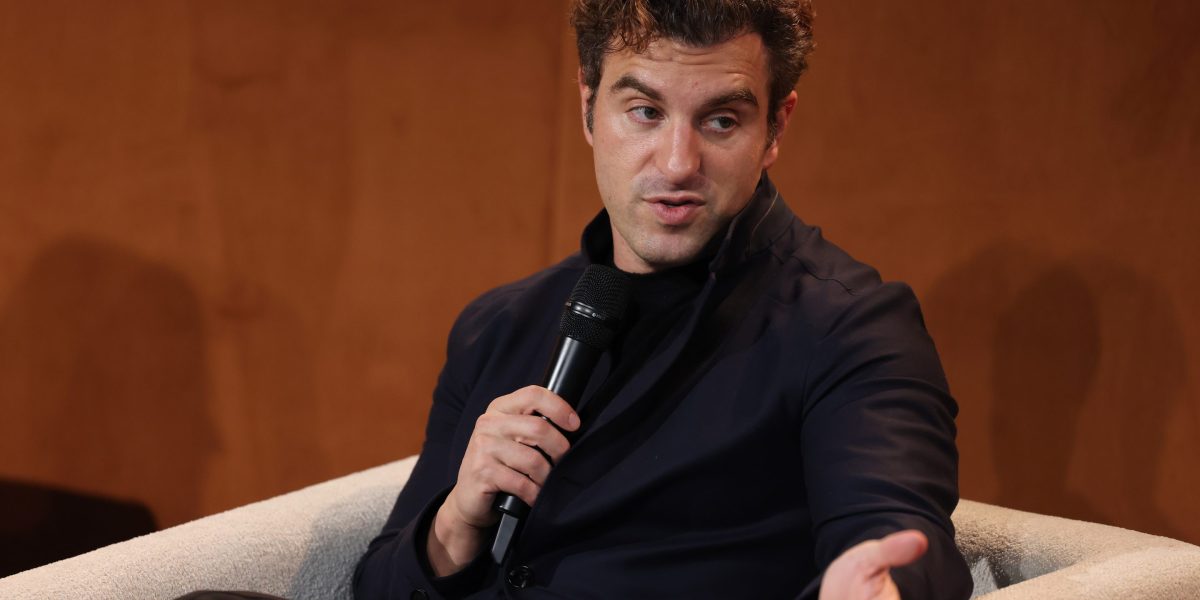
Tech leaders have spent the past few years warning workers that AI will threaten every single job, from computer programming and customer service to law and finance. But according to Airbnb CEO Brian Chesky, the biggest risk to professionals isn’t the technology itself—it’s refusing to evolve alongside it. And in his view, there are two kinds of employees who “will not survive the age of AI.”
“The two types of people who will not make the shift to AI are pure people managers, and people that [sic] are rigid and don’t want to change and evolve,” Chesky said recently on the Invest Like The Best podcast.
Anthropic CEO Dario Amodei has previously warned that AI could disrupt half of entry-level white-collar work, and Microsoft’s AI chief, Mustafa Suleyman, has offered an even more aggressive timeline, estimating that most professional work could be replaced within 12 to 18 months.
But Chesky presented a more optimistic view of the future, with the caveat that adapting is key for success.
Chesky explained that as AI transforms company structures and how staffers do their jobs, bosses need to adapt to the new era. And he called out people managers in particular—now, every higher-up will have to be a “hybrid people manager” or “manager IC” (individual contributor) to succeed. That means bosses will have to adopt a more technical approach and maintain a connection to the end product, rather than focusing solely on team leadership. They need to actually be involved in the “context” of the work to hold onto their jobs.
“I don’t think people managers will have any value in the future. When I mean people managers, [I mean] people that only manage people,” Chesky continued. “You can’t just be these managers where you’re people’s therapists, and you’re just doing meetings, you’re doing one-on-ones.”
The Airbnb CEO cited former Apple chief design officer Jony Ive as a prime example; the British executive struck the right balance between product design and team leadership. Chesky said it’s good to build relationships with staff: have routine check-ins, and go out to dinner with direct reports. But now, simply supervising people won’t cut it—it’s all about managing employees through the work.
And any rank-and-file worker who believes they can evade the new technology won’t have an easier time in the AI era either, Chesky predicted. Luckily, the CEO said, it’s incredibly easy to master the tools and keep up with the times, so long as professionals have a “growth mindset.” And the sentiment echoes a slew of tech leaders telling anxious workers that the chatbots and AI agents won’t take their jobs—but someone who leverages the software will.
The CEOs who say tech-savvy workers will thrive in the AI era
This isn’t the first time Chesky and other tech leaders have doubled down on the importance of adapting to an AI-driven world.
The Airbnb CEO has said that AI has been instrumental to the success of his $84.4 billion short-term rental company. And the billionaire founder is telling other business leaders that the tech isn’t just a plus—it’s a necessity for success.
“From a business standpoint, I think AI is the best thing that ever happened to Airbnb,” Chesky told CNBC in an interview earlier this year.
“The founder-led companies and the companies that are prepared to change and transform are the companies that are going to benefit from AI, because AI means everyone changes,” he continued. “And if you don’t change, you’re going to be disrupted.”
Nvidia leader Jensen Huang has also popularized the idea that AI won’t be what swipes roles from humans—instead, it’ll be tech-savvy talent that takes over jobs. And echoing Chesky, the leader of the $5.05 trillion GPU giant said that as AI spreads into every corner of every industry, no worker will be exempt from keeping up with the tools. It could even mean the difference between holding down a stable gig and getting the boot.
“Every job will be affected, and immediately. It is unquestionable,” Huang said at the Milken Institute’s Global Conference in 2025. “You’re not going to lose your job to an AI, but you’re going to lose your job to someone who uses AI.”
“I would recommend 100% of everybody take advantage of AI,” Jensen advised. “Don’t be that person who ignores this technology and as a result, loses your job.”
Ted Sarandos, the co-CEO of streaming empire Netflix, has also admitted that the tech will impact entertainment jobs. But just like Huang, he doesn’t believe the tools will be taking over the call sheet. Instead, the creatives who lean into AI will be better off than those who don’t in the intensely competitive industry.
“I don’t believe that an A.I. program is going to write a better screenplay than a great writer, or is going to replace a great performance,” Sarandos told The New York Times in 2024. “A.I. is not going to take your job. The person who uses A.I. well might take your job.”
Disclaimer : This story is auto aggregated by a computer programme and has not been created or edited by DOWNTHENEWS. Publisher: fortune.com