
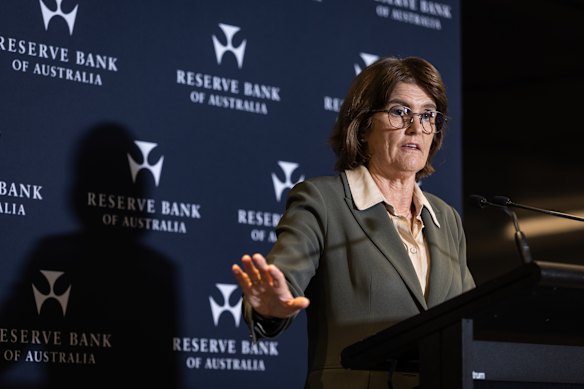
Reserve Bank governor Michele Bullock is pretty good at holding a line. She can identify when journalists are trying – sometimes quite sneakily – to get her to give what’s called “forward guidance”: a sense of what the next interest rate moves might be. And she very often sidesteps those questions with a knowing smile.
This week, though, she did something a little unusual. Instead of putting on her poker face and batting away probing questions about future moves, she gave journalists – and the public – a bit more to work with.
In fact, her press conference was interesting enough that her words visibly shifted where people were parking their money.
Markets – largely made up of traders who shuffle money around and keep an eagle eye on anything that could affect their investments (such as interest rates) – had been betting on an interest rate hike, so there was little fanfare when the decision was announced to raise interest rates for the third consecutive time this year.
But by the end of the press conference, the S&P/ASX200 – a broad gauge of the Australian sharemarket – had climbed. Why? Because Bullock had played down how likely the bank might be to keep cranking interest rates.
Most traders become more optimistic about the growth prospects of Australia’s companies (and invest more money in them) when interest rates look like they’ll ease – or when they seem like they might not go up by as much as they thought. That’s because lower interest rates lower borrowing costs for those companies and might lead to customers spending more rather than saving.
So, what exactly did Bullock say to make traders more bullish? And does it mean borrowers can expect interest rates to come down soon?
Bullock, early in the press conference on Tuesday, pushed back against the suggestion that the bank was in “wait and watch” mode after pushing interest rates to 4.35 per cent.
“Wait and watch” is a relatively easy position to defend, especially given uncertainty about things like how long wars overseas might last and the (ever present) uncertainty in predicting how human beings might behave.
But “wait and watch”, Bullock said, was probably the wrong term.
Instead, she explained that the Reserve Bank board – the nine people who decide which way to send interest rates – now felt the “excess demand” they were trying to dampen in the Australian economy before the Iran war began, was no longer the main focus.
“We needed to get demand to slow so that it was putting less pressure on inflation,” she said. “We’re now in a position where we’ve got space to be alert to both sides of the risks.”
By that, she meant the bank could now turn its focus to balancing risk. Rather than being chiefly concerned about getting inflation under control, the bank is now just about equally worried about slowing the economy down too much in the process.
Remember, interest rates work to slow down price rises by discouraging people from spending as much: when spending and demand for goods and services falls, especially relative to supply, so does the size of price increases. But when you put a brake on demand, you’re also slowing down the economy. When you do that too much, you end up with low (or negative) economic growth and more people out of work.
Bullock has never been completely dismissive of the negative effects of unemployment. But on Tuesday, she went to greater lengths than usual to explain why she worried about joblessness.
“Having a job is just really important for people’s self-worth, what they think about themselves, and their self-esteem,” she said, flagging she was especially worried about vulnerable Australians and those with a mortgage.
There was a clear sense, far beyond what the bank’s written documents got across, that Bullock – and almost certainly her board – were worried about the prospect of a slowing economy and job losses.
That’s despite the very real possibility that the war in Iran – which Bullock made clear was a key factor in the latest rate rise – will be dragged out.
The war in Iran, which has contributed to a big spike in fuel prices across Australia (and the world), is pushing prices across the economy higher. But after pushing up interest rates again, the bank isn’t too panicked about inflation.
Part of that is because the bank, in its “base case” forecasts (its guess of the situation and outcomes most likely to happen), assumes the oil supply issues contributing to higher prices will resolve within months.
How did they come to this conclusion? Well, the bank looked to the very people who also closely monitor them: traders. In particular, they looked at how oil market traders were expecting Brent crude oil prices to move over the coming months. “Market pricing currently suggests that oil prices will soon start to decline from elevated levels, though they remain well above pre-conflict levels through 2026 and beyond,” the bank said.
Basically, they made an assumption, based on what traders think, that oil prices – and the cost of things linked to them such as transport – would drift back down. And since demand in the economy broadly has soured a bit, there doesn’t seem to be as urgent a worry about inflation.
If the bank were to continue hiking interest rates this year – as markets and most economists were expecting, especially before the press conference – headline inflation would be roughly back within the bank’s target range of 2 to 3 per cent by the middle of next year.
Meanwhile, although unemployment has remained historically low, coming in at 4.3 per cent most recently, the bank now expects it to rise steadily to 4.7 per cent over the next two years. That’s tens of thousands more Australians being out of work.
And annual economic growth will come in at just 1.3 per cent or 1.4 per cent from the end of this year to the middle of 2028. Accounting for population growth over that period, it’s possible there’ll be close to no growth (or even shrinkage) when we measure economic growth per person. That would mean our living standards barely budge, or even slip into reverse.
It could be that after facing more than a dozen press conferences, Bullock has become less scared of stumbling over risky questions or being seen to provide “wrong” guidance (her predecessor, as you may remember, ended his term on a bit of a low after suggesting a path for interest rates which didn’t end up playing out).
But it’s also likely that with economic growth crawling, some borrowers under considerable pressure and the bank’s forecasts showing inflation rapidly falling over coming years, the prospect of job losses and the risk of a recession are simply looming large enough now to tip the scale against further rate hikes.
While she hasn’t ruled anything in or out, and the Iran war may yet change things, Bullock’s stance – and greater consideration of the downside risks – is the right move.
The Market Recap newsletter is a wrap of the day’s trading. Get it each weekday afternoon.
 Millie Muroi is the economics writer at The Sydney Morning Herald and The Age. She was formerly an economics correspondent based in Canberra’s Press Gallery and the banking writer based in Sydney.Connect via X or email.
From our partners
Disclaimer : This story is auto aggregated by a computer programme and has not been created or edited by DOWNTHENEWS. Publisher: www.smh.com.au


