Claire Isaac
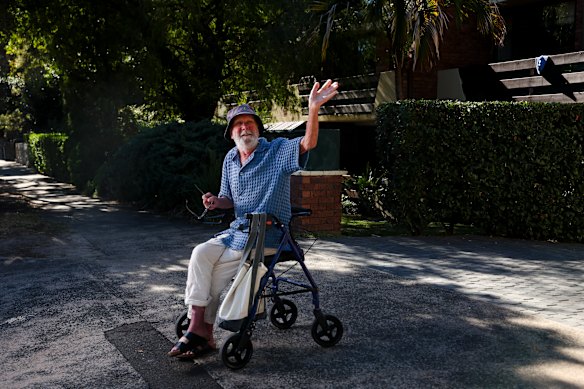
A car turns the corner on Cook Road in Sydney’s Centennial Park and gives a quick toot of the horn. Sitting outside his home, perched on a walker in the morning sun, Donald Shrubb lifts a hand in greeting.
Another car passes, another toot. Shrubb waves again, this time with both hands. This happens dozens of times a day. On the footpath, people often stop – 76-year-old Shrubb is always happy to have a chat.
After more than two years of sitting outside nearly every day, even in the depths of winter or the heat of high summer, Shrubb has become a familiar presence on the street – the man in the chair who seems to know everyone, as much a fixture in the neighbourhood as the footy traffic or the parking inspectors.
Shrubb never set out to become a local celebrity. In fact, sitting outside his building started for a much simpler reason: to stay connected.
For 45 of the 65 years he’s lived in the suburb, he worked as a supervisor on Australia’s interstate railways, travelling the country and even living on board the Indian Pacific during long journeys. He’s also part of Australian history as one of the original 78ers, the activists who marched in Sydney’s first Mardi Gras protest in 1978. He’s had a rich, colourful time: “I’m very lucky, what I’ve got out of life.”
However, just over four years ago, everything changed.
“I went to bed one night quite normally … I woke up in the morning, put my left foot on the floor and my right one just went bang,” he recalls. “The pain was so bad I cannot describe it.”
Doctors found four damaged discs in his spine. The situation was so serious that his neurosurgeon at St Vincent’s Hospital told him he needed emergency surgery.
The operation was complicated – a second one was needed – and recovery was hard. At one point, doctors told him he would never walk again. They suggested a nursing home might be the only realistic option, but Shrubb had other ideas.
“They said, ‘How do you get to your home?’ I said ‘I’ve got probably 40 stairs’. They said, ‘You won’t be going there. You’re going to a nursing home.’ I said, ‘No way.’
“If it takes me all day, I’ll get up there,” he says now. “And I’ll never give up.”
And so, in 2024, he started sitting outside, as a way to keep himself entertained without constant coming and going. Today he can walk a little, assisted by his walker, mostly around the block or up to bustling Oxford Street for lunch. But it’s slow-going and he feels every step.
At first, just a few people waved as they drove by. One of the earliest was plumber Chris Bazely.
“I used to drive past him all the time, so one day I waved at him,” says Bazely. “Now I stop and speak to him whenever I go past. And if I don’t see him on the street for a few days, I wonder if he’s alright.”
More and more people started waving, tooting or checking in as time went on. Now Cook Road has become something of Shrubb’s extended front yard. Neighbours bring him tea and snacks. A couple opposite sometimes arrive with muffins. Even the priest from local church St Francis of Assisi comes by to offer the occasional blessing.
Sisters Genevieve and Barbara Daly live across the road and often bring Shrubb food or remind him to put on sunscreen.
“He’s an iconic figure,” says Genevieve. “He’s an enjoyable, sociable, lovely gentleman, and he’s our neighbourhood watch. He notices everything. When I get home from work, he’ll say, ‘That courier arrived, it’s on the front porch’.”
“He knows everyone and everything that goes on,” adds local postman Julian Lowe, who stops by most days, popping Shrubb’s deliveries directly into his waiting hands. Sometimes, Lowe jokes, when they’re chatting, he feels that Shrubb would rather he moved on because “I’m cramping his style”.
When Shrubb disappeared for 10 days during a hospital stay, the entire neighbourhood noticed.
“People were quite concerned about my wellbeing,” he says. Someone even posted online asking if anyone had seen him. “I didn’t realise I had such a close connection to the public.”
But there really is a connection. For many locals, Shrubb has become a small but meaningful part of daily life, a reassuring presence and, in an increasingly disconnected world, a simple moment of human contact.
Shrubb, however, doesn’t see himself as anything special. In fact, he says he doesn’t know what people get out of seeing him sitting there every day. What he does know, though, is that he’ll keep doing it.
“I’ll do it ’til the end,” he laughs. “What else would I do?”
Make the most of your health, relationships, fitness and nutrition with our Live Well newsletter. Get it in your inbox every Monday.
From our partners
Disclaimer : This story is auto aggregated by a computer programme and has not been created or edited by DOWNTHENEWS. Publisher: www.smh.com.au