
Inflation is likely to hit 5 per cent by the middle of the year and could soar to 7 per cent by Christmas if the war against Iran pushes oil to $US200 a barrel, with Jim Chalmers’ fifth budget to confirm Australians will face ongoing price pressures.
This masthead can reveal Treasury believes inflation will peak higher than the Reserve Bank estimates, contributing to a slowdown in the economy that will also feed into a softer jobs market.
The government is waiting until the latest possible time to finalise its most important economic forecasts given the turmoil in global oil markets created by the war against Iran. Brent crude has moved between $US98 and $US115 a barrel in the past five days, meaning $200 is an extreme scenario.
But Treasury’s “baseline” forecast is that with oil around $US100 a barrel until the end of May before edging down to $US80 by the middle of next year, inflation will peak at 5 per cent by the end of June.
That is above the 4.8 per cent the Reserve Bank forecast this week as it announced a third consecutive increase in official interest rates. RBA boss Michele Bullock warned this week that while inflation had been pushed up by the war, prices were already running hot before hostilities broke out, putting pressure on Chalmers to rein in spending.
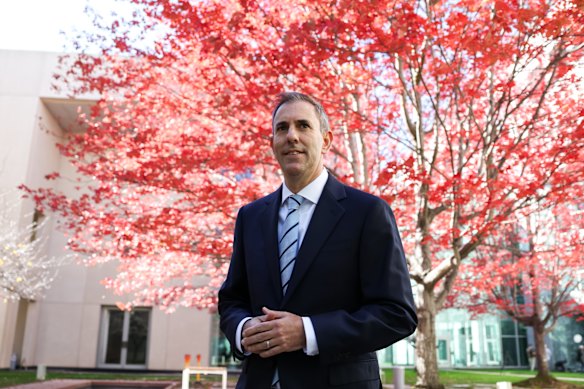
Chalmers said on Thursday at a press conference in Canberra that “Australia is hostage to a lot of uncertainty coming out of the war”.
“The primary consequence of that is much higher inflation in those figures that we saw in March. And once again, this inflation challenge in our economy, which existed before the war in the Middle East, but which is made much tougher by decisions taken in DC and Tehran,” he said.
The Reserve is expecting economic growth to slow to just 1.3 per cent over the next 14 months, effectively in line with population growth.
Next week’s budget will contain Treasury analysis of the economic damage created by an extension of the war and even higher oil prices. Some private analysts have warned that the longer the Strait of Hormuz is closed, the greater the chance of oil climbing beyond $US150 a barrel.
Treasury has examined the impact of oil at $US200 a barrel, with it not returning to $US80 a barrel by mid-2029. Under that scenario, inflation will be above 7 per cent by the end of this year.
The threat posed to the economy from a continuation of the war against Iran was highlighted by new research from Oxford Economics.
Senior Oxford economist Harry McAuley said if the war continued, with oil around $US150 a barrel until the Strait of Hormuz opened in September, then the economy would fall into a recession next financial year.
It would be an unusual recession as the budget bottom line could improve.
“The economy’s loss is the government’s gain. Gas and coking coal prices soar, and bumper mining tax revenues more than offset lower personal income tax receipts and higher unemployment payments,” McAuley said.
This masthead revealed on Thursday that Chalmers will forecast a modest improvement to the budget bottom line over the next four years. In the mid-year budget update, Chalmers forecast cumulative deficits of $143.3 billion between 2025-26 and 2028-29, with debt expected to soar past $1 trillion later this year.
Economist Chris Richardson said cutting the cumulative deficit over the next four years was “not the right test” because the government was raking in higher tax receipts from coal and gas firms benefiting from war-induced profits.
“The economy is handing them money on a platter – that doesn’t mean they’re management geniuses, it means they’re lucky,” the veteran budget-watcher said.
Instead, Richardson said the more important test was whether the government’s spending and saving decisions took money out of the economy.
“Don’t make the inflation challenge worse, and help with long-term budget repair,” he said.
Financial markets expect the Reserve Bank, which has pushed the cash rate to 4.35 per cent, to deliver at least one more rate increase this year before reversing direction in the second half of 2027. Every major lender has confirmed it will pass on this week’s rate rise.
It has prompted concerns that mortgage holders will struggle to repay their loans while also dealing with the financial hit caused by high inflation.
The Australian Bankers Association said the financial sector understood the pain facing some of its customers with banks having specialist teams to support those who may struggle with their repayments.
But association chief executive Simon Birmingham noted that most borrowers remained ahead on their repayments.
“While many households remain in a relatively strong position in terms of repayments, financial situations can change quickly, and banks stand ready to support all their customers during these uncertain times,” he said.
Cut through the noise of federal politics with news, views and expert analysis. Subscribers can sign up to our weekly Inside Politics newsletter.
 Shane Wright is a senior economics correspondent for The Sydney Morning Herald and The Age.Connect via X or email.
 Paul Sakkal is Chief Political Correspondent. He previously covered Victorian politics and won a Walkley award and the 2025 Press Gallery Journalist of the Year. Contact him securely on Signal @paulsakkal.14.Connect via X or email.
From our partners
Disclaimer : This story is auto aggregated by a computer programme and has not been created or edited by DOWNTHENEWS. Publisher: www.smh.com.au





