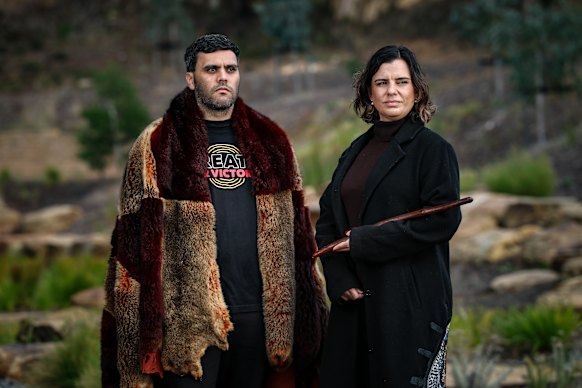

The newly elected leadership of Victoria’s First Peoples’ Assembly have put their organisation on a campaign footing against the Coalition and Opposition Leader Jess Wilson, challenging her to lay out a constructive vision for Aboriginal people living in the state.
The assembly’s co-chairs, Meriki Onus and Djaran Murray-Jackson, within hours of taking up their new roles within Gellung Warl – an independent, statutory body established by Victoria’s treaty with its First Peoples – took aim at Wilson and her promise to scrap the historic agreement on treaty if she wins the state election in November.
Murray-Jackson accused Wilson of pandering to hard-right elements within her party to buttress her personal support and warned that she risked sharing the fate of former federal opposition leader Peter Dutton.
“It is disappointing to see that Jess Wilson has made a captain’s call to go all in and put her face to this culture war when she is in the fight of her life to keep her own seat of Kew,” he told this masthead.
“The last time the opposition leant into culture wars against Aboriginal people, they lost the election and their leader, Peter Dutton, lost his seat.”
Onus said that if Wilson was intent on abolishing Gellung Warl, she needed to detail what her party was offering instead to improve the lot of Aboriginal people. The opposition has flagged the creation of a new government department, to be known as First Nations Victoria, but has provided no details about what the additional bureaucracy will do and what it will cost.
“Leadership and governing is what you want to build, not what you want to tear down,” Onus said. “We have heard a lot from Jess on what she is against and very little on what she stands for.”
Murray-Jackson questioned whether the opposition had consulted any Aboriginal communities about its plans. “It is just the Coalition being the Coalition and saying how things should be for blackfellas,” he said. “The statewide treaty was 10 years of self-determined work. It would be very disappointing for them to take that away from us.”
The elevation of Onus and Murray-Jackson at Thursday’s meeting of the freshly elected assembly in Bendigo signals a shift in Victoria’s peak Aboriginal representative body, after three years of conciliatory leadership under the past co-chairs Rueben Berg and Ngarra Murray.
Onus, the younger sibling of senator Lidia Thorpe and a founder of the militant Warriors of Aboriginal Resistance (WAR) group – which was inspired by the black power movement of the 1970s – is a radical activist who led the Invasion Day protest rallies.
The WAR’s manifesto vowed to “destroy the colonial Australian state”, restore tribal sovereignty and push for political and economic independence for Aboriginal people. It promoted resistance and revolution.
In an incendiary 2018 Facebook post, the group declared: “WAR will not rest until we burn this entire rotten settler colony called Australia, illegally and violently imposed on stolen Aboriginal land at the expense of the blood of countless thousands, to the f—ing ground.”
Onus, a Gunai and Gunditjmara woman, came to national prominence as a young activist when they burnt an Australian flag at a 2014 protest in Brisbane on the eve of the G20 Summit. The demonstration also vented its anger at established Aboriginal leaders Noel Pearson, Marcia Langton and Warren Mundine, who they derided as being part of the “colonial machine”.
“Unlike other groups we’re not here to dance with other existing enslaving power structures,” Onus said during a 2015 interview with Vice Media. “We are young and ready to fight for everything our ancestors had taken from them.”
Onus later frustrated the Andrews government and public health officials by organising a Black Lives Matter mass demonstration in central Melbourne just as the city was hit by the second wave of COVID-19. They were fined for breaching lockdown rules but the charge was later dropped.
Onus is older and more measured today. In the decade since WAR was formed, they have completed post-graduate studies at the University of Melbourne where Langton teaches and worked in a senior role at the First Peoples’ Assembly supporting treaty negotiations with government lawyers and officials.
The moderation of views is partly due to growing older but also a reflection of how Victoria’s treaty has changed the outlook for Aboriginal people.
“That was pre-treaty Australia,” Onus said of their previous, more combative approach. “I have different feelings now that we have mechanisms to self-govern.
“I don’t think I’m the first activist to turn to politics, so it is not that unusual. I am still very angry about Aboriginal deaths in custody, and rightly so. I am still very angry about the forced child removal and treatment of our people. But 10 years ago is a long time.
“I learned how to take on the fight in a different way with diplomacy and decolonising policy and nation building. I am really keen to see how Gellung Warl can be used as a mechanism for Aboriginal and Torres Strait Islander people to realise our self-determination. I can see the vision and the transformation of what we can achieve.”
Now as co-chair of the assembly, Onus is committed to working with some of the same government structures they previously vowed to destroy. But Onus remains an activist at heart and says the assembly is primed for an election year stoush to protect treaty. “I can bring experience in campaigning and I can bring 50,000 people who are out on the street,” they said.
Murray-Jackson, like Onus, was born into a family of Aboriginal activists. His older sister, Ngarra Murray, helped secure treaty. His grandfathers, Pastor Sir Douglas Nicholls and John Stewart Murray, were founding members of the Aboriginal Advancement League. His childhood weekends were spent with his father, Gary Murray, who also served as a member of the assembly, travelling the state and attending native title meetings and listening to community elders.
Murray Jackson is a Dja Dja Wurrung man who has strong links to other traditional owner groups across northern Victoria. His formative experience with the assembly, while working on staff as an engagement officer, was visiting the state’s prisons and encouraging Aboriginal inmates to take part in assembly elections.
“Roughly 700 or 800 of our mob had been locked up, which is disappointing and another conversation, and about 50 per cent of them voted in the last election. That is something I was really proud of, giving our most vulnerable mob a chance to vote,” he said.
Murray-Jackson said that once the assembly began holding regular chamber meetings, he would be accompanied by his one-year-old daughter, Yurri, named after the Yorta Yorta word for moon. “I’m excited for her to come and see her old man at work, similar to what my old man did with his dad and I did with him.”
Gellung Warl has broad powers to consult and make representations to all levels of government on legislation and decisions which affect Aboriginal people. The treaty architecture also includes a standing truth commission and accountability and oversight body with the power to conduct inquiries.
As it begins its work, it must also convince enough Victorian voters, over the next seven months, that it is an idea worth keeping. “Our people are keen to get started,” Onus said.
Be the first to know when major news happens. Sign up for breaking news alerts on email or turn on notifications in the app.
 Chip Le Grand leads our state politics reporting team. He previously served as the paper’s chief reporter and is a journalist of 30 years’ experience.Connect via email.
From our partners
Disclaimer : This story is auto aggregated by a computer programme and has not been created or edited by DOWNTHENEWS. Publisher: www.smh.com.au