
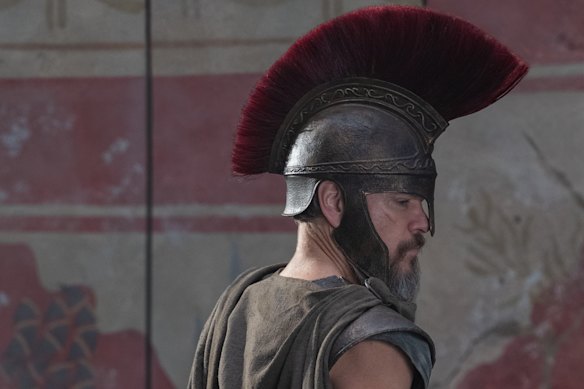

In two months’ time, Christopher Nolan will share his take on the greatest story ever told. Based on Homer’s 24 poems, The Odyssey chronicles the 10-year journey of Odysseus, King of Ithaca, as he ventures home after the Trojan War. As far as stories about Ancient Greece go, you can’t really get more iconic. Why, then, does it sound like Nolan’s actors are straight out of Boston?
Following the release of the film’s latest trailer on Tuesday, fans have been scratching their heads over the American accents pervading the cast. So jarring was it that The Hollywood Reporter even weighed in, arguing they sounded “more Ithaca, New York, than Ithaca, Greece”. This appeared particularly confusing for actors like Tom Holland and Robert Pattinson who are British, not American. Why didn’t they just stick with their native brogue?
Well, because that would also be wrong. The British accent as we know it today, often called the “Queen’s English”, has only existed since the 1800s. The Odyssey, meanwhile, is set around 1200 BC. Technically, neither American nor British accents would be accurate for this film. Yet people still seem much more comfortable with a British-coded Ancient Greece. Why?
It stems from a long-standing unofficial rule in Hollywood. Films set in ancient worlds, be it biblical times or Ancient Egypt, have historically featured actors with British accents. Just think of Gladiator (2000), Cleopatra (1963) and Troy (2004).
If a film like The Odyssey were aiming for total accuracy, it would have characters speaking in varying dialects of Ancient Greek, including Mycenaean, Aeolic and Archaic Greek. Meanwhile, a film like Gladiator or its 2024 sequel would have featured anything from Latin accents to Aramaic, Hebrew, Syriac, Gaulish and Punic.
Therein lies the challenge for filmmakers. Ancient worlds were melting pots of different languages, lexicons and dialects, all of which differed enormously over even just short distances. Spartans and Trojans, both of which feature in The Odyssey, wouldn’t speak or sound the same. Arguably the easiest thing for filmmakers to do is streamline their cast by getting them all to speak with one broad accent – consistency over accuracy.
Many have thus chosen British accents. Julius Caesar (1953), The Fall of the Roman Empire (1964), Centurion (2010), Land of the Pharaohs (1955), the list goes on. The thinking was probably that the British accent sounded “exotic” enough within Hollywood circles to signal an “otherworldly” ancient time and place, but also just familiar enough to be easily understood and pleasing to the ear.
Theatre could also have partly steered this choice. Shakespeare’s plays in the 20th century were largely performed in the “Queen’s English”. Over time it became associated with “highbrow” entertainment, with renowned Shakespearean actors like Laurence Olivier further driving that trend, especially within historical dramas. So when these plays began transitioning to the screen, the British accent essentially became a sign of prestige in Hollywood productions.
Deviations from this trend haven’t always gone down well, either. Kevin Costner’s American accent in 1991’s Robin Hood: Prince of Thieves threw audiences off, given he was the only one with a non-British drawl in a production set in the late 12th century. Few likely wanted to repeat this.
While British accents have long been the norm, some films have experimented with accents, often combining British and American brogues. Ben-Hur (1959) deliberately had Roman aristocracy speak with British accents to signal their status and class, while more “lowly” characters like Charlton Heston’s sounded American. Spartacus (1960) did the same thing. Meanwhile, The Ten Commandments (1956) employed both British and American accents to distinguish between the Hebrews and the Egyptians.
A more recent example is in Armando Iannucci’s 2017 film The Death of Stalin. Despite being set in 1950s Russia, no Russian accents are featured. The director instead asked his cast to lean into their natural accents (including Cockney and thick Brooklyn drawl), thus creating a superbly comedic result. This also prevented the film from falling into additional inaccuracy traps, given those living in Moscow would have a very different accent than those from Ukraine or Georgia.
A total outlier was Mel Gibson’s The Passion of the Christ (2004), which did away with both British and American accents, instead employing Aramaic, Latin and Hebrew pronunciations. And Gibson’s 2006 film Apocalypto was in Yucatec Maya, a Mayan language. These, however, remain exceptions among historical epics.
So, as out of place as Odysseus’ American drawl may seem in The Odyssey, it isn’t committing a new cinematic sin. In fact, it could actually be pushing back against an unwritten rule that has plagued Hollywood for decades. Now it’s just up to audiences to develop an ear for it.
The Odyssey is in cinemas from July 16.
Must-see movies, interviews and all the latest from the world of film delivered to your inbox. Sign up for our Screening Room newsletter.
 Nell Geraets is a Culture reporter at The Age and The Sydney Morning Herald.Connect via X or email.
From our partners
Disclaimer : This story is auto aggregated by a computer programme and has not been created or edited by DOWNTHENEWS. Publisher: www.smh.com.au


