

This year’s SCG Test match was not the first time Cricket Australia’s head of cricket James Allsopp had been bounced by Stuart Clark.
As a wicketkeeper talented enough to play second XI games for New South Wales and captain the state’s under-19s, Allsopp faced up to Clark plenty of times in Sydney grade cricket over more than a decade.
“I played at a high level and played against some of the greats of the game, including Stuart. He probably got me out a couple of times, but he was always a great competitor whether he was playing for Sutherland, NSW or Australia.
“I don’t think I scored many off him because he never missed his line and length, very much out of the Glenn McGrath mould.
“I was a throwback ‘keeper. I was as good a ’keeper as anybody in the game, but Adam Gilchrist ruined it for people like me because he set a different standard for batting, and I wasn’t scoring enough hundreds to compete.”
Out of those years in grade cricket grew a career that took Allsopp to coaching roles within the CA development pathway, before he became chief executive of ACT Cricket from 2018 to 2021, then onto CA and a job that grew from community cricket to cover the whole of the game from the top level down.
So it was irksome to Allsopp – and CA’s chief executive Todd Greenberg and chair Mike Baird – that Clark used his ABC Radio gig to dismiss his former opponent’s “background” as “a grade club cricket coach that throws underarm balls to kids”, suggesting the 42-year-old was not up to the task of leading the likes of men’s coach Andrew McDonald or a players such as Steve Smith.
Clark and Allsopp haven’t spoken, but Greenberg had words with Clark at the time, and there was a brief ban on the ABC’s player access during the Test. Clark, who is a Cricket NSW board director and selector, has been a strident critic of Australia’s team performance level for over a decade, whether joining Simon Katich in hammering the part-time national selectors in 2011, or firing numerous barbs at Allsopp’s predecessor Pat Howard after CA hired him out of rugby.
If CA’s hiring policy was dictated by “how many Test matches have you played”, its Jolimont office would be sparsely populated indeed. The system Allsopp oversees has been more successful than not over his five years in the building.
But at the same time, Allsopp acknowledges that the system needs capable people in place to protect its standing as the envy of the rest of the world, something recently summarised by Mike Atherton in The Times.
“Australia boasts a simple pyramid structure, deriving from a strong and broad base, courtesy of the game being the summer sport and central to the national conversation,” Atherton wrote. “It has a competitive professional structure, kept tight and lean by dint of there being only six states. And the national team is the pinnacle to which everything is geared. It is a system that continues to deliver serious, hardened cricketers capable of competing and winning on the world stage.”
Asked about his role in preserving that system, Allsopp sounds like he’s reading from similar notes.
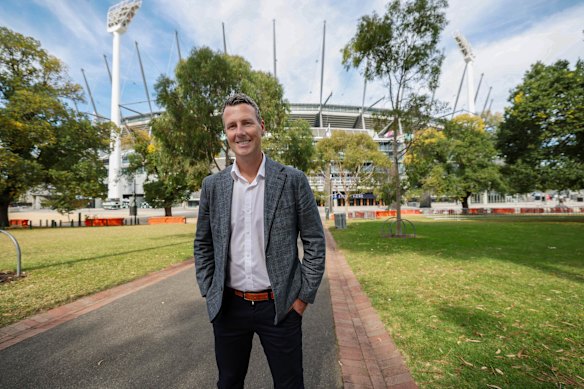
“One thing I’m really mindful of is what has stood Australian cricket above the rest over a long period of time is our high-performance system,” he says over coffee in the Trumble Cafe at the MCG.
“Our pathways, our domestic competitions I think are the best in the world, and despite what’s happening globally, and what might happen to the BBL, one of the biggest things we need to maintain is that high-performance system.
“If you think about India, we’re never going to compete with their volume of players, and England own the northern hemisphere, but what sets us apart is that we’ve got great domestic competitions, a great system, a great pathway. While that is strong, that’s going to set up our teams.”
As for another Clark query, being “not really sure” what the head of national teams Ben Oliver does, Allsopp explains that his exit from the CA executive allows for more time to spend on the intensive task of supporting the national teams in the Twenty20 era.
“I’m chief of cricket, which is a horrible acronym – HR never thought of that when they were naming the title,” Allsopp jokes of his “COC” badge. “But it’s got oversight for all of cricket, from participation, to community experience, to national development, domestic competitions and the national teams.
“The reason the board moved to that structure was to try to connect the whole of the game like we haven’t done before, and also provide Ben Oliver the freedom to focus wholly on the teams. So the day-to-day, Ben spends a heap of time now with Ronnie [Andrew McDonald] and George [Bailey], talking about strategy, selection, schedules and reviews. So that’s what his focus is, and my role is to try to stitch all of cricket together.
“The way our 19s team plays, and the environment the coaches and support staff create, we want that to replicate what we do at the national team level. My job is to make sure that’s all coming together and then give Ben the freedom to work intimately with the team, particularly the men’s team, as they navigate a period of transition and the changing landscape globally plus a really busy schedule over the next couple of years.”
The broad oversight also gives Allsopp a chance to look strategically at resourcing across the game: in the 2025 CA annual report, the money spent on the combination of national teams, pathways and community cricket and player payments came to almost $176 million.
Allsopp and Oliver are involved in vital contract negotiations with Australia’s best players. While Pat Cummins stands to gain most from prospective deals, there is plenty of pressure to make the money work for everyone.
Allsopp shared a recent advancing visit to Pakistan (and a round of golf) with players union boss Paul Marsh. A fellow Bankstown alumni, Kevin Roberts, fell afoul of the players either side of his brief stint as CA chief executive, and Allsopp is conscious of keeping open lines of communication with the players.
“We’ve started having discussions with the ACA, and I’d say the relationship with the ACA is as strong as it’s ever been,” Allsopp says. “There’s some slightly different objectives around what we want to achieve with the discussion.
“We’ve been pretty clear around where we think the market pressures are and what we need to address through the MOU, but we’re not far apart in terms of intention. It’s just how we get there.”
The prospect of more than 20 Tests over the next 12 months, including chances to break long away-Test-series droughts in South Africa (last win in 2014), India (2004) and England (2001) is a resounding motivation.
“In 2005 I was there playing in the UK, and it was memorable to see such an iconic series. Warnie carried the team on his back,” Allsopp says. “But I remember how painful it was when we lost, and I was over there as a young Aussie.
“So it’s where there’s unfinished business, those away series. This team has been phenomenal, but when you think about Pat, Nathan [Lyon], a few of those guys, you feel like there’s some unfinished business with the Ashes away and India as well.”
A tricky current project is reshaping the junior talent pathway to maximise game time for the best young players.
While Allsopp is adamant that the six men’s state teams and seven women’s teams should not be tampered with or expanded, he is now into year two of discussions about rejigging junior championships to avoid mismatches between the bigger states and smaller ones.
During the summer this was first reported as a scheme to remove the likes of Tasmania from their traditional place among the competing teams, but the current proposal is more nuanced.
It calls for a three-tier structure. In the first tier, Metro and country teams from New South Wales, Victoria and Queensland will play off against each other to form consolidated state sides for each.
At the same time, Tasmania, ACT and the Northern Territory will play a series, with the best players from those sides forming an “Allies” team for the next phase, where Western Australia and South Australia will complete the “Super Six”.
From there, the best 26 players will be picked in two teams for a talent series, from which the national under-19 squad will be chosen. This will, Allsopp argues, provide as many as 13 games for the best young players, with opportunities for a Gen-Z Ricky Ponting to still progress to the top.
“State identity is really important, and I get why this is a sensitive matter for states and territories, and this is why we want to keep walking through it with them,” Allsopp says. “But this is not about trying to take opportunities away.
“In this model, if you’re an outstanding player in ACT or Tasmania, you’ll play in the Allies, you’ll then go to Super Sixes and if you do well in that you’ll be in the talent series, and all of a sudden you’ve played 13 games.
“The other thing about the three-tier model is it’s played at different times of the year. At the moment, if you’re injured you don’t get any experience against other talented players. There’s still a bit of work to do, but we do like the model, and we need to keep discussing it with the states and territories.”
As for junior and club cricket, Allsopp is tracking promising trends in terms of participation, but also seeing how the game needs to change with a changing nation.
“Almost one in five of our registrations is south Asian, which is extraordinary,” he says. “There’s a lot of people playing cricket, but they want to play more, and it’s very much on my mind at the moment.
“Our traditional cricket structure is registering in September and playing through October, have a break in January and come out February March through to finals. But particularly with the south Asian market, they want to play every day of the year, and more days of the week.
“So I’m asking our team at the moment, what’s our role in that?”
CA is looking for ways to support more mid-week cricket, easier in the southern states in summer when the sun won’t set until after 8pm. In Queensland the solution may lie in more floodlights at junior and club venues. Allsopp’s job isn’t just about winning enough games of cricket to keep the lights on a Jolimont, but installing some new ones elsewhere.
“The preference from a lot of young families now is to get the cricket in during the week,” he says. “If we keep growing the way we are, we need to accommodate for that growth. The way to do that is opening up more days to play and later times.”
Those underarm balls to kids, then, have not been wasted.
News, results and expert analysis from the weekend of sport sent every Monday. Sign up for our Sport newsletter.
 Daniel Brettig is The Age’s chief cricket writer and the author of several books on cricket.Connect via X.
From our partners
Disclaimer : This story is auto aggregated by a computer programme and has not been created or edited by DOWNTHENEWS. Publisher: www.smh.com.au


