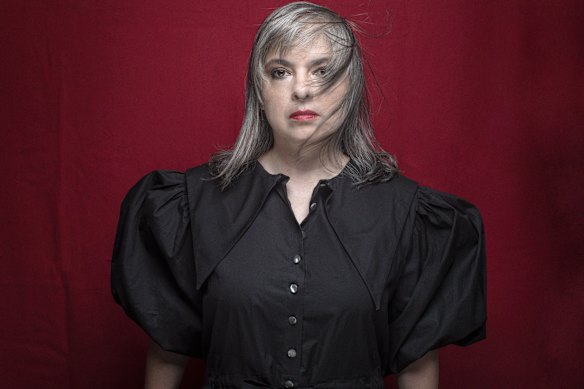
Mariana Enriquez, acclaimed Argentinian author and master of the macabre, now calls Australia home.
It almost makes sense that Mariana Enriquez, the leading figure of Latin America’s gothic horror renaissance, now calls Tasmania home. Outside of, say, Transylvania or Salem, Massachusetts, is there anywhere more suited to a horror writer? The Argentinian author moved from Buenos Aires to Launceston a year ago with her husband Paul, an Aussie originally from Perth.
“We lived in Buenos Aires for 20 years, been married since … 2005? I can’t remember, that’s embarrassing,” she says, laughing. “But there was always the idea of moving, at some point, to live a life that is easier than it is in Argentina.”
They’d considered Sydney and Melbourne but were scared off by our real estate prices, and the kind of space they were after would’ve precluded them to the suburbs. “Suburbia? I can’t do it. So a small town like [Launceston] was better,” says Enriquez. “I mean, this is not South America, I knew there’s not going to be a lot of life in the streets. But I’m walking distance to a cafe, which is what I wanted.”
She’s already knee-deep in ghost stories from Tasmania’s penal past. “Do you know the hangman of Van Diemen’s Land?” Enriquez asks. “They’d send him a message and this poor man would walk from Launceston to Hobart to do the hangings, like a walking Death. They wouldn’t even give him a horse!”

She’s also hoping to write about Port Arthur’s Isle of the Dead for a sequel to her freshly translated cemetery guide-cum-memoir, Somebody Is Walking on Your Grave. “It’s basically a mass grave because the officers that died there have gravestones but the convicts don’t. So yeah, it’s a pretty creepy place,” she adds with not a small amount of glee.
Coincidentally, I’m speaking to Enriquez on what’s the 50th anniversary of Argentina’s military dictatorship (1976-83), a period whose horrors – including the disappearance of 30,000 leftist students, journalists and activists – cast a shadow over much of her work, and that of her wider generation of acclaimed Argentinian gothicists, including Samanta Schweblin.
In Kids Who Came Back, Enriquez’s best-known story from her International Booker Prize-shortlisted The Dangers of Smoking in Bed, swarms of lost children return to take up residence in Buenos Aires, the ghosts of the desaparecidos made real. In another Dangers story, Back When We Talked to the Dead, a group of teenage girls do ouija board seances to speak with the spirits of the disappeared.
The country’s 50th-anniversary observances in March came amid a politicised landscape in which the right-wing libertarian president Javier Milei downplayed the junta’s crimes and threatened to pardon figures who’d been tried and jailed for their crimes during the dictatorship. Milei’s inflammatory rhetoric was met with mass protests across the country.
“The mobilisation was very peaceful and big and included all three generations of Argentinians since [the dictatorship], so Milei didn’t do anything,” says Enriquez. “The denialism he’s doing, it’s an ideological [play] to his voters, but I don’t think it will erode the human rights movement.”
Highly publicised trials in the ’80s of commanders of the military junta attuned Argentinians to the horrors of the dictatorship, says Enriquez. “The trials were quite historic. Very few countries, if any, took their dictators to justice and found them guilty – and the whole country listened to the testimonies,” she says.
“So the discussions of the numbers of the dead that [Milei] has tried to downplay, or of the violence of the leftist revolutionaries in the ’70s [used as justification for the junta’s actions], there’s a clear conscience in most people that no war justifies raping pregnant women or stealing the babies of the people you conquered. The mobilisations on the 50th anniversary were a message to the government saying, ‘don’t touch this, it’s done’.”
The dictatorship and the absurd dread it instilled are not distant concepts for Enriquez. In Somebody Is Walking on Your Grave she writes about a journalist friend, a former colleague at the Buenos Aires newspaper Pagina 12, whose mother was among the disappeared and whose bones were only recovered decades later.
“The generation that lost their parents, that’s my generation. That friend whose mother’s bones were recovered, she was a girl I worked with, I partied with; we went to movies together, I had opinions about her boyfriends, I took care of her child. One day she says, ‘They found my mother.’ And it was just parts of her mother, three or four bones. She identified them because she remembered the clothes her mother was in.”
Her friend spent a year with her mother’s bones at home, not knowing what to do with them, before deciding they needed to be buried. “It was this utterly macabre situation that gave me the idea for the book,” says Enriquez of Somebody Is Walking on Your Grave. “This is a country that is obsessed with a generation that doesn’t have a grave. That’s the main trauma. They don’t have a place to grieve or a way to mourn because the state took that away, not just from the families but from society.”
‘This is a country obsessed with a generation that doesn’t have a grave. That’s the main trauma.’
In Kids Who Came Back a character calls Buenos Aires a “city full of ghosts”. Reading the line, I was reminded of my time living in the city more than a decade ago. My girlfriend and I would watch a free movie every week – public screenings in places like bars, bookshops, galleries. One night we caught the bus to Belgrano to see Blade Runner in a museum basement. Only years later, recalling its dark corridors lined with endless photos of the desaparecidos, did I realise we’d been in ESMA, the notorious clandestine prison – a site of murder and torture and a home base for the junta’s infamous “death flights” – since transformed into a thriving cultural centre.
“It’s a horrendous place, it gives me headaches, but people use it and people work there and the cultural centre is very nice,” says Enriquez. Much of Buenos Aires over the past 50 years has been constructed with the idea that “memory should be a constant”, she adds.
“But that has problems, too, because you are overwhelmed by the past and you live, all the time, in this gothic atmosphere where the past has not passed and is very much present. In a way, that explains the reaction of some young people that are more right-leaning who are rejecting that completely and saying, ‘no, we need progress, we need money, we need to leave history behind’,” says Enriquez.
Ghastly reminders are all over the city, she says. “You’ll be somewhere having a coffee and you look at the ground and there’s a colourful mosaic that says, ‘Here in 1977, this person was taken. He was 22.’ They are people that don’t grow up and their body is nowhere, so they are technically ghosts. It’s a heavy atmosphere but it’s the environment where I grew up.”
For someone so aligned with darkness, Enriquez casts a playful energy. Wearing a baby blue jumper with her unruly grey hair tied back, she’s Zooming in from her Launceston home, seated in front of countless trinkets from her global travels, including a Cuban flag from a trip to Havana to see her favourite band, the Manic Street Preachers.
Not present is the human bone she once swiped from the Catacombs of Paris, a morbidly riotous story she tells in Someone Is Walking on Your Grave. “It’s in Buenos Aires in the good hands of one of my best friends,” she says with a chuckle. “I was too scared of Australia’s border police to bring it.”
Latin America’s distinct social conditions – violent dictatorships, economic inequality, narco-terrorism, Catholic ritual – aren’t the only things that fuel Enriquez’s horror. Her 2024 collection, A Sunny Place for Shady People, explored childhood trauma, addiction, bullying, misogyny, even perimenopause. What is scaring her most in the world right now?

Enriquez ponders the question slowly. “Right now it’s the discourse in social media. You can go there and see a version of society that is rational and scary. When I started writing horror, what I was scared about in a literary sense was the idea of a reality that crumbles, either because of violence or something sinister happens,” she says, citing Chernobyl and mental illness as examples from across the spectrum.
Social media’s distortion of reality is something else, she says. “You can’t tell what’s real and what’s not real any more, to the point where these terms are losing their meaning. Even in the smallest things that are not so small things: if I go to Spotify, I never go to a jam or something Spotify suggests to me. It’s not that I don’t want to listen to music that was made by a robot, it’s that I don’t want to not be able to tell the difference! That would scare me.”
It’s telling that Enriquez’s concerns went straight to Spotify because music has always been significant to her work. Her unforgettable story Meat, from The Dangers of Smoking in Bed, is about the parasocial (and cannibalistic) relationship between two teenage girls and their favourite rock star. Enriquez started as a music journalist, covering heavy metal for Pagina 12.
“There were not that many women doing [rock writing] in my era – maybe three of us in the whole country – and the guys didn’t want to do metal bands because metal was never looked on as legitimate, so the girls went there,” says Enriquez. “It made us tough journalists because we were in the mosh pit interviewing bands like Pantera, Metallica and Sepultura. It was a job but I learned to love those bands.”
At 52, her enthusiasm endures. “Not that many bands come to Tasmania but we’re only one hour on a plane to Melbourne, and the planes are not very expensive, so two or three times a month I go to Melbourne to see stuff.”
I’m picturing scores of gig-goers at Melbourne’s Corner Hotel unaware that a Booker Prize nominee is in their presence. What gigs has she been to lately? “I went to see Nick Cave and the Bad Seeds in Alexandra Gardens, then Gillian Welch. In Hobart I saw Portal, a black metal band from Queensland. I really want to see Rosalia if she comes. I’m all over the place,” she says with a laugh.
At the back of A Sunny Place for Shady People, Enriquez includes a playlist acknowledging the music that inspired her while writing the book, including Lana Del Rey, and Nick Cave’s Ghosteen. What’s been inspiring her writing lately?
Enriquez picks up her phone to pull up the answer. “It’s tricky with moving recently and having to speak in a different language to the one I’m writing in all the time, but let’s see,” she says. “I’m listening to Suede. I have three playlists that are called Black #1, Black #2 and Black #3 that are all black metal. There’s a band from Australia I like that I just discovered called The Belair Lip Bombs. I’m listening to the new Mitski. I’m listening to Geese, like everybody my age,” she says, laughing. “There’s a rapper I like named Billy Woods – his atmosphere and delivery is menacing, so that really makes sense to me.”
And how’s this for horror: in Somebody’s Walking on Your Grave, she writes that she never liked Joy Division. Why? “I think they’re overrated,” Enriquez says with a laugh. “They’re boring. There were many bands in those days that were much better. But what happens in rock and roll is you become a myth. The fact that [Ian Curtis] killed himself at 23 and the way he looked contributed to their myth, and that is OK. But to listen to them? I can’t do it.”
Mariana Enriquez will appear at the Sydney Writers’ Festival, May 17-24.
The Booklist is a weekly newsletter for book lovers from Jason Steger. Get it delivered every Friday.
Disclaimer : This story is auto aggregated by a computer programme and has not been created or edited by DOWNTHENEWS. Publisher: www.smh.com.au