
Michaela Boland
I held zero envy for the Archibald Prize judges this year, charged with picking a winner that is right for the times.
They were spoilt for choice with an array of artistically strong portraits, while also navigating a febrile domestic and geopolitical landscape.
Choosing an entertainer would have misread the mood; choosing a campaigner or activist could have leant too heavily into it. Landing on Richard Lewer’s beautiful, powerful portrait of APY Pitjantjatjara elder Iluwanti Ken strikes the perfect balance.
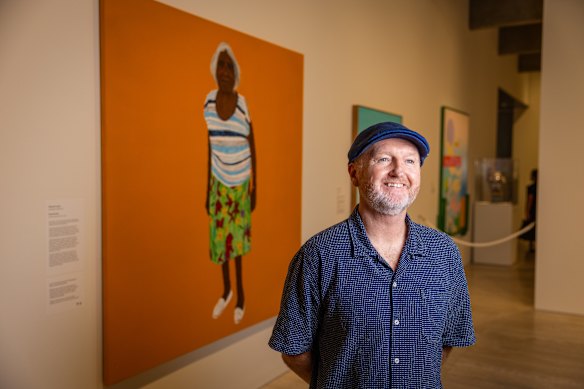
Rendered life-size and on unprimed canvas drenched in yellow ochre-coloured paint, Ken, in her trademark colourful clothing, shoulders thrown back in cheerful defiance, appears to hover like a cutout staring at the viewer with calm expectation.
Lewer’s portrait of Ken is a firm nod to 65,000 years of continuous cultural influence, Aboriginal Australia’s gift to us all, in the perspective it brings to the current mood.
The portrait is an instant classic from a veteran Archibald finalist and long-time AGNSW favourite, chosen by one of the more art-literate judging panels in the prize’s recent history.
Lewer was also a contender last year, with a self-portrait with paint-splattered clothes, a burnt orange background that time.
Artistically that work could also have taken the prize, but this year’s entry with Ken carries a much more powerful post-Voice referendum message about collaboration, defiance and friendship between artists who share gallery representation.
Gaypalani Waṉambi is having a moment – winning the 2025 Telstra National Aboriginal and Torres Strait Islander Art Award and now the nation’s most significant open prize for landscapes or sculpture, the Wynne.
The second-generation north-east Arnhem Land sculptor repurposes found metal, such as road signs, in the tradition of her father, Mr Wanambi, who died four years ago.
The Waṉambi Tree is at once sculpture and a landscape, a piece as much at home in a private collection as it is hanging at the AGNSW.
The poetry of Waṉambi, having etched deeply cultural songlines of the Wuyal honeyeater onto materials once used for way-finding in contemporary Western culture, is as poignant as the finished product is beautiful.
Lucy Culliton’s Sulman Prize is recognition of her, finally, as one of Australia’s most beloved artists.
Culliton’s life work, depicting the vibrancy of regional Australia’s social and cultural interactions has culminated in a portrait of one of her own rescue greyhounds, on a tapestry lounge chair placed in front of a rural landscape, the three elements blending into each other.
In the hang chosen and curated by former multiple Archibald winner Del Kathryn Barton, Toolah, artist model stands out not so much an exceptional painting but another painting by a consistently exceptional artist.
The Booklist is a weekly newsletter for book lovers from Jason Steger. Get it delivered every Friday.
From our partners
Disclaimer : This story is auto aggregated by a computer programme and has not been created or edited by DOWNTHENEWS. Publisher: www.smh.com.au






