

In most federal byelections, the decisive issues tend to be familiar: cost of living, housing, migration, or the performance of the government of the day.
But in the city where half of the seat of Farrer’s population resides, the political gravity has shifted in a different direction. Health infrastructure – specifically, the future of services run by Albury Wodonga Health – has become a dominant force shaping the contest.
This week, the NSW parliament heard the nation’s only cross-border health service was facing a deficit of 91 acute inpatient beds, alongside repeated emergency department breaches that left patients waiting more than 24 hours for ward beds.
While Albury Wodonga Health disputed the precise figure, it did not deny the system was under intense pressure, warning of longer emergency department and ambulance delays due to sustained demand from patients with complex conditions.
For many locals, those numbers crystallised what clinicians and advocates have argued for years. The region’s health system has outgrown its infrastructure.
The service operates in both Albury and Wodonga, treating a catchment population approaching 300,000 people. It is one of the largest regional health services between Sydney and Melbourne, yet acute care is still split across two ageing hospitals on either side of the Murray River.
Clinicians routinely move between sites. Patients are transferred across the border for treatment. And with emergency demand climbing, the debate over whether the region needs an entirely new hospital has shifted from long-term planning to an immediate political flashpoint.
The situation has also affected morale, with an independent review last year finding staff were concerned negative aspects of workplace culture, management, and resource constraints across all levels were affecting or would affect patient safety and outcomes.
A $558 million redevelopment of the existing Albury hospital campus is already under way, funded jointly by the NSW and Victorian governments alongside the Commonwealth. The “brownfield” project will expand and modernise the current site while retaining elements of the broader dual-campus model.
Governments argue the redevelopment will deliver upgraded surgical theatres, emergency facilities and expanded clinical services. Supporters say abandoning the project now would risk years of delay and potentially jeopardise funding already committed.
But a growing number of critics argue the works will still fall short of what the border region ultimately requires.
Many clinicians and advocacy groups say the redevelopment does not adequately address projected population growth, future bed demand or the operational inefficiencies of continuing to split services across two sites. Their fear is that the region will spend more than half a billion dollars only to emerge with infrastructure that will be constrained almost immediately.
Independent candidate Michelle Milthorpe has made a new single-site hospital the defining issue of her campaign, arguing the current redevelopment risks locking the community into a compromised system for decades.
Her position has drawn support from many clinicians and from Better Border Health, the advocacy group campaigning for a greenfield hospital model. Director Stan Stavros argues the byelection has exposed frustrations that had been building long before polling day.
“It should not have taken a byelection to put our hospital on the agenda,” he said this week. “Our community and clinicians have been telling governments for years that the current plan is not good enough.”
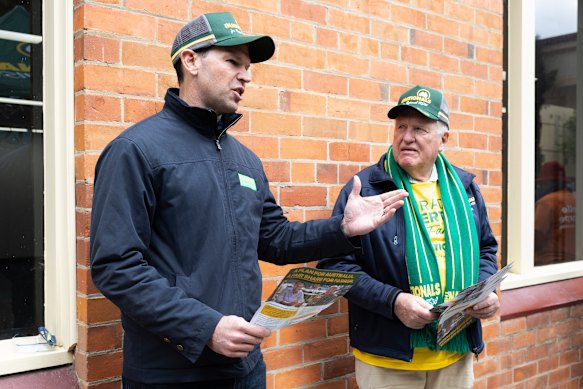
One Nation candidate David Farley has taken a more cautious approach, backing the current redevelopment while leaving open the possibility of a future greenfield expansion. At the start of the campaign he said a conversation about a private operator running the cross-border health service could introduce competition.
The Coalition, meanwhile, has attempted to straddle both positions politically. The Liberal and Nationals candidates have pledged a $200 million Farrer healthcare package, including $185 million for infrastructure aimed at completing the current redevelopment and beginning planning work on a future hospital.
That commitment reflects the political sensitivity of the issue. While the Coalition supports finishing the existing build, it is also attempting to acknowledge growing community concern that the redevelopment alone will not solve long-term demand pressures.
The debate has also highlighted the unusual governance structure of border health services. Although Albury hospital sits in NSW, Albury Wodonga Health operates under Victorian jurisdiction, creating a system where responsibility for funding, planning and political accountability is often blurred between governments.
Last year, both state governments unsuccessfully sought additional federal funding for elements of the redevelopment, including a helipad and extra dialysis chairs, a reminder that even the current project remains incomplete in the eyes of many local advocates.
Independent MP Helen Haines, a former health professional whose electorate of Indi takes in Wodonga, says the state governments should step up and make a bigger ask of the Commonwealth.
“Our community deserves certainty and a serious plan – not politics and patchwork,” she says.
For voters, however, the issue is less about intergovernmental complexity than visible strain. Ambulance ramping, bed shortages and long emergency waits have turned what was once a technical infrastructure dispute into everyday life.
Cut through the noise of federal politics with news, views and expert analysis. Subscribers can sign up to our weekly Inside Politics newsletter.
 Rob Harris is the national correspondent for The Sydney Morning Herald and The Age based in Canberra. He is a former Europe correspondent.Connect via email.
From our partners
Disclaimer : This story is auto aggregated by a computer programme and has not been created or edited by DOWNTHENEWS. Publisher: www.smh.com.au







