
T
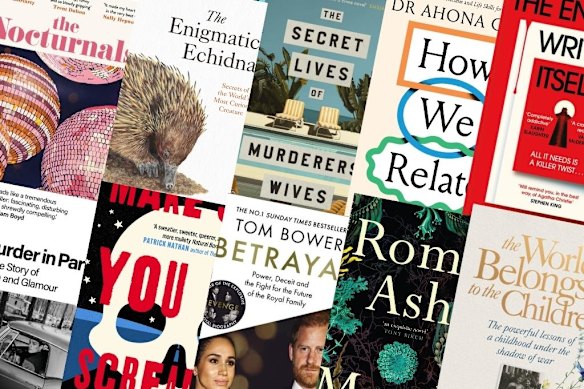
his week’s reviews run the genre gamut from dystopian cli-fi, queer road-trip fiction and murder mysteries to the Royals, navigating relationships and a moving WWII memoir.
FICTION PICK OF THE WEEK

The Secret Lives of Murderers’ Wives
Elizabeth Arnott
Viking, $34.99
Set in 1960s California, Elizabeth Arnott’s latest is sun-drenched period crime that sees secondary victims turned sleuths. Beverley, Elsie and Margot were all unlucky in love. Each of them married a convicted killer. Becoming friends in the aftermath, they’re trying to put their lives back together in the face of neighbourhood gossip and the lingering stigma of their husbands’ notoriety. When a string of fresh killings grabs the headlines, though, the three women might just be the key to catching a serial murderer: they do, after all, possess the distinct advantage of having lived with one themselves. The Secret Lives of Murderers’ Wives weaves a world of gossip and glamour, though it’s the emotional authenticity of the characters – and their familiarity with the darkness behind the idyllic facade – that shapes their transformation into sleuths and gives this serial killer thriller a winning edge. Arnott gets under the skin of women whose lives are derailed by crime, before letting them reassert agency as unlikely detective avengers.
Mantle
Romy Ash
Ultimo, $34.99

Romy Ash’s debut Floundering (2013) was shortlisted for the Miles Franklin. Her long-awaited second novel, Mantle, surfs a wave of dystopian cli-fi. It might have felt faddish (flirting as it does with the popular premise of human doom via fungal pandemic) were it not so distinctive. Middle-aged Ursula travels to the Tasmanian coast to care for her mother, Delores, through a mystery illness. Delores has become a hippy recluse, and her clifftop house overlooking the ocean looks set to be where she will die. The rash Dolores has developed is spreading among the population. A pandemic is declared. Borders are closed and Ursula finds herself trapped, and though she has a pleasant distraction – sleeping with Toby, a much younger man she met at the pub – their encounters take a surreal turn when they wake up with their skin stuck together by strange tendrils. Nothing seems to stop the fungal infection from killing its hosts, and Ursula is consumed by fear and wonder as the novel takes an existential turn. At its best, Ash’s dark vision is personalised and grounded – sometimes figuratively in Ursula’s emotional landscape; and sometimes literally (Ursula is a geologist). It’s an involving disaster novel, layered with griefs personal and planetary.
The Ending Writes Itself
Evelyn Clarke
HQ, $32.99

A knives-out publishing satire and locked-room murder mystery rolled into one, The Ending Writes Itself takes place on a remote, privately-owned Scottish island, where six jobbing authors from different genres have been invited. Their mission? To pen a worthy ending to the unfinished final novel of the world-famous – and recently deceased – Arthur Fletch. Within 72 hours. Reward? A small fortune in cash and a three-book publishing contract. The competition to write the best ending reveals each writer’s secrets and pet peeves and, as the book ricochets between character perspectives, the literary game soon turns into a lethal one. Co-authored by V.E. Schwab and her screenwriter friend Cat Clarke, The Ending Writes Itself fuses a black comic skewering of life-denying trends in the publishing world (especially the tenuousness and frustration meted out to “midlist” authors) with all the tropes and twists you’d expect from a classic Agatha Christie-style mystery. The latter should attract a broad audience of crime fiction lovers, while the swift, cutting, character-driven satire will make industry insiders grimace in recognition.
Make Sure You Die Screaming
Zee Carlstrom
Verve Books, $24.99

The unnamed, and nonbinary, queer narrator of Make Sure You Die Screaming is on a mission to find their father – a MAGA supporter and conspiracy theorist who’s gone missing in rural Arkansas. The narrator is rather left-wing. They can’t stand their parents’ politics, and they’re full of rage at the state of the world. A booze-fuelled road trip from Chicago, accompanied by new friend and self-proclaimed “garbage goth” Yivi, starts messy and gets messier quickly, with a Fear and Loathing in Las Vegas vibe of self-destructive debauchery and bizarre encounters piling up, before a hellish homecoming beckons. Zee Carlstrom creates a youthful voice that swells with rancour at every kind of inequity (class most of all) and flirts with an almost nihilistic worldview. It’s a novel sparked by the kind of modern political polarisation that divides families, Carlstrom is astute enough to suggest that parallels may be found at both poles, as this queer road trip careens from blue heartland to red.
The Nocturnals
Frances Whiting
HarperCollins, $34.99

An unusually close group of high-school friends used to call themselves the Nocturnals, and joke that they were Australia’s answer to The Breakfast Club. Ten years have now passed since they’ve seen each other, but when charismatic Hunter calls for a reunion, there’s no question that Nina (the Good Girl), Beatrice (the Poetess), Harriet (the Ghost), and Cosmo (the Professor) will heed the call. Why did the friends’ paths diverge long ago? And why has Hunter gathered them now? All is revealed in dual timelines, in a well-constructed novel that nimbly introduces an endearing cast of characters. Whiting leans into teen movie stereotypes before complicating and shading them, yet The Nocturnals is, above all, a joyful look at the formative friendships of youth and the loyalties they can inspire. Indeed, the fumes of adolescent alchemy are so strong in this novel that it ought to appeal to a YA readership as much as a more mature audience.
NON-FICTION PICK OF THE WEEK

The Enigmatic Echidna
Danielle Clode
Black Inc, $36.99
Welcome to the fascinating world of the echidna. Native to Australia and New Guinea, they are, among other things, incredibly strong; one scientist, after trying to confine an echidna to a kitchen overnight discovered in the morning that the beast had shifted the fridge. They’re also legendary escape artists and can bust out of just about anything, while also having “a dismissive air about them, as if they care nothing for what the rest of the world is doing”. Clode, a biologist and lauded natural history writer, divides her study into three parts: the echidna’s mysterious past (early ones were huge), the way it perceives and inhabits the world, and the future. Along the way she incorporates depictions of the beast by indigenous artists, from rock art to children’s tales – as well as the first European studies, usually by scientists who’d never seen one in the flesh. It’s no wonder the likes of Banjo Paterson saw the “Bristler” as emblematic of the rugged Aussie battler – “…prickly, unsociable and non-conformist”. Clode has an engaging, slyly amusing style that enters the spirit of the spiky thing itself.
Murder in Paris ’68
Edward Chisholm
Monoray, $34.99

Reading this reconstruction of a scandalous 1968 Paris murder is like stepping into the pages of a Georges Simenon roman dur, or immersing yourself in one of those cool, existentialist New Wave French films. It begins with a body. Found by a tramp just outside Versailles. Head pulverised. Fingerprints reveal it was Stevan Markovic, a Yugoslav émigre – leading to his Paris address. Which is where L’homme fatal actor Alain Delon comes into the tale; Delon also lived at the same address. Markovic, a petty crim, part-time movie double and bodyguard employed by Delon, also moved in the murky underworld circles of not-so-petty crims. The two are the same height and look like each other; Chisholm writes that in some photos he could be Delon. He was even wearing Delon’s clothes when murdered. And that’s just for starters, for the scandal goes all the way to top, involving future French president Georges Pompidou’s wife. Chisholm meticulously draws on a reputed five tonnes of archival material, creatively orchestrating events (sometimes cutting between Delon on the film set and being questioned by police, Delon “acting” the whole time), in what he calls narrative non-fiction, but which reads like a novel. Brilliantly written and compellingly re-imagined.
How We Relate
Dr Ahona Guha
Scribe, $36.99

This is an unusual guide to navigating relationships, in that it’s often as confessional as it is analytic. Guha, a clinical psychologist, incorporates her own story: the complexities of an Indian cross-cultural family, an explosive mother (who re-enacted her own abuse as a daughter), a distant father, a culture of silence, and a dysfunctional first marriage. But, above all, she examines the many ways we experience relationships in all their forms, from romantic love to our relationship with ourselves and pets. In fact, our relationship to ourselves is seen as pivotal in understanding what we want, especially in terms of our past patterns of behaviour and attraction. Guha, for example, came to realise that what she valued was “a community and care, not a single, intimate relationship”. She also invites readers to accommodate their contradictory impulses. “We might,” she writes, “be fulfilled in our relationships and lonely”. A forthright look at the human need for connection.
The World Belongs to the Children
Raya Goldtwig
Affirm, $36.99

In 1941, at a railway station in Russia, Raya Goldtwig’s mother lay down on the rails in front of the engine with her two children. They were Polish Jews who’d escaped to Russia in 1939. But Germany had invaded Russia (her father had been conscripted), this was the last train out of town and her mother had decided, if they couldn’t catch it, to die there and then rather than be captured by the Germans. It’s just one of the many harrowing scenes in this reminiscence of her family’s experience of WWII. And the book is made all the more dramatic for being seen through the imaginative eyes of a child: air raids, narrow escapes, snowstorms, hunger and brutal violence are invested with the unreality of a dark fairytale. It’s also deeply moving, especially Goldtwig’s haunting memory of childhood friend Mala. Goldtwig’s book emphasises the sanctity of childhood, but also chronicles events that no human (let alone a child) should have to endure.
Betrayal
Tom Bower
Blink, $36.99

The name Wallis Simpson is only mentioned a few times in Tom Bower’s sequel to his previous study of Harry and Meghan, Revenge, but there is a sense of déjà vu about the saga: “that woman” Simpson, an American divorcee who precipitated the 1936 abdication of Edward, and Meghan, an American divorcee behind “megxit”. Bower goes into the key points, the tension and distrust inside the royal family, the controversy surrounding Elizabeth’s death and funeral, the Netflix flops, the publicity drives and the emergence of the couple as a “brand”. And, often as not, they don’t come off looking too good. Like other observers, Bower sees the House of Windsor (no stranger to scandal) as at the cross-roads and the resolution, if one is possible, of this latest scandal is crucial to its future. A tangled, sometimes tacky web. One for royal watchers.
The Booklist is a weekly newsletter for book lovers from Jason Steger. Get it delivered every Friday.
Disclaimer : This story is auto aggregated by a computer programme and has not been created or edited by DOWNTHENEWS. Publisher: www.smh.com.au


