
With fuel prices up significantly, and Europe seemingly on the brink of a jet-fuel shortage, this may prove to be the summer of international train travel. Here’s where Deutsche Bahn is extending its reach beyond Germany.
Deutsche Bahn is looking to expand its international services as more and more railway passengers from Germany book trains to destinations like Paris, Amsterdam or Zurich.
“Last year, 25 of around 140 million customers in Deutsche Bahn’s long-distance transport booked cross-border journeys, which is 30 percent more than in 2019,” long-distance transport board member Michael Peterson told the German Press Agency in Frankfurt.
He added that the number of cross-border travellers on Deutsche Bahn (DB) trains are expected to grow this year and in the following years.
Which is why Germany’s national railway operator is now expanding services to major cities beyond the country’s borders.
According to Deutsche Bahn, passenger numbers rose sharply in 2025 on several connections, including: Munich – Zurich, up 27 percent compared to the previous year; Frankfurt to Paris, up 22 percent; and Cologne to Brussels, up 16 percent.
“International rail transport has become more attractive for many people,” Peterson said, adding that city-to-city travellers tend to appreciate arriving directly in city-centres by train as opposed to touching down at airports far outside of the cities.
Where is DB expanding its international connections?
From mid-June, the direct connection between Copenhagen and Prague via Hamburg and Berlin will be expanded to two daily trains, according to DB.
READ ALSO: First train in a decade between Copenhagen, Berlin and Prague to depart on May 1st
From June to the end of August, the ICE connection between Cologne and Brussels will also extend to Ghent, Bruges and the Belgian coast on weekends.
In July and August, DB also offers a direct connection between Frankfurt and Bordeaux on Saturdays.
From September 7th, four daily ICEs will then run between Cologne and Antwerp, for the first time with a stop at Brussels Airport.
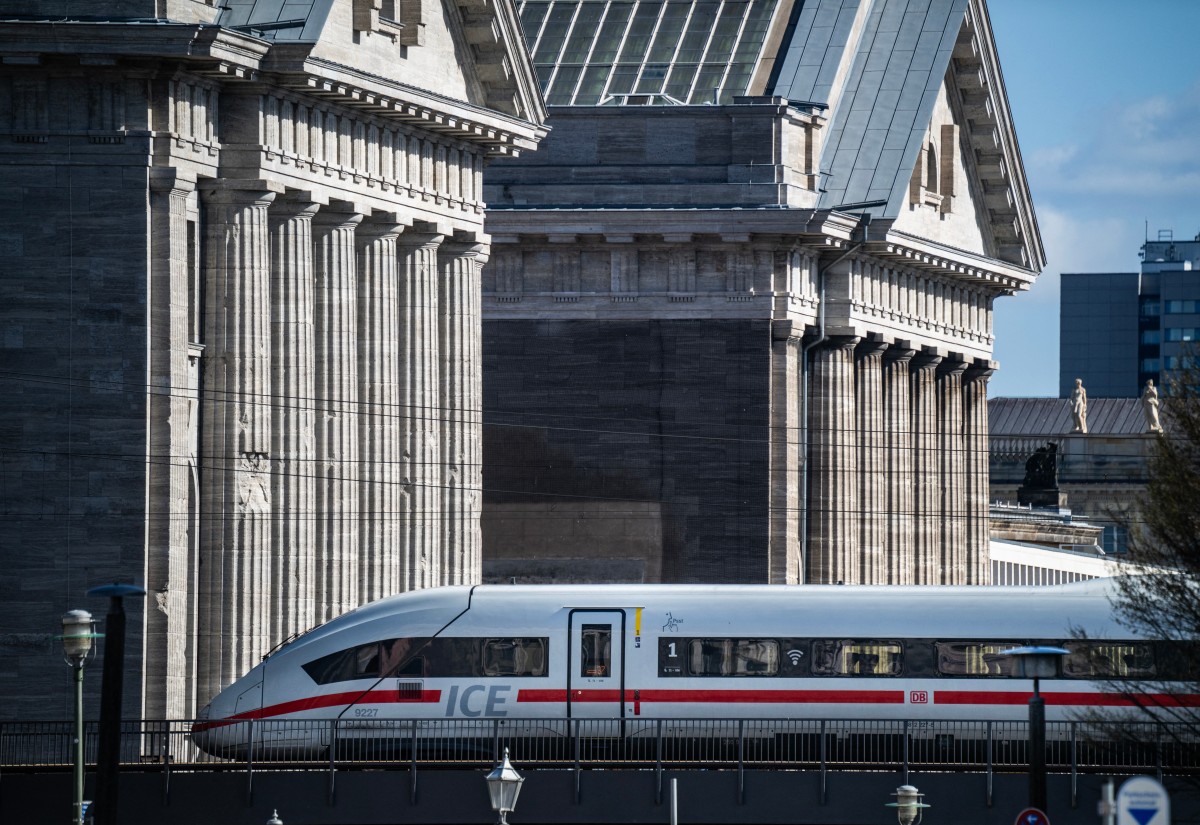
An ICE (Inter-City Express) train travels past the facade of Berlin’s Pergamon Museum on April 6, 2026. (Photo by John MACDOUGALL / AFP)
Looking ahead, DB maintains a goal for 2027 of introducing a new direct connection between Munich, Milan and Rome together with the Italian Trenitalia and the Austrian Federal Railways.
Also, in view of high demand, DB is considering adding more trains on the Berlin to Paris route. The direct journey currently takes around eight hours, and stops in Frankfurt on the way.
READ ALSO: 5 tips for surviving Deutsche Bahn’s new Paris to Berlin ‘direct’ train link
“There is interest in expanding the connection on both sides, in Germany as well as in France,” Peterson said.
Hurdles to London
Obstacles remain hard to clear, however, on other routes.
Talks are underway about a direct rail connection from Germany to London. But connecting directly to Great Britain, which is not part of the Schengen area, is logistically difficult. The route would require a dedicated terminal with security checks, for example.
For now, travellers can travel to London from Frankfurt or Cologne, but they must change trains in Brussels.
More travellers turn to rail when fuel prices rise
As opposed to Europe’s airlines, railway companies appear to benefit from the fact that fuel, and therefore driving, has become more expensive since the US and Israel started a war in Iran.
LISTED: The major airlines in Germany cancelling flights and adding extra charges
“We see that people are increasingly choosing to travel by train in view of the high fuel prices,” Peterson said. “On individual days, we record up to ten percent more demand.”
Although the Iran war is driving up energy costs for companies, the railways run on 100 percent green electricity in long-distance transport, making these routes effectively immune to fossil fuel price shocks.
In addition, according to Peterson, the group has additionally hedged against price increases for this year and contractually secured large amounts of electricity in 2027.
The biggest annoyance for rail passengers, of course, remains the frequent delays that travel with DB has become notorious for.
DB maintains a goal of hitting 60 percent punctuality with its long-distance trains in 2026. It did better than that in April (at 64.4 percent) but worse in February (59.4 percent) and January (52 percent).
Last year, DB’s long-distance punctuality figures hit severe lows — around 40 percent last June. DB has been moving forward with a series of big infrastructure projects and track upgrades meant to improve punctuality in the network.
READ ALSO:
Disclaimer : This story is auto aggregated by a computer programme and has not been created or edited by DOWNTHENEWS. Publisher: thelocal.de



