After 12 years of dating and one year of marriage, high-school sweethearts Samuel and Penelope started trying to conceive. Both grew up in tight-knit families, and had long dreamed of having biological children together.
But when a year passed without a positive pregnancy test, the couple — who asked to use pseudonyms because they haven’t even told some relatives about their fertility experience — asked doctors what was going on.
“We were looking at everything,” Penelope told The Post. “They did all of this blood work, and nothing came up.”
Eventually, Samuel was diagnosed with Klinefelter syndrome, a common genetic condition in which male babies are born with an extra copy of the X chromosome. While it can cause physical symptoms like smaller testicles, in many cases like Samuel’s, people don’t realize they have it until they’re adults — if they find out at all.
“It was sort of like that missing puzzle piece: That was the key to why we were having fertility issues,” Samuel said.
Not that the key unlocked many solutions. Rather, it presented a grim reality: Due to Klinefelter’s, Samuel’s semen lacked sperm. To extract any sperm he might have would mean operating on his testicles themselves. Even then, the chances of fishing out healthy swimmers would be around 25%, Samuel was told.
“It was mentally draining and hard,” he said. “I had my depressive moments because it kind of shattered the dream of having my own kid biologically.”
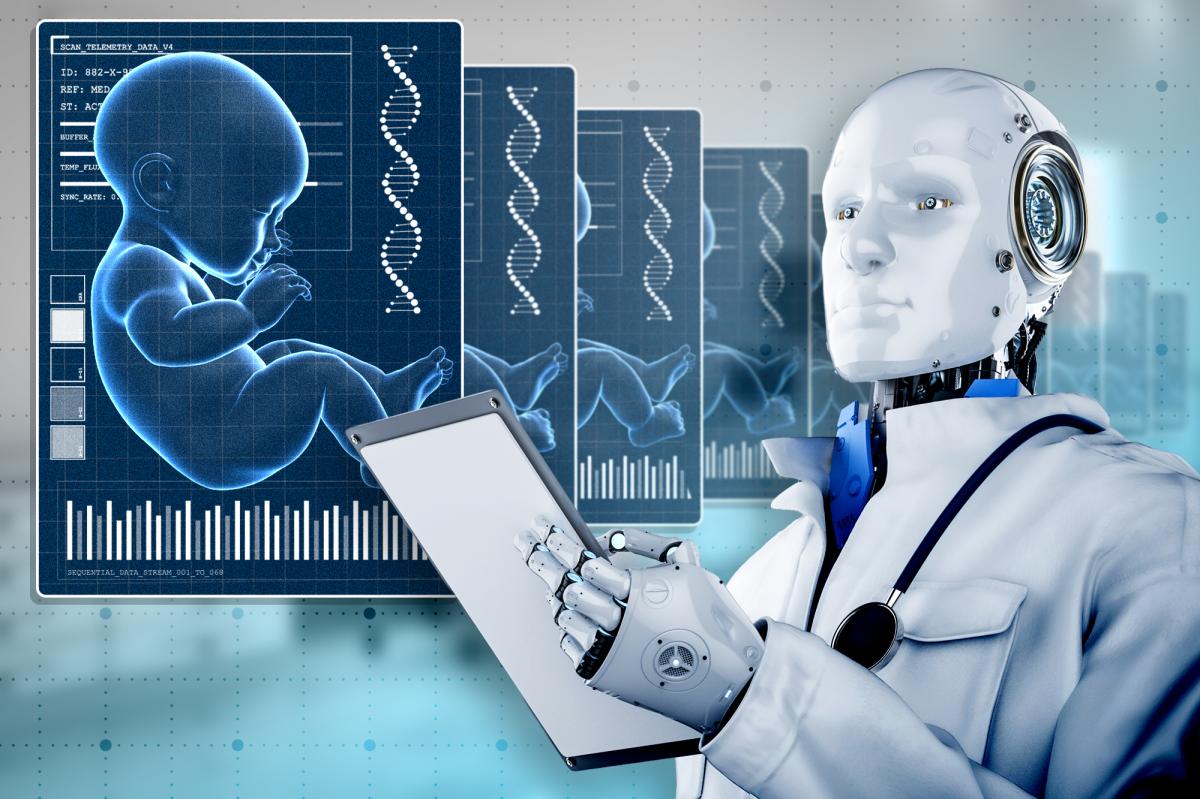
But thanks to artificial intelligence, that dream is not only repaired — it’s an impending reality. Using Columbia University Fertility Center’s AI-powered Sperm Tracking and Recovery system, which identifies and isolates rare sperm that conventional methods miss, Samuel and Penelope are expecting a baby boy in July.
The newborn will be among the first in a generation to exist directly because AI does too. “We wouldn’t have been able to even have a baby together if it wasn’t for AI,” Samuel said. “So we’re very grateful.” Some experts say the comparison to the early days of in vitro fertilization, or IVF, is apt.
“When [people] used the term ‘test-tube’ babies, it reflected that this was a transformative technology or something very new and very different, but these are completely healthy, normal babies that were just conceived using a new technology that hadn’t existed before,” Dr. Zev Williams, MD, director of Columbia University Fertility Center, told The Post.
“The same is true with the term ‘AI babies.’ These are healthy, normal babies, but … they were conceived in a way that was previously impossible to do.”
When stars align
STAR works by using high-powered imaging technology to scan through sperm samples and take over 8 million images in under an hour. AI spots and recovers live sperm within milliseconds.
“I use this analogy of finding a needle in 1,000 haystacks, but you have to do it within an hour, and you have to do it so gently that you can then take that sperm and use it to fertilize an egg and result in a healthy, ongoing pregnancy,” Williams said.
“That’s something that was impossible for a human to be able to do,” he added. “It’s just not possible even for a whole team to do.”
When Penelope and Samuel first learned about STAR shortly after it came out in 2025, they joined Columbia’s waitlist. Samuel started hormone therapy to boost testosterone, and Penelope prepared for an egg retrieval. Come September, the hope was to merge any of Samuel’s recovered sperm with Penelope’s eggs to create embryos in a lab, all on one day.
“This is one chance,” Samuel said he thought, since the couple only had insurance coverage for one round of IVF.
“AI will not replace fertility doctors, [but] fertility doctors that do not embrace AI will be replaced.”
Dr. Brian Levine
At first, it didn’t look good: His procedure yielded no sperm when evaluated the traditional way — i.e. via a high-powered microscope. But when run through the STAR system, eight sperm appeared. “It’s truly a miracle for there to be just one,” Penelope said.
It wasn’t the last miracle they needed. After doctors retrieved 23 of Penelope’s eggs and injected eight with Samuel’s sperm, only two became fertilized. Just one grew into a blastocyst, or the late-stage embryo that’s ready for implantation.
Even when doctors transferred it to Penelope’s uterus, they still couldn’t guarantee a pregnancy would “stick.” Just about 55% of IVF cycles in women under 35 result in pregnancy on the first try.
But Penelope was one of them. Eric Forman, MD, Columbia University Fertility Center’s medical and laboratory director, called her with the good news. “I just started sobbing,” Penelope recalled. “I couldn’t even believe it.”
Samuel broke down when he saw Penelope’s reveal — a baby blanket and card — after work that day too.
“I know a lot of people are a little skeptical about [AI]. It’s a controversial topic right now, but I would not think twice again about it,” he said. “If we want another kid, we would have to do the same thing.”
Oh baby, oh bab-AI!
Beyond a solution for Klinefelter’s syndrome, STAR may be a game-changer for men whose semen seems sperm-less for any reason, known as azoospermia. The first baby born to a dad with the diagnosis using STAR was born in December. The couple had been trying to conceive for 18 years.
“You realize the difference between zero and one [sperm] is the difference between a child — and, God willing, grandchildren and great-grandchildren — and not being able to have a child,” Williams said.
STAR isn’t the only AI invention influencing a potential future AI baby boom. Another system, OvaReady by the company AutoIVF, says it uses an automated system to find and isolate eggs from a woman’s follicular fluid during IVF.
While traditionally embryologists use a high-powered microscope for the task, one study found OvaReady identified extra eggs in more than 50% of cases — eggs that otherwise would have been thrown out. As of the study’s February publication, one baby conceived from an egg identified by OvaReady was born.
“I think labs will all be deploying this AutoIVF technology to take a common task that’s fraught with human error and now to add some rigor to it,” said Dr. Brian Levine, MD, founding partner and practice director of CCRM Fertility of New York.
In Mexico, the startup Conceivable Life Sciences says it’s doing just that, not with one task, but with 205. Its AI system called Aura does everything from scanning and selecting the egg and sperm to robotically fertilizing the former with the latter. Twenty Aura babies had been born by October 2025, the Washington Post reported.
It won’t be long before some of those elements are embedded into IVF protocols closer to home, Dr. Aimee Eyvazzadeh, MD, a reproductive endocrinologist and infertility specialist in the San Francisco area known as “The Egg Whisperer,” told The Post.
“I’m not at that point where I can say we’re going to create an ‘AI baby’ where AI is completely choosing the egg and the sperm and we’re creating an embryo. We’re not there yet,” she said.
“Could we be? Probably in five years or less, these tools will actually do and help with that selection, and there will be very little human interaction with picking which egg and sperm come together.”
‘AI is now omnipresent’
Meantime, AI is already more widely implemented in the embryo selection phase of IVF.
Some companies say it’s helping intended parents choose embryos at the lowest risk of developing cancer and other illnesses. It’s also controversially screening babies-to-be for characteristics like height and smarts.
Even embryos that seem equally healthy might be sussed out on a deeper level using AI-powered time-lapse incubators. The machines capture and compile videos as embryos develop, potentially helping embryologists more reliably choose the winners. Some research shows that this kind of monitoring can boost pregnancy rates by 11%, but how much it helps in a real-world setting remains up for debate.
Fertility clinics are also using AI regularly in administrative tasks like onboarding and scheduling patients, explaining test results and getting prior authorization for medications and treatments from insurance companies, a process that can take two or three months, Eyvazzadeh said.
“For a patient who’s 42 years old, three months is a big deal, and that’s when egg panic sets in and people start losing hope,” she said.
Likewise, Levine said, AI is poised to increase access to fertility specialists by allowing them to remotely evaluate scans and develop treatment protocols while the patient sees their local doc. Only once a woman is ready for an egg retrieval will she step foot in a fertility clinic, he predicted.
“AI will not replace fertility doctors,” he said, “[but] fertility doctors that do not embrace AI will be replaced. And the reason is that AI is now omnipresent in what we do every day.”
Not everyone is thrilled about that, of course.
Some experts caution that we still don’t know if many of these systems offer marked improvements to traditional IVF, and any new technologies can bring with them costs and unforeseen complications to the staffers tasked with learning them. There are broader worries about AI’s environmental impacts. Plus, will human error just be replaced with AI error?
“None of the AI models went to medical school,” Levine said. “And none of them understand how a constellation of symptoms can present as a disease.”
Patients are wary, too.
According to a survey by the media platform Pregnantish, which covers infertility and modern family building, just 18% of respondents were “comfortable” or “extremely comfortable” with the idea of using AI to help with embryo selection. Twenty-eight percent said they weren’t comfortable, and another 28% said they weren’t sure how AI could help.
The platform’s founder, Andrea Syrtash, said some people are worried that too much automation lacks that human touch.
“When everything is replaced by AI — including communications with endless auto-messages and no human to answer — it gets annoying,” she said. “We have to remember that chapters like infertility are deeply human experiences, and it’s a balance.”
But if doctors, scientists and technicians can strike it, the concept of babies made in figurative “test tubes” sans AI may become quaint.
“No one comes to my office and says, ‘I want a baby without AI.’ No one comes to my office and says, ‘Help me build my family, but don’t use technology,’” Levine said. “Everyone says the exact same thing: ‘I want a baby as quickly as I can.’ And I think that’s where AI is going to be amazing.”
Disclaimer : This story is auto aggregated by a computer programme and has not been created or edited by DOWNTHENEWS. Publisher: nypost.com