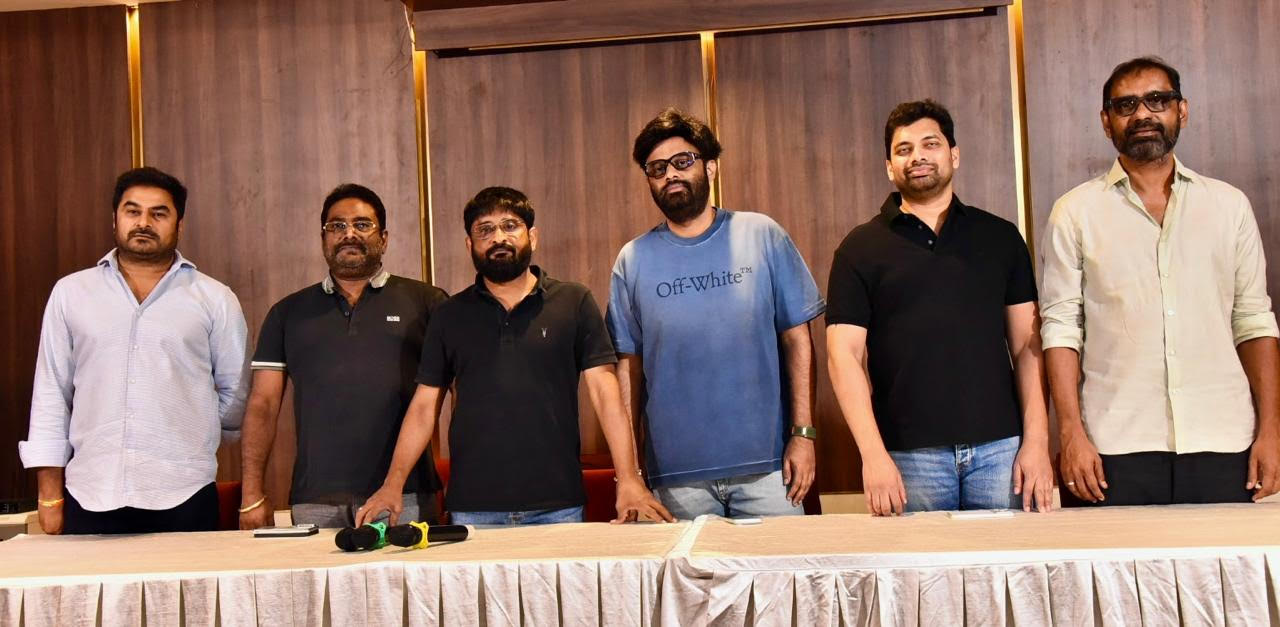
Telugu film producers on Wednesday responded strongly to the recent press meet conducted by exhibitors, stating that the crisis in the theatrical business is not limited to exhibitors alone, but is equally impacting producers and distributors. They stressed that the industry cannot move forward through threats, deadlines, or one-sided decisions, and called for collective discussions to arrive at practical solutions acceptable to all stakeholders.
Leading producers Yalamanchili Ravi Shankar, Suryadevara Naga Vamsi, Sahu Garapati, Sudhakar Cherukuri, Venkata Satish Kilaru, and others participated in the media interaction held in Hyderabad on Wednesday evening.
Addressing the media, the producers said they felt compelled to present their side after exhibitors claimed they were being treated unfairly and demanded the immediate implementation of the percentage-sharing system in theatres. While acknowledging that exhibitors are indeed facing financial difficulties, the producers maintained that distributors and producers have also been going through severe challenges over the last few years.
Producer Yalamanchili Ravi Shankar said the Telugu film industry has always functioned as a combined ecosystem where producers, distributors and exhibitors depended on one another for survival. He said none of the three sectors is currently in a comfortable position and warned against treating the issue as the problem of just one sector.
“We agree exhibitors are facing problems, but producers and distributors are also suffering. This is not something that can be solved overnight. All stakeholders must sit together and discuss these issues calmly instead of creating pressure publicly,” he said.
Ravi Shankar questioned why the issue was being aggressively pushed now, especially when several films had already been released after ‘Hari Hara Veera Mallu’ without major disruptions. He pointed out that the industry has been struggling for the past few months due to lack of strong theatrical content and said creating uncertainty at a time when big films are gearing up for release would only hurt cinema further.
He also emphasized the need to improve infrastructure in theatres, particularly single-screen theatres, saying a better audience experience would naturally improve footfalls. “Not all theatres provide the same facilities. Theatre grading and infrastructure development are important discussions that must happen alongside revenue-sharing talks,” he added.
Producer Suryadevara Naga Vamsi said the survival of the theatrical business depends on the balance between exhibitors, distributors and producers, and any disruption in one sector would eventually impact the others as well.
“Exhibitors themselves admitted that many theatres were shut because there wasn’t enough content in recent months. If more restrictions are imposed now, producers may become even more cautious about making films, which will affect the entire ecosystem,” he said.
Naga Vamsi also objected to what he described as a threatening tone in the exhibitors’ press meet, saying unilateral decisions and deadlines would only create fear within the industry. He pointed out that several films are already deep into production, with a majority of their budgets spent, making it impossible to suddenly implement a completely new business model.
“At least 25 films have already crossed major stages of production, and nearly 70 to 80 percent of their budgets are spent. At this point, introducing a new system is not practical. For future films, we are open to discussions on the percentage system, but such discussions must also include theatre grading, maintenance standards, and online ticket booking charges,” he stated.
Producer Sahu Garapati said the exhibitors’ press meet appeared more like a warning than an invitation for dialogue and stressed that internal conflicts would only weaken the Telugu film industry at a crucial time.
“If we keep fighting among ourselves, the industry will suffer further. Discussions are already happening at the Film Chamber level, so there was no need for one-sided statements in public,” he said.
Garapati also expressed concern over statements suggesting certain films may not be screened despite receiving government approvals and revised ticket pricing permissions. “Every film belongs to the industry. It is not right to target films selectively. The industry survives only when cinema succeeds collectively,” he remarked.
Producer Sudhakar Cherukuri questioned why these concerns were surfacing only now, despite the same distribution and exhibition system functioning for decades in Telangana. He pointed out that ticket price hikes were approved even during recent Sankranti releases and said the sudden change in stance was difficult to understand.
The producers collectively reiterated that they are not against reforms or discussions regarding revenue-sharing models, but insisted that any decision affecting the industry should be taken only through mutual consultation and consensus among exhibitors, distributors, and producers.
Disclaimer : This story is auto aggregated by a computer programme and has not been created or edited by DOWNTHENEWS. Publisher: deccanchronicle.com