The COVID-19 pandemic permanently reshaped how Americans work, accelerating the shift toward remote and hybrid employment across nearly every industry.
What began as a temporary solution during the lockdowns quickly evolved into a long-term workplace transformation, proving that many employees could remain productive outside a traditional office environment.
As remote work became more common, many professionals also began uncovering the downsides of working from home full-time, including isolation, distractions, and blurred boundaries between personal and professional life. That shift helped fuel the rapid growth of coworking spaces, which offer flexible work environments, social interaction, and professional amenities without requiring employees to return to corporate offices full-time.
The trend has since evolved into a major business movement. Around 55% of global corporations now use flexible workspace solutions in some capacity, according to Allwork.Space.
Coworking spaces have also become more attractive because they reduce overhead costs by allowing members to share internet, utilities, office equipment, meeting areas, and other workplace essentials.
Despite return-to-office pushes from major corporations such as Amazon (AMZN) and JPMorgan Chase (JPM), the coworking industry continued expanding across the U.S. as hybrid work models remain firmly in place.
The numbers reflect that momentum. Grand View Research estimated the global coworking market at $14.91 billion in 2023 and projects it will reach $40.47 billion by 2030, representing a compound annual growth rate of 15.7%. The U.S. accounted for the industry’s largest revenue share at 68% in 2023.
Research also suggests coworking environments may improve employee well-being and engagement. Harvard Business Review analysts found that coworking members reported significantly higher levels of workplace thriving than employees working in traditional office settings.
“People who belong to them report levels of thriving that approach an average of 6 on a 7-point scale,” wrote Harvard Business Review analysts. “This is at least a point higher than the average for employees who do their jobs in regular offices.”
Denny’s enters the flexible workspace trend
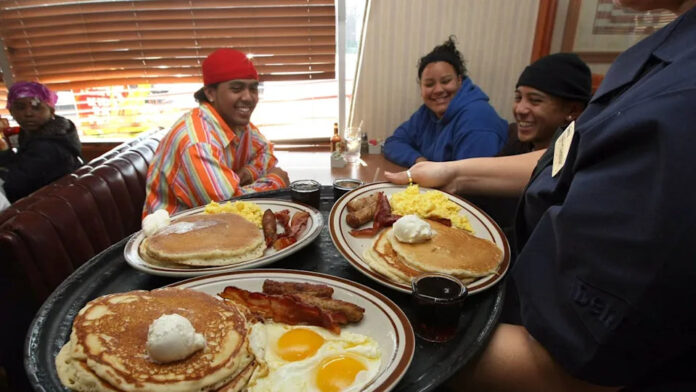
Denny’s is now tapping into that growing demand by expanding the use of private dining areas and meeting spaces inside select restaurants.
The company is positioning its locations as gathering spaces for both social and professional occasions, including:
-
Birthdays and milestone celebrations
-
Family reunions and group gatherings
-
Teams, clubs, and group meetups
-
Recurring meetups and casual get-togethers
According to Denny’s, select locations now offer on-site private restaurant rooms at no additional charge and without requiring a special event package. Guests can reserve spaces based on group size and scheduling availability while still ordering from Denny’s full menu.
Availability, room size, and setup vary by location, and not every restaurant offers dedicated meeting areas. Customers are encouraged to contact their local Denny’s directly for booking information.
Why restaurants are becoming alternative workspaces
Denny’s move reflects a broader shift in how remote workers are approaching productivity and workspace flexibility.
For many professionals, working from a restaurant or café creates a clearer separation between home and work while helping reduce distractions commonly associated with remote work. Although restaurants typically lack traditional office perks such as IT support or dedicated office equipment, they offer several advantages that appeal to freelancers, entrepreneurs, and hybrid employees, including:
-
No membership fees
-
Flexible seating and meeting areas
-
Food and beverage service on-site
-
Extended operating hours, including many 24/7 locations
Cost is another major factor driving interest in nontraditional workspaces.
The U.S. coworking market continued expanding in early 2026. The country reached 9,136 active coworking locations by the end of the first quarter of 2026, marking a 3.2% quarter-over-quarter increase, according to CoworkingCafe.
At the same time, traditional coworking memberships remain relatively expensive for many independent workers and small businesses. Pricing varies significantly depending on location, services, and membership type, according to Launch Workplaces.
CoworkingCafe reported that the national median membership rate for coworking spaces was $220 per person per month in early 2026. Dedicated meeting rooms averaged $45 per hour, while day passes cost around $33 per day. Virtual office memberships ranged between $159 and $169 per month.
Against that backdrop, restaurants offering free meeting space with food purchases have become an increasingly appealing option for budget-conscious workers and groups.
Still, restaurants are unlikely to fully replace traditional coworking spaces. Noise levels, limited privacy, inconsistent Wi-Fi quality, and customer traffic can make restaurants less practical for workers who need quiet or highly professional environments throughout the day, according to CircleHub.
Restaurants are searching for new revenue opportunities
Denny’s expansion into flexible gathering spaces also comes during a difficult period for the restaurant industry.
Persistent inflation continues to put pressure on household budgets, prompting many Americans to reduce restaurant visits and reevaluate discretionary spending. Rising food costs have changed dining habits nationwide.
Approximately 27% of Americans reported skipping meals to save money, according to a recent Credit Karma survey.
In response, restaurant chains across the country have increasingly leaned on discounts, bundled meals, and value-focused promotions to attract customers.
Earlier in 2026, Denny’s launched its new Slammin’ Meal Deals starting at $5.99, offering all-day breakfast, lunch, and dinner options as part of a broader affordability strategy, according to a company announcement.
Previous coverage by Fernanda Tronco on restaurant industry strategy:
Prices for food away from home increased 3.6% in the 12 months ended April 2026, according to recent data from the U.S. Bureau of Labor Statistics.
Meanwhile, menu prices at 16 major restaurant chains, including IHOP (DIN), Denny’s, Cracker Barrel (CBRL), and Waffle House, rose an average of 39% between 2020 and 2025, nearly double the national inflation rate during the same period, according to FinanceBuzz.
Restaurant traffic has also softened as consumers become more selective about dining out.
Foodservice traffic declined 1% in the quarter ending June 2025, as diners cut back on restaurant visits, according to Circana. However, value-menu traffic climbed 1%, marking the category’s first positive growth in three years.
“Value buyers are 33% more likely than non-value buyers to purchase value menu items when visiting other restaurant chains, indicating they actively seek out deals across various brands,” said Circana Senior Vice President and Industry Advisor Food and Foodservice David Portalatin.
What the coworking trend means for the future of restaurants
Denny’s push into flexible meeting and coworking-style spaces highlights how restaurants are adapting to changing consumer behavior and evolving workplace trends.
As hybrid work remains a long-term reality, restaurants may increasingly position themselves as affordable community hubs that serve multiple purposes beyond dining alone. Offering free gathering spaces, extended hours, and low-cost food options could help chains generate additional traffic while creating new revenue opportunities in a challenging economic environment.
“Hundreds of thousands of people already work in coffee shops despite that not being their intended purpose,” wrote Candor Ventures Tech Entrepreneur and Founder Noah Berkson on Forbes. “If a coffee chain were to invest in making some of their locations even more friendly to remote work, that chain could become the remote office of the future.”
“More people in their stores means more food and drink sales throughout the day, providing coffee shops with a revenue boost,” Berkson added.
The strategy also reflects a broader shift across the hospitality industry, where restaurants are no longer competing solely on food quality or pricing, but increasingly on convenience, flexibility, and overall customer experience.
Related: Coors brings back cult-favorite beer after 5-year hiatus
This story was originally published by TheStreet on May 13, 2026, where it first appeared in the Restaurants section. Add TheStreet as a Preferred Source by clicking here.
Disclaimer : This story is auto aggregated by a computer programme and has not been created or edited by DOWNTHENEWS. Publisher: finance.yahoo.com