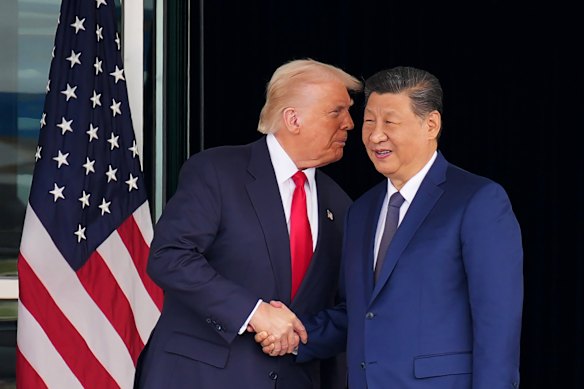

Washington: The last time Donald Trump met Xi Jinping – in South Korea in October – he referred to the encounter as a “G2 meeting”. That language didn’t go unnoticed, and hasn’t been forgotten.
Some foreign policy analysts – who pay a lot more attention to words than the US president, it must be said – often ascribe to Trump a sphere-of-influence philosophy on geopolitics. By that, they mean that he sees the world as being dominated by great powers (and strong men) who have the right to control their region.
No more so than the US and China – the world’s two largest economies, and the two great geostrategic rivals of our time. Any meeting of their two leaders is therefore consequential for the world at large.
For middle powers such as Australia, a “G2” world where the important decisions are made in Washington and Beijing would be disadvantageous. Canberra benefits from a stable relationship between the US and China, but still wants a seat at the table.
Michael Kovrig, a former Canadian diplomat turned geopolitical risk consultant, wrote in the Foreign Affairs journal recently that US allies had little trust that Trump would remember or represent their interests when sitting across the table from Xi in Beijing.
He noted they were also hedging their bets by shoring up their own relations with China – hence the steady stream of leaders visiting Xi in recent months, including Canada’s Mark Carney, France’s Emmanuel Macron, Britain’s Keir Starmer – and, before all of them, Australia’s Anthony Albanese.
They are also forming stronger links with each other. No leader made this clearer than Carney, who earlier this year spoke about a “rupture” in the world order and the need for middle powers to forge a new path.
Like the rest of the world, Australia’s immediate interest in the Trump-Xi meeting is ending the conflict in the Middle East and reopening the Strait of Hormuz – an outcome in which the US and China are also invested.
Beyond that, says Kovrig, “Australia would like a stabilising agreement of some kind – not a grand bargain, but to see that the outcomes are broadly stabilising in the short term”.
The risk is that Trump – in his dealmaking fervour and rush for a foreign policy win – will make concessions that leave middle powers exposed.
“The big danger for Australia [and others] is some kind of Xi-Trump deal over their heads that leaves them with more hawkish policies on China than the US apparently has now,” Kovrig tells this masthead.
“That’s partly why I’ve been watching a number of other middle powers really downplaying any criticism [of China], just in case they end up on the wrong side of Trump.
“Nobody wants to be more critical of China than the US, because the smaller countries want to be able to hide behind the US on that.”
Kovrig was detained by China for nearly three years, beginning in December 2018, along with fellow Canadian Michael Spavor, in what was widely considered a retaliatory act for Canada’s arrest of Meng Wanzhou, the chief financial officer of Chinese tech giant Huawei.
Meng was detained on a provisional US extradition request. The charges against her were ultimately dropped, and she was released in September 2021 – Kovrig and Spavor were freed hours later.
Kovrig notes Australia’s strategic model rests on a security alliance with the US – through the ANZUS treaty, defence co-operation and now AUKUS – while having China as its clear largest trading partner.
“That’s an inherent contradiction similar to South-East Asian countries that is always challenging for the government to manage,” he says.
“Australia is trying to reduce its dependence on both, just as many other countries are. But that’s a long-term project, that’s a generational project.
“In the short term, what Australia and other countries want is to be able to temporise. They want breathing space. They would like no major problems while they keep working on getting their own houses in order.”
Kovrig says that in some ways, the worst outcome for Australia would not be a failed summit, but an optically successful one that leads to ambiguity and uncertainty. In that case, Trump would claim to have struck a great deal, and Xi would declare the US had respected China’s core interests.
That sounds like exactly the sort of outcome a Trump-Xi meeting might deliver.
The problem there, Kovrig says, is that Australia and other US allies will be unsure of what Trump has actually promised. After the summit, Beijing is likely to test the ambiguity by pushing harder on Taiwan and the South China Sea, or on economic coercion, “to see if the US does anything.
“The way the Chinese Communist Party works, it’s a Leninist organisation. It will try to take as much as it can until somebody stops it,” says Kovrig.
“If they think they can buy Trump off with some soybean deals, what you’ll see after the summit is they’ll continue salami slicing. They’ll keep trying to take more.
“For Australia, that will manifest in trying to take more in Australia’s neighbourhood – further constraining Australia, further expanding Chinese influence in the Pacific Islands and South-East Asia, more assertive military manoeuvres in Australia’s immediate area, more use of coercion.
“Basically, [Beijing] could conclude that the US is not going to help Australia as much as it was before, and they can push harder. That’s the outcome Australia’s security community would be worried about.”
Get a note directly from our foreign correspondents on what’s making headlines around the world. Sign up for our weekly What in the World newsletter.
 Michael Koziol is the North America correspondent for The Age and Sydney Morning Herald. He is a former Sydney editor, Sun-Herald deputy editor and a federal political reporter in Canberra.Connect via X or email.
From our partners
Disclaimer : This story is auto aggregated by a computer programme and has not been created or edited by DOWNTHENEWS. Publisher: www.smh.com.au