The acclaimed actor on the “trauma phase” of her busy career, how Prima Facie helped to fortify change, and growing up “povvo”.
Sheridan Harbridge has long been inspired by rebellious women. When we meet, the actor, writer and director has just finished a Melbourne run of Amplified, a cabaret based on the life of Oz-rock goddess Chrissy Amphlett.
Inhabiting the bad-girl persona of The Divinyls frontwoman, she says, has been one of the highlights of her career. “During the show, I try to steal a purse from someone,” Harbridge says with a mischievous grin. “I ask them for it, as Chrissy, and I’m always amazed when they give it to me. I’d never give my purse in that situation. The performer would need a tetanus shot! What’s in my handbag is horrific. Right now, there are boiled eggs in there.”
Having purloined the purse, Harbridge’s Chrissy crosses the stage, opens it, and dumps the contents onstage. She goes through their wallet, wears their perfume, sometimes takes the money. “And every night, there’s a gasp from the women in the audience to see a purse emptied because they know that’s a sacred space.”
Audiences expect Chrissy to be as naughty as possible, Harbridge says, though she admits once flying a bit close to the wind. “One time I pulled out a lanyard and discovered I’d nicked the purse of a NSW policewoman,” she says wtih a laugh. “And I’m like, have I committed a crime?”

If Harbridge ever did face theft charges, her next character – ruthless criminal defence barrister Tessa Ensler – would relish getting her off the hook. Tessa is the protagonist of Suzie Miller’s 2019 play Prima Facie – a whip-smart, working-class outsider who ascends into a rarefied elite among criminal defence barristers. She experiences the law from two drastically divergent angles – first in the theatrical cut and thrust of advocacy, as a brilliant lawyer fighting for her clients, and then, after a drunken sexual encounter goes horribly wrong, as a complainant and lead witness in a rape trial.
It’s arguably the most consequential of the plays to take up the torch of the #MeToo movement, putting the legal process itself in the dock and subjecting it to the kind of unflinching cross-examination that helped to usher in real-world change.
The criminal law has since been reformed in Victoria and NSW among other jurisdictions, to give greater protection to witnesses in sexual assault cases, and to embrace an affirmative consent model for such crimes. Harbridge remembers the first season vividly as a time of optimistic ferment. “When [#MeToo] was cresting,” she says, “the play helped to fortify change and activism.” She’d get victim/survivors coming up to her after shows to share their experiences, though “a majority of the audience were people from the law, gathering in foyers with their carry-on roller cases”.
“They just loved seeing themselves, and that ‘the game’ had been put on stage. Some of them were so desensitised. They’d tell me war stories; all these f—ed accounts of trials… [like one in which] a rape complainant spent nine weeks on the stand.
“And I’m there thinking,” and here Harbridge makes a couple of rather convincing retching noises, “That poor woman, what she went through. Like Tessa at first, the lawyers saw themselves as generals and soldiers in a game.”
TAKE 7: THE ANSWERS ACCORDING TO SHERIDAN HARBRIDGE
- Worst habit? I am a professional grot with many questionable habits. My FAVE habit is coffee in the bath in the morning. Emailing in the bath. Doing my tax in the bath. Worst? Treating the back seat of my Honda Jazz like a mad woman’s hoarding house.
- Greatest fear? Dying without seeing Machu Pichu. Dying without singing Peggy Lee’s Is That All There Is? in front of an orchestra.
- The line that stayed with you? I think about “A girl with dreams is a lonely thing”, from My Brilliant Career.
- Biggest regret? I wish I went to bed for a year during covid and watched movies. Instead I wrote like a maniac. Writing? Good. But imagine all that REST. Gah.
- Favourite book? Master & Margarita (Mikhail Bulgakov), but recently, I read Glorious Exploits by Ferdia Lennon and every day I wish I was reading it again.
- The artwork/song you wish was yours? God’s Away On Business by Tom Waits. Oh, for his mad grit and gravel-mouth to be mine.
- If you could time travel, where would you choose to go? I’d like to go to Belle Epoque era Paris, and be painted in the background of a Toulouse-Lautrec painting at the Moulin Rouge.
In the play, Tessa’s desolating ordeal tests her devotion to the law but can’t break it, and Harbridge has long thought of the play’s final line: “Something has to change” as a rallying cry. “An activist has been born,” she says. “That’s my interpretation. All the women who pushed for law reform after Prima Facie happened? Well, I think Tessa becomes one of them.”
Harbridge did extensive prep to play a criminal lawyer, attending many trials and observing parallels between theatre and the law: “Sometimes I was there going, ‘Oh, let me do it. I can do this better. Let me up there! You said it all wrong! Mm… you need some dramaturgy on this bit’.”
Yet Harbridge didn’t have to prep to play a talented outsider. For a girl who grew up poor in regional Victoria, it felt like a natural fit and, when I ask her about her childhood, her accent instinctively shifts a few degrees in a more bogan direction. “Ah, good old Traggas,” she laughs. “I grew up on a farm just outside Traralgon, a little town called Tyers. It was pretty povvo, but I had an amazing mum, who made it clear in a very matter-of-fact way that, even though we didn’t have much, anything I wanted to do, I could do. A woman who had absolutely no pathway… saw pathways opening for me and went, ‘They’re yours to take’. So, I did.”
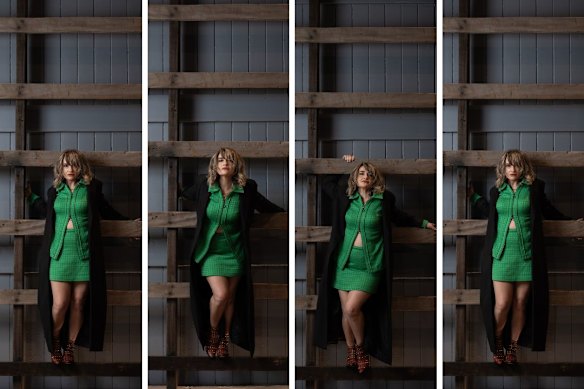
You can hear the gratitude, too, in the way she talks of her high-school drama teachers, or her love of Rock Eisteddfods as a girl. “All the new graduate teachers had to go to the country first,” she explains. “So, we got all these fresh, undecimated acting teachers turning up in the shithole of Traralgon, full of optimism and joy. It rubbed off on me.”
Harbridge auditioned for NIDA halfway through another course and got in, though she wasn’t wild about the mainstream trajectory the institution assumed. “There was this sense of pumping you out to be on MacLeod’s Daughters,” the actor admits, and although she dodged that bullet, she did her “obligatory All Saints time”.
All the while, she had “an unscratched itch” to write her own work, and her star rose when she created and performed in her first piece of musical theatre. Songs for the Fallen was based on the life of French courtesan Marie Duplessis – the source of Verdi’s La Traviata, – and it toured for years in Australia and internationally.
Being cast in Prima Facie was a shift for Harbridge, inaugurating what she calls “the trauma phase” of her career. It was a turn that would stretch her acting skills to their fullest capacity, as well as reinforcing a sense of responsibility to make sure that women’s stories were heard. The last is especially important in the area of sexual assault, most of which still go unreported, though Harbridge points to Bri Lee’s excellent memoir, Eggshell Skull, as an inspiring exception that helped her develop Tessa’s character.
How does Harbridge perform Tessa’s story safely? Music plays a role. “The show is highly scored [by Paul Charlier], and I’ve got the performance to a point where I don’t think about it. I don’t warm it in, or anything like that. I press play and go. Like a dancer, my muscle memory with the music does the job, and when I bow at the end, it’s like I’ve been through an athletic experience rather than an emotional one.”
Equally fascinating is the effect of losing the natural responsiveness, the connection between performer and audience.“Things got gnarly around COVID,” she says. “I did quite a few shows [during the pandemic] at 50 per cent houses, with people socially distanced and masked, and it nearly broke me… I started reaching for real things to get there because I couldn’t tell if I was landing [with the audience]. It was a hectic experience.”
Curtain calls at Prima Facie, and the near universal standing ovations that accompany them, testify to the emotional intensity and power of her performance. They’re also important resets for her, given the traumatic nature of the material. “Bowing does a lot for me,” Harbridge admits. “It’s saying, ‘Here we are. We’re here together. We told a story. We’re out’. That’s a very significant ritual and – this is going to sound ridiculous – the act of smiling when I bow: it’s a release.”
Harbridge smiles often, despite a frenetic schedule of performances, as well as other significant projects as writer and director over the last few years – adapting Miles Franklin’s My Brilliant Career into a musical, directing Christie Whelan Browne in the autobiographical cabaret Life in Plastic, and playing Blanche in an acclaimed production of A Streetcar Named Desire, to name a few.
Is there anything she isn’t good at? “Um, relationships,” she says ruefully. “Cooking, cleaning. I have no work-life balance, and I’m leaking collagen out of my eyeholes.”
It’s hard for audiences to regret a lack of domesticity, though, when Harbridge’s talent and drive have produced so much unforgettable, and unabashedly feminist, theatre.
Her tour de force in Prima Facie is not only a superlative acting achievement, it played an active role in changing the law, and helping the long arc of history bend towards justice.
Prima Facie is at Melbourne’s Comedy Theatre from May 20 and Sydney’s Roslyn Packer Theatre from June 3.
Disclaimer : This story is auto aggregated by a computer programme and has not been created or edited by DOWNTHENEWS. Publisher: www.smh.com.au