
We never thought much about city people when I was a child, unless it was to feel a bit sorry for them.
We lived on the land.
Yes, we powered up the lights at night by kicking to life a diesel generator in the shed, and we had to turn off a light in the kitchen if we wanted to turn one on in the lounge.
Did we envy city people enjoying reliable power and luxuries such as sewerage?
Perhaps. But there was an absence of resentment.
We could travel to the big city by a regular train if we wished, climbing aboard at our own local station.
If cattle and wool prices were up, we could fly aboard one of Reg Ansett’s Fokker Friendships, which took off every day from either one of two aerodromes in towns not far away.
We didn’t take the opportunity often.
Melbourne felt crowded. Everyone seemed in a hurry. All those houses side by side. The shops were amazing, but who could afford all that stuff?
Life in the country felt pretty good.
Politicians fell over themselves to make sure country people were content. In return, Bob Menzies’ Liberals and Black Jack McEwen’s Country Party received overwhelming support.
Protectionism was the order of the day and Britain was our big reliable market for agricultural products such as beef, wool, wheat and butter, until the UK joined the European Community in 1973 and dumped Australian agriculture like a cast-off bride.
Every little place had a doctor and at least a bush nursing hospital.
You could tell when a farmer was in town to see the bank manager. He was wearing a tie. Most towns had two, three or even four bank managers.
The news and stock reports came from the wireless, almost universally tuned to the comforting tones of the ABC.
Teachers in our town’s growing primary school and at a brand-new secondary school ran book clubs and theatre groups for the citizenry. A play or a musical was always under way.
That was then. The ’50s and ’60s.
These decades later, there hasn’t been a doctor resident in the south-west Victorian town where I was born since the 1970s, or in any number of other such places across country Australia.
The big banks closed their branches and the managers moved away years ago until a group of locals, frustrated and alarmed, formed a consortium to set up their own branch of the Bendigo Bank.
There hasn’t been a passenger train to Melbourne on the local line since 1981.
Instead, you can ride a bus for more than an hour before boarding a crowded train on the only passenger line still running between the south-west and the Victorian capital.
Many locals with serious medical problems, including cancer, must do that trip to get specialist treatment in Geelong or Melbourne. Some with dry senses of humour call the bus-train service the Big-C Express.
You can’t fly because airlines dumped services from every airport in the south-west – Hamilton, Portland and Warrnambool – years ago.
You could drive the four or five hours if you could afford the fuel, but the roads are so damaged by big log trucks that plenty of locals are dissuaded.
Country people everywhere see the vast billions of dollars lavished on new tunnels, roads, railway systems and airports in big cities and simmer, wondering aloud in the pubs that are still open why their district doesn’t get a slice of that munificence.
Step into farmhouses or homes in country towns, and the TV in the corner these days is likely to be tuned to Sky.
Sky News, the voice of garrulous conservatives and right-wing ranters after dark, has been broadcast free-to-air in regional and rural Australia since 2018.
The ABC, Sky’s commentators warn their audiences, is a taxpayer-funded mouthpiece for “woke” elites talking down to ordinary people doing it tough.
Immigrants, supported by the elites, have flooded in and caused a housing crisis while foisting suspect foreign ideologies on our nation, the Sky mouths insist.
These messages, repeated endlessly across the land, are designed to resonate with audiences that feel locked out of the main game, whatever that might be.
They are the sort of messages that worked successfully for Rupert Murdoch’s Fox network in the US to ensure Donald Trump won the presidency with his Make America Great Again hogwash.
They help explain the rise of the UK’s voluble empty vessel, Nigel Farage.
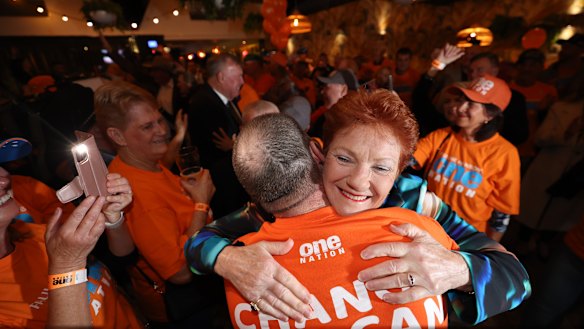
Should anyone be awfully surprised that Pauline Hanson is now ascendant in country Australia?
Hanson may have spent 30 years getting just about nowhere in the national political firmament because her messages and behaviour were so extreme that she drove even her most prized recruits away.
But gradually, her nationalistic, vacuous call to “take back our country”, amplified by conservative commentators, has been mainstreamed among the disappointed and the confused.
If nature abhors a vacuum, so too do angry or disillusioned voters who refuse to be patronised.
The Liberal and Country (National) parties that once gave many country people reason to consider themselves at least equal with city dwellers, if not superior – why, the Victorian country electorate where I grew up produced a prime minister, Malcolm Fraser – have lately done their best to destroy each other.
After the Peter Dutton experiment went south last year, the so-called Coalition blew itself to smithereens when the Nationals’ David Littleproud declared his party couldn’t work with then Liberal leader, Sussan Ley.
Now both leaders are gone, and so too is the Coalition’s old Farrer electorate. The place where Ley had been comfortably re-elected nine times since 2001 is now One Nation country.
You’d have to be as flexible as Houdini to figure out how the conservative parties might undo the knots into which they have tied themselves.
More pointedly, how might they begin to recapture those country people who have abandoned their belief in the old parties, choosing ballot-box protest at the bewilderment that time and tide has caused them?
Get the day’s breaking news, entertainment ideas and a long read to enjoy. Sign up to receive our Evening Edition newsletter.
 Tony Wright is an associate editor and special writer for The Age and The Sydney Morning Herald.Connect via email.
From our partners
Disclaimer : This story is auto aggregated by a computer programme and has not been created or edited by DOWNTHENEWS. Publisher: www.smh.com.au