
Beijing: Welcomed with a red carpet ceremony of military pageantry and pomp, US President Donald Trump was effusive with praise for his Chinese counterpart and “great leader” Xi Jinping, who used the first talks of their two-day summit to send a warning about Taiwan.
The world’s two most powerful men, keenly attuned to the optics of this high-stakes visit, projected an image of friendly rapport but had contrasting messages, before closing the doors at the Great Hall of the People to discuss the deep tensions that underpin the US-China relationship.
More restrained than his American rival, Xi said the two countries stood to benefit from co-operation and should be “partners and not rivals”, adding that “when we confront each other, both sides suffer”, in brief remarks that were open to the media.
But behind closed doors, he delivered a warning to Trump over Taiwan, which he described as the “most important issue” shaping the future of China-US ties.
“If mishandled, the two nations will experience collision or even clashes, pushing the entire China-US relationship into a highly dangerous situation,” Xi said, according to a readout by China’s state-run Xinhua news agency.
Before this occurred, Trump – the first US president to make a state visit to China in nearly a decade – lavished praise on Xi during his opening remarks, saying it was “an honour to be your friend”.
“I say it to everybody, you’re a great leader. Sometimes people don’t like me saying it. But I say it anyway because it’s true,” he said, noting he had brought top US executives with him “to pay respects to you and to China”.
Accompanying Trump’s delegation are Tesla’s Elon Musk, Nvidia’s Jensen Huang and Apple’s Tim Cook, among other business leaders, including from Boeing, which is expected to secure more Chinese orders for its jets.
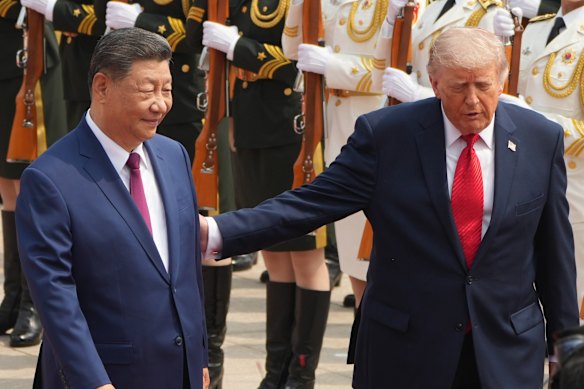
The summit kicked off with a spectacle on the forecourt of the Great Hall, the prestigious building used for China’s legislature and ceremonial events, with Xi descending the steps to greet Trump with a handshake. They then walked a red carpet together, inspecting an honour guard and pausing to admire groups of cheering children waving flags and flowers.
At one point, the US anthem played as a 21-gun salute echoed across Tiananmen Square.
Inside the building, Trump touted their meeting as “maybe the biggest summit ever” and predicted the US-China relationship “is going to be better than ever before”.
But his rosy assessment comes against a more sobering backdrop of a simmering trade feud, a race to dominate artificial intelligence, and friction over Taiwan, plus the added tension of the Iran war, all of which have intensified the two countries’ competition for power and prestige on the world stage.
Chinese and Western analysts have low expectations that the summit will secure major outcomes much beyond extending the trade truce sealed by Trump and Xi during their last meeting in South Korea in October, and more commitments by China to buy US goods.
“Both Xi and Trump need the optics right now,” said Ja Ian Chong, an expert in Chinese foreign policy at the National University of Singapore.
“Xi is facing domestic economic headwinds, wants to show some sort of ‘win’ – that he’s a big, powerful leader and Trump is a very useful prop to that end.”
Trump is also looking to lock in “wins”, arriving in Beijing under pressure to end the Iran war, which has caused a global oil shock and hammered his popularity back home. His tariff regime is also in tatters after a key component was ruled illegal by the US courts.
He is expected to announce new deals that will see China buy more American agricultural products, energy, beef and jets, and establish a “Board of Trade” to oversee those commitments.
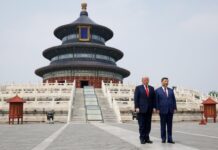
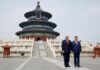
It is not yet clear whether any deals were agreed on the first day of talks, which lasted about two hours. Xi and Trump later toured the Temple of Heaven, a 15th-century World Heritage site used by Ming and Qing dynasty emperors to offer sacrifices and pray for good harvests.
Xi will host Trump at a banquet on Thursday evening, before further talks at Zhongnanhai, the Chinese leadership compound.
Before his arrival in Beijing, Trump said he anticipated speaking with Xi about US arms sales to Taiwan, with the Chinese leader expected to press him to reduce or end the military support to the democratic island.
This has triggered speculation that Trump could agree to scale back support for Taiwan, either militarily or rhetorically, in exchange for Xi using China’s influence on Iran to help end the war and reopen the Strait of Hormuz. Beijing buys 90 per cent of Iranian oil, making it a key financial lifeline for the Islamic Republic.
Speaking on Air Force One while en route to China, US Secretary of State Marco Rubio confirmed that China’s relationship with Iran would be on the agenda, though he made no link to Taiwan. US officials have previously downplayed suggestions that Trump will make any changes to Taiwan policy.
“It’s in [China’s] interest to resolve this, and we hope to convince them to play a more active role in getting Iran to walk away from what they’re doing now and trying to do now in the Persian Gulf,” Rubio told Fox News’ Sean Hannity.
Wu Xinbo, director of the Centre for American Studies at Shanghai’s Fudan University, said China certainly had some influence with Iran, but it was unlikely Xi and Trump would find common ground on how it should be used.
“When the US asks China to help to exert some influence, it usually means you should embrace our position and exert pressure on Iran. That’s not the way we think we should exercise our influence,” Wu said.
Chong said the Taiwan card would be a big concession by the US, but he doubted Beijing’s influence over Iran was sufficient to get the result Trump wanted, such as abandoning its nuclear weapons program.
“Beijing might be able to do things on the margins, but on things that are pretty fundamental to Tehran’s position, I’m not sure even Beijing has the wherewithal to persuade Iran,” he said.
Get a note directly from our foreign correspondents on what’s making headlines around the world. Sign up for our weekly What in the World newsletter.
 Lisa Visentin is the North Asia correspondent for The Sydney Morning Herald and The Age based in Beijing. She was previously a federal political correspondent based in Canberra.Connect via X or email.
From our partners
Disclaimer : This story is auto aggregated by a computer programme and has not been created or edited by DOWNTHENEWS. Publisher: www.smh.com.au