
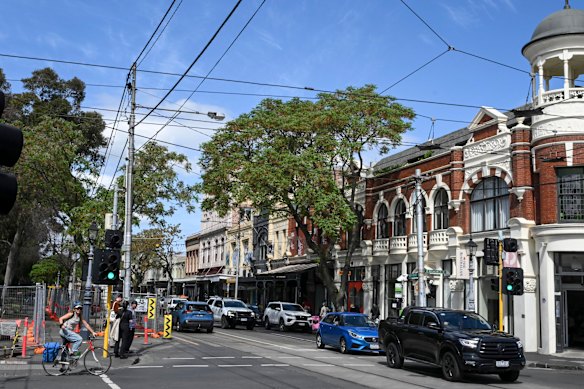

Towers of up to 15 storeys would be permitted in inner Melbourne suburbs under the final piece of the state government’s signature planning overhaul that’s designed to boost housing density close to public transport.
But the height limits for inner-city corridors in Fitzroy, Collingwood and North Melbourne are notably more modest than those implemented in middle and outer suburbs like Caulfield or Frankston, where limits of between 16 and 20 storeys have been flagged.
The plans unveiled on Thursday affect the final two of the government’s 60 designated activity centres – City of Melbourne and City of Yarra – where the government argues too much land remains locked away from residential development.
In a departure from the other 58 activity centre zones, where local councils were frequently sidelined during the mapping process, the latest draft maps are based on existing council plans, though the planning minister retains final authority over building heights.
Under the draft changes, some of the busiest pockets of Fitzroy, Collingwood, and Richmond could house buildings between three and 12 storeys along major corridors, including Brunswick Street, Gertrude Street, Smith Street, Victoria Street and Bridge Road
In North Melbourne, the Macaulay precinct is earmarked for building heights ranging from four to 15 storeys near Macaulay, Arden and Kensington train stations.
The plans do not include the Arden precinct – a major inner-city urban renewal project near the new Arden station, which is currently surrounded by industrial land.
The state government is assessing proposals from two short-listed bidders – Hampton Group and Lendlease – to become the master developer for Arden Central.
In Alphington, Heidelberg Road has been identified as a key development corridor, with heights of between four and eight storeys within walking distance of Dennis, Fairfield and Alphington stations.
Premier Jacinta Allan notably made the announcement in the seat of Kew, held by Opposition Leader Jess Wilson, while simultaneously approving a contentious 18-storey development that Wilson had opposed.
It was fast-tracked through the development facilitation program, which allows the state to override local regulations – including activity centre limits – to fast-track major housing projects.
Labor has intensified its political attacks on Coalition MPs over housing policy, seeking to portray them as “NIMBYs” locking young people out of the market. In response, Wilson has pledged to roll back the government’s activity centre planning rules and return decision-making powers to local communities.
Planning Minister Sonya Kilkenny said the inner-Melbourne sites were strategically different to the 58 other activity centres.
“That’s because already in these areas there are many, many homes, but there’s also many areas that need to be unlocked and unblocked,” she said.
“So we’re working very closely with the City of Melbourne and City of Yarra to look at those sites. Look, how can we unlock these through the train and trams zone activity centre program.”
Earlier draft maps for suburban activity centres – including in Caulfield, Oakleigh, Kew, Springvale, and Frankston – have proposed significantly higher maximum height limits of 16 to 20 storeys in designated areas.
Kilkenny said the initial tranche of priority sites within the two inner-city activity centres was expected to unlock capacity for approximately 30,000 homes, with ongoing work aimed at identifying space for an additional 70,000 dwellings across the two precincts.
Government projections suggest the broader activity centre program will eventually unlock more than 300,000 homes by 2051 in areas defined by their access to public transport, jobs, and essential services.
However, the Grattan Institute has estimated that only 110,000 homes would be financially viable to build under current market conditions.
The opposition accused the government of copying its plan to expand capital city zones into Collingwood, Fitzroy and North Melbourne.
“These are the types of areas where we actually should be building high-rise, not through the suburbs,” deputy opposition leader and planning spokesman David Southwick said.
Southwick said the state’s high property taxes and increasing cost of construction, not planning approval processes, were the real handbrakes on housing supply.
Late last year, the state government released its plans to charge developers more than $11,000 per new unit built in activity centres to help fund key amenities.
Last week’s budget revealed the government expects to make $98 million from the new taxes in its first full year of implementation in 2027-28, with revenue to ramp up to $140 million by 2029-30.
Get the day’s breaking news, entertainment ideas and a long read to enjoy. Sign up to receive our Evening Edition newsletter.
 Daniella White is a state political reporter for The Age. Contact her at da.white@nine.com.auConnect via X or email.
From our partners
Disclaimer : This story is auto aggregated by a computer programme and has not been created or edited by DOWNTHENEWS. Publisher: www.smh.com.au


