
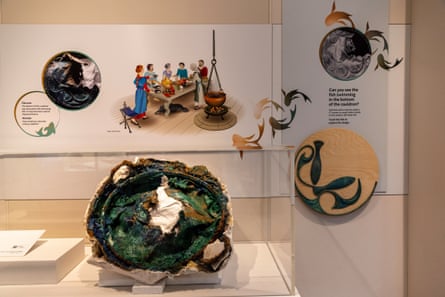
Iron age objects that tell a dramatic story of female power and which dispel the myth that northern Britain was a left-behind backwater have gone on display for the first time.
The objects exhibited in York are from the Melsonby hoard, the largest trove of iron age metalwork ever found in the UK, which experts say could alter our understanding of life in Britain 2,000 years ago.
The hoard, which comprises more than 800 items, is almost certainly associated with a tribe called the Brigantes, who controlled most of what is now northern England and whose most famous leader was Queen Cartimandua.
There are fragments of chariots, bridle bits, weapons, a cauldron, a mysterious mirror and much more – all of them deliberately dismantled and burned before they were buried. It was a “crazy amount of effort and work”, said Yorkshire Museum’s senior curator, Glynn Davis.
The hoard was acquired by the museum after it raised more than £265,000, including £192,000 from the National Heritage Memorial Fund.
It is, everyone associated with the hoard believes, an unprecedented, once-in-a-generation find. Five years after its initial discovery by a metal detectorist, the public will now be able to see what all the fuss is about.
The big question is why the objects were buried: was it to mark an important feast or festival? Did the Brigantes capture treasures after a fight? Was it for the funeral of one of their most important people?
The exhibition asks the questions rather than answering them, although its lead curator, Emily North, points to one rare object going on display – a large, heavily corroded iron mirror.
“The mirror is my absolute favourite object,” North said. “It is spectacular and that’s not because of how it looks, because it doesn’t look like an awful lot at the moment.
“It is the clue that could solve the puzzle of why people buried this hoard.”
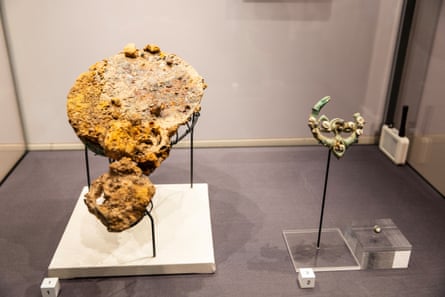
Iron age mirrors are exclusively associated with powerful women and have not been found in the graves of men or children.
North said the timing was not quite right for it to have belonged to Cartimandua but that it could have belonged to her mother or grandmother.
“It is a magical object associated with female power,” she said. “This mirror would have given quite a distorted view of the person who was looking into it.”
North said the mirror was less likely to have been an object of vanity and more seen as a “bridge to a past life”. It suggests a story of a powerful older woman “and her connection to a mystical world”.
Just under a fifth of the hoard has gone on display, with more to come in future years.
At the centre of the show is a climate-controlled case containing what has become known as “the block” – a 150kg corroded tangle of objects.
Early on it became clear that to dismantle the block would permanently damage objects in it, curators said.

“It is an incredibly tantalising object,” said North. “You can peek through the surface at some of the things that are hidden inside. There’s a stylised boar’s head that’s part of an object and also a man’s face … To see the face of an iron age Briton as they depicted themselves is something very, very special.”
From Roman times onwards, iron age life in northern Britain has been seen as less developed and less connected than in the south, but experts say the Melsonby hoard means we need to rethink that.
“The sheer wealth, artistry, skill and international connections that are revealed by the objects in the hoard really show that the iron age north of Britain was a vibrant place to be,” said North. “It was not left behind in any sense of the word.”
Disclaimer : This story is auto aggregated by a computer programme and has not been created or edited by DOWNTHENEWS. Publisher: theguardian.com



