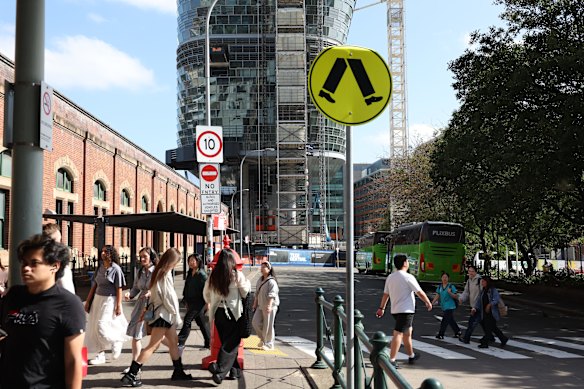
A stretch of prime land from the southern end of Sydney’s CBD to the airport and Port Botany, which new modelling shows generates $33 billion for the state’s economy each year, is under increasing pressure from competing development, illustrating growing friction between jobs and housing across the city.
Dubbed Sydney’s “quiet economic giant”, the corridor’s economic value is higher than that for a similar area in Adelaide at almost $30 billion and Parramatta at $14 billion, the modelling by SGS Economics and Planning for Sydney Airport and the Committee for Sydney think tank shows.
The “southern enterprise corridor” includes the Tech Central precinct between Haymarket and Eveleigh, which will become home to Atlassian’s new headquarters, while that for Adelaide’s CBD incorporates an area to the city’s airport and for Parramatta, the industrial hub nearby at Camellia.
Committee for Sydney head of policy Jeremy Gill said jobs and housing were jostling for space on hotly contested land in the southern corridor, which was crucial for the economy and needed “to do more than one thing”.
“These places are the engine rooms that power everything from the logistics hubs that deliver your groceries right through to advanced businesses building everything from future foods to satellites. The issue is once they’re lost, they don’t come back,” Gill said, adding there was substantial pressure on planners and policy-makers to deliver housing, which the committee supported.
“The challenge is getting the balance right. It’s important that we don’t solve one problem by causing another, and that’s what building over the city’s strategically significant industrial lands would mean.”
The tensions emphasise the dilemma facing the NSW government as it seeks to balance retention of employment and industrial zones with its uphill battle to deliver 377,000 homes by mid-2029.
One in four jobs in Sydney’s southern corridor are in the transport, postal and warehousing sectors.
However, the SGS analysis found the industrial sector’s dominance of the area is waning, citing a 17 per cent drop in transport and logistics jobs between 2016 and 2021.
Sydney Airport chief executive Scott Charlton said the southern corridor was one of the city’s greatest economic assets, and “right now it’s under pressure”.
“Once freight and industry are pushed away from the port and airport, efficiency drops, costs rise, and supply chains become harder to run. That’s the real risk here,” he said.
The corridor, which takes in parts of the City of Sydney, Randwick, Inner West and Bayside council areas, includes densely populated residential precincts such as Green Square, and suburbs close to heavy rail or metro train stations that are designated for greater density, such as Waterloo.
Gill said the stretch of land in the inner south was one of many innovation corridors in the city, from Macquarie Park, the Lucas Heights nuclear facility in the Sutherland Shire and Bradfield near the new Western Sydney Airport.
Sydney would need more employment zones with productive spaces in coming decades, particularly in areas close to other businesses, universities, services and public transport. “It’s really important we get this balance right across the whole city,” he said.
“We have this network of amazing innovation places that mean we can support businesses and industry that are key to our future economic growth – but we need to understand what they need, where they need to go, and have a plan that lays out that vision and strategy clearly.”
Gill noted the NSW government had prepared its long-term draft Sydney Plan and industrial lands policy – aimed at protecting industrial lands while delivering well-located homes – and an innovation blueprint to boost the sector and create thousands of new jobs over the next decade.
He said the next stage was “to work out how those two marry up”.
“We must have a clear economic strategy for Sydney’s role in the long-term future of Australia’s prosperity, and what that means for the different places that jobs and businesses are located,” he said.
“Then councils in those areas can understand the role their enterprise centres play in the city’s future and plan accordingly.”
Planning and Public Spaces Minister Paul Scully said the industrial lands policy would support more jobs and strengthen how the government planned, secured and managed industrial land in NSW.
“Through strategic planning we’re creating a future where communities have homes, jobs, transport, shops and services,” he said.
Scully said the government was also aiming to create thousands of jobs through initiatives such as its Investment Delivery Authority, which was formed last year to accelerate private sector projects.
Separately, the government this week said it would tweak the criteria for applications to its Housing Delivery Authority, which was formed to fast-track approvals for large residential projects, to prevent developers from lodging such proposals in the Sydney, North Sydney and Parramatta CBDs.
Start the day with a summary of the day’s most important and interesting stories, analysis and insights. Sign up for our Morning Edition newsletter.
 Matt O’Sullivan is transport and infrastructure editor at The Sydney Morning Herald.Connect via X or email.
From our partners
Disclaimer : This story is auto aggregated by a computer programme and has not been created or edited by DOWNTHENEWS. Publisher: www.smh.com.au