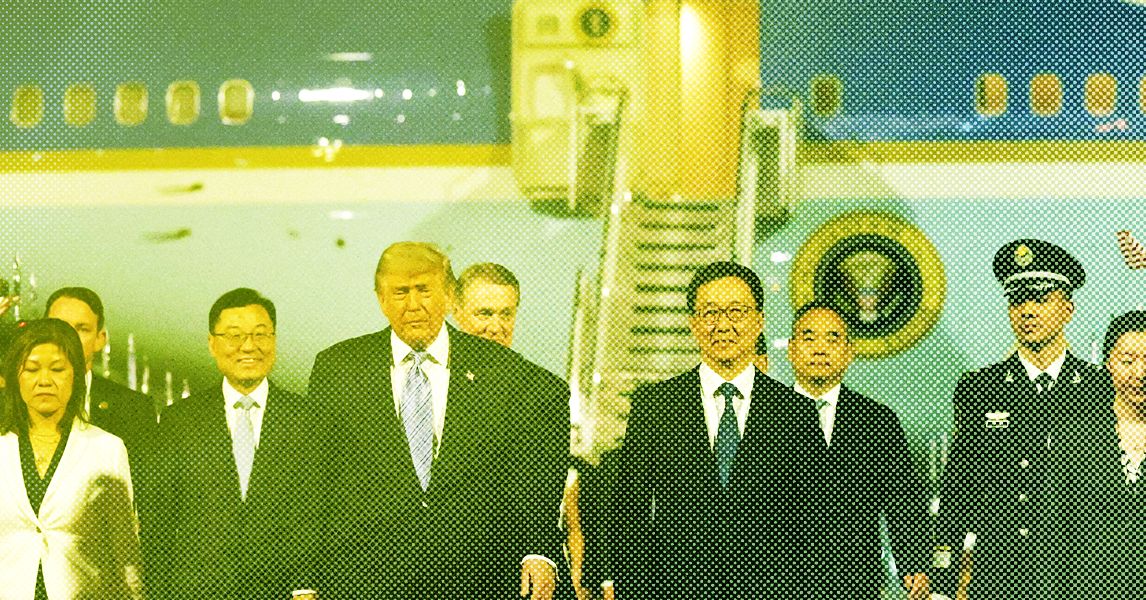
This week on Uncanny Valley, the team dives into Trump’s selected entourage for his high-stakes visit to China, ranging from Silicon Valley’s tech billionaires to Melania director Brett Ratner. We also break down the latest developments in Elon Musk’s lawsuit against Sam Altman, alleging that OpenAI abandoned its original nonprofit mission for profit-driven goals, and whether either side is actually gaining an edge in the trial. Plus, Leah shares with us some of the most outlandish conspiracy theories that have been swirling around the hantavirus outbreak.
Articles mentioned in this episode:
- Everyone at the Musk v. Altman Trial Is Using Fancy Butt Cushions
- Elon Musk Had ‘Hair-Raising’ Idea of Passing OpenAI On to His Kids, Sam Altman Says
- Hantavirus Conspiracy Theories Are Already Spreading Online
- Inside the Race to Develop a Test for the Rare Andes Hantavirus
You can follow Brian Barrett on Bluesky at @brbarrett, Zoë Schiffer on Bluesky at @zoeschiffer, and Leah Feiger on Bluesky at @leahfeiger. Write to us at [email protected].
How to Listen
You can always listen to this week’s podcast through the audio player on this page, but if you want to subscribe for free to get every episode, here’s how:
If you’re on an iPhone or iPad, open the app called Podcasts, or just tap this link. You can also download an app like Overcast or Pocket Casts and search for “uncanny valley.” We’re on Spotify too.
Transcript
Note: This is an automated transcript, which may contain errors.
Zoë Schiffer: Welcome to WIRED’s Uncanny Valley. I’m Zoë Schiffer, director of business and industry.
Brian Barrett: I’m Brian Barrett, executive editor.
Leah Feiger: And I’m Leah Feiger, director of politics and science.
Zoë Schiffer: Today on the show, we’re diving into the final week of the Musk v. Altman trial. The high profile testimonies we’ve heard this week, including from OpenAI CEO, Sam Altman himself, have resurfaced a lot of past events and a lot of drama, but we’re asking will this actually be consequential to the trial’s verdict?
Brian Barrett: Also happening this week, President Trump is headed to China. He’s accompanied by a select number of Silicon Valley’s top CEOs. We’ll discuss how their presence could influence conversations between world leaders at a moment when the economic and foreign policy stakes could not be higher for the US.
Leah Feiger: We’ll also get into the wild conspiracy theories that have been increasingly swirling around the hantavirus from wellness influencers to grifters. A lot of them have been recycling very similar conspiracy theories from the Covid-19 pandemic. We’re going to tell you what they’re sharing and also how to spot this kind of harmful misinformation.
Zoë Schiffer: So we’re wrapping up the final week of one of the most consequential and honestly one of the pettiest trials in Silicon Valley history. The one between Elon Musk and Sam Altman. The last time we spoke about the trial, we were still at the very beginning figuring out who was going to speak and what they were going to say. But now we’ve heard Musk’s team put forth their key argument, namely that Sam Altman and OpenAI President Greg Brockman deceived him by creating OpenAI’s for-profit arm instead of keeping OpenAI as a classic charity. This week we heard from some of the key people who have been central to both the past and the present of OpenAI. We’re talking about Ilya Sutskever, who’s the former OpenAI Chief Scientist, who is part of the effort to briefly oust Sam Altman as CEO back in November 2023. We also heard from Microsoft CEO, Satya Nadella, who is one of the earliest backers of OpenAI. And finally, Sam Altman himself took the stand.
Leah Feiger: Appearing in federal court in Oakland on Tuesday, OpenAI CEO Sam Altman testified that he believes himself to be, “an honest and trustworthy business person.”
Brian Barrett: Testifying for the first time in the landmark trial, Altman said that it was Musk who had sought to seize control of OpenAI and make money from it.
Zoë Schiffer: Brian, Leah, I feel like I’m so close to this. I have two reporters who are in the courtroom every single day. I’m curious for your perspective on everything we’ve heard so far, what do you think about what’s happened in this trial, which could be wrapping up at least in terms of major testimony Thursday this week?
Leah Feiger: This is must-see TV. I have been particularly taken with the Business Desk’s reporting on this and I think it was just a few days ago a piece that came out about Sam Altman’s testimony on how apparently Elon Musk was just going to hand OpenAI to his children. Am I misstating this? Did that happen?
Brian Barrett: No, that’s right.
Leah Feiger: What?
Zoë Schiffer: It was a suggestion. It was a suggestion.
Leah Feiger: What?
Zoë Schiffer: Yeah. So I mean, this is crazy. Just to back up a little bit, Elon Musk has had to convince the jury of two key things. One was that he attached special conditions to the $38 million that he gave OpenAI in its very early days and that Greg Brockman and CEO Sam Altman violated those conditions. The other one, and this is really tricky, is that he only realized that it had violated these agreements in 2023 when Sam Altman was ousted as CEO. And that’s because the statute of limitations on this lawsuit expired way before that. He left OpenAI years before. And so he’s basically trying to start the clock around the time that Sam Altman left the company and then came back saying, “I didn’t realize until then that things were as bad as they are.” I will say that from my perspective so far he hasn’t made a really strong case, but what he has done really, really well I think is embarrassed Sam Altman in many, many ways by forcing him to sit there as various people he worked with over the years basically called him untrustworthy.
Brian Barrett: Yeah. There’s been a parade of people and also text messages from the—I think a fun part about trials and the legal process is that there’s the discovery process, which means that you get to read all kinds of emails and texts—
Zoë Schiffer: The most fun.
Brian Barrett: —from when bad things are happening, may it never happen to any of us. But there was a very crowded time, I believe, Zoë, correct me here, it was OpenAI’s Sam Altman had texted Mira Murati about how things were going around the time of the lip, and she wrote back that it was directionally very bad, which was like such—
Zoë Schiffer: Yeah, this became a meme.
Leah Feiger: Oh, I mean, they’re everywhere. It’s like the screenshots of those texts.
Zoë Schiffer: It was everywhere. Yeah. I mean, what was going on at this time, this is so interesting because I feel like we went from knowing Sam Altman was ousted as CEO and everyone was like, “Why did it happen?” And literally for weeks, if not months, it was like, we probably will never know the real reasons. He was kicked out, then he came back. It’s just going to be a mystery. Now I’ve gotten to the point where I’m like, I actually know way too much. I’ve had three different incredible writers describe the look on Sam Altman’s face when he was on the Zoom at the racetrack realizing that he was no longer going to be the CEO. Mira Murati was being asked to step in as interim. She’s texting with Sam Altman on the side as she’s with Satya Nadella kind of negotiating between all of the parties. But yes, at one point Sam was, I think, very, very stressed and anxious. He was having to lay down on the floor because he was so overwhelmed with the events.
Brian Barrett: Been there.
Zoë Schiffer: And he was texting Mira, “What’s going on? ” And she classically said, “Directionally, things are very bad.”
Leah Feiger: I have to ask, obviously so much dirty laundry is getting aired here about the history of the company, about where things are now, about all of these different stakeholders. Who’s winning? I know that we are not the judges and jury here, but what can we tell about what’s been shared and how it’s been received?
Zoë Schiffer: Yeah, it’s such a good question. And I think the fascinating thing about a jury trial is we just really don’t know. Ultimately, it’s up to the judge to decide, but the jury’s kind of decisions and what it thinks about what’s been said so far will weigh heavily into that decision. And so I don’t know what the jury thinks so far, but in the court of public opinion, which I think is a really important aspect of this trial and the reason that Musk is moving forward with it in a lot of ways, I think it’s a bit more complicated. I do think Sam Altman really has a reputation as being untrustworthy and that reputation has only been cemented over the course of this trial. I think one interesting thing that I was thinking about yesterday when I was watching testimony was that Sam Altman and OpenAI has really been trying to position Elon Musk as this power hungry figure who was trying to get control of a Frontier AI lab and then bitterly filed a lawsuit when he was unable to retain that control. But my takeaway from everything I’ve seen so far is that Elon Musk and Sam Altman are actually very similar in a lot of ways. Sam Altman has this great quote about Elon Musk that he gave the New Yorker years ago where he said, “Elon Musk desperately wants to save the world, but only if he can be the one to save it.” I don’t know Sam Altman. I kind of get similar feelings about him. I do think he has these really lofty visions of how he thinks AI can improve the lives of many people and change the world in a positive way. I think it’s really important to him that he is deeply involved in that effort.
Leah Feiger: I mean, not to wrench this back to politics, but I can’t help myself. It’s been really fascinating. We were quite literally just talking about this in Slack this morning watching as OpenAI, obviously led by Sam Altman is working to introduce these state leveled regulations for AI usage and watching this in some ways level up from California and New York and Illinois from all these small little plants, but seemingly level up to this larger federal regulation landscape that is very clearly in OpenAI’s best interest. This is not regulatory in the sense that we’re all thinking of. He has a vision here and in all of the different ways. So I very much hear you on the saving the world, putting in the regulations as I see fit.
Brian Barrett: It was just a few weeks ago that OpenAI published their sort of like, “Here’s how we think the future economic systems need to work and this big policy favor, but also we’re kind of backing off of universal basic income because we think there’s probably another way, but we’ll get back to you on what exactly that is.” It is a little muddied.
Leah Feiger: Messages from above.
Zoë Schiffer: Yeah. Will Knight published in AI Lab, his AI newsletter this week, a little piece. The whole bottom of his newsletter is new research that’s coming out. It’s actually really, really interesting. But one thing that caught my eye this week was that he talked about what we know so far about regulatory capture in the AI industry and how AI companies are really involved in shaping and slowing regulations, which is something that I think is on one level obvious, but now we’re actually seeing data to back it up.
Brian Barrett: I want to go back to the trial real quick, just one more thing that I enjoyed because again, the discovery is my favorite part. Ilya Sutskever, who was an original OpenAI employee. Leah, do you want to guess what his stake was there?
Leah Feiger: His stake is worth, I’m assuming in the billions, right?
Zoë Schiffer: Correct.
Leah Feiger: Three billion, four billion.
Brian Barrett: $7 billion.
Leah Feiger: Wait, is he with them anymore?
Zoë Schiffer: No, he is not.
Brian Barrett: He’s got his own thing and he’s actually, if anything, he split with Sam Altman pretty publicly.
Leah Feiger: Why is there so much money here? Not even just for all of this. There’s just so much money. I can’t even comprehend how much money is involved here.
Zoë Schiffer: It’s so much money and we’re not even talking about Anthropic at this point, which borderline valuation could be even higher than OpenAI’s on any given day. I personally loved on Wednesday when OpenAI brought a small statue of a donkey’s ass to court and tried to include that in the official record. The judge said, “I don’t want it. We can talk about it, but please don’t give it to me because then the court has to take possession of it.” Apparently Elon Musk, when he left, had a tense interaction with an OpenAI employee and called the employee, I think it’s the current chief futurist of OpenAI or something like that, a jackass. And then this guy’s colleagues gave him the trophy as a joke. Now it’s part of the official record. So love that.
Brian Barrett: Wow.
Leah Feiger: Iconic.
Brian Barrett: Elon Musk has been very busy. This is not the only thing on his agenda. He is also one of just a few CEOs that are joining President Trump to his state visit to China. That’s the administration’s first one since almost a decade ago. In addition to Musk, you’ve got Apple’s Tim Cook or Tim Apple, as Trump likes to say, Larry Fink of BlackRock. And my favorite story around this, Nvidia’s Jensen Huang, who was not included on the trip. There were lots of news reports about how he who was not included on the trip and how he had volunteered to go on the trip and was still not included on the trip until finally he met them in Alaska and got on the plane just in time to make it to China. Persistence—
Leah Feiger: As Air Force One refueled in Anchorage. It’s just incredible stuff. You can’t make it up. You can’t make it up.
Brian Barrett: The trip was originally scheduled to happen about two months ago, but it was postponed because the US and Israel went to war in Iran and that obviously complicated all kinds of things. Now the visit comes at a time when the war is still ongoing in addition to all kinds of other hot button issues, trade, AI regulation, you name it, that involve both China and the US. They were going to do this trip at some point, but the timing still seems a little bit odd to me in that China is one of Iran’s key economic and diplomatic partners. There are so many tensions on so many levels between these two countries and it doesn’t feel like there’s any real progress in the works. You know what I mean? It doesn’t feel like we’re at a moment where, oh, we’re finally going to figure out trade. We’re finally going to figure out AI. We’re finally going to figure out how to stop hacking into each other’s systems and stealing everybody’s personal identity. None of that seems to be imminent. And I guess you only get there by talking, but I don’t know. It seems like a strange time to do this if you actually want to get anything done. So I guess, Leah, my question to you is, does anybody actually want to get anything done here? What are we doing?
Leah Feiger: It’s such a great question. I guess the first thing that I really, really want to talk about though is regardless of what the plans are here, obviously we have Iran happening. You have the chips battle, you have all of these different AI strategy machinations. But what’s really, really interesting to me as well is that I’m very much getting in some ways inauguration vibes. When Trump surrounded himself with the tech leaders, everyone’s lined up in a row and that’s not dissimilar to what’s happening right now. And it’s very, very hard to argue that it’s like, no, no, no, it’s just the tech people because we’re only focused on tech. You know who else was on this plane? Fox News personality, Sean Hannity, filmmaker Brett Ratner. He has assembled a motley crew of—
Brian Barrett: Our best and brightest.
Leah Feiger: Yeah. And so I’m just like, no, no, no, this is clearly not just about tech. This is about showing very specifically who Trump’s allies are and being able to position himself in front of a country and leader that he hasn’t spent a lot of time with recently.
Zoë Schiffer: Since we’re still talking about the people that he is going to China with, what do we know about why Jensen Huang was left off the list and then re-added last minute? Because my though when I saw it was, oh, this is about export controls and they think it’s going to be kind of weird and complicated to have him on the trip. But then obviously he is now on the trip.
Leah Feiger: So someone I cannot name, someone said to me, “Oh, I think the President may have just forgotten him,” to which I laughed.
Zoë Schiffer: Oh, you remembered Brett Ratner and you forgot?
Leah Feiger: No, I was like, “This is not true.” It’s just not even sort of true to the point where I was like, “I’m sorry, you’re expecting me to entertain this right now?”
Zoë Schiffer: I would absolutely buy that Trump forgot this man, but I’m like, “Trump has other people around him.”
Leah Feiger: This team didn’t forget this man.
Zoë Schiffer: Yes, please.
Leah Feiger: No, there’s no way on earth. I was very much just like, “Uh-huh. Yeah, yeah, yeah. Keep it moving.” And obviously guys, we have to talk about the Musk of it all. I know that Elon has been making his appearances back at a variety of White House or White House adjacent events, but this does feel like such a big moment for him to be on the international stage again by Trump’s side.
Zoë Schiffer: Did you know that Elon Musk’s mother is like low-key a celebrity in China?
Brian Barrett: Maye Musk, international model, Maye Musk.
Leah Feiger: Wait, new information. Say more.
Zoë Schiffer: People are obsessed with her there.
Leah Feiger: What?
Zoë Schiffer: Just a little fun fact.
Brian Barrett: I want to take a moment too not to get away from Maye Musk. We can talk and talk about Maye Musk all day long. About a year ago when the Pentagon set up Musk for a war briefing about what would happen if the US went to war. Do we remember this?
Leah Feiger: I do.
Zoë Schiffer: Oh, my gosh, I fully forgot about this. Yes.
Brian Barrett: The Pentagon invited Musk over to check out what the war plans would be if we went to fight China over Taiwan and that got scuttled apparently before he went. This was a New York Times report, but it is how far we’ve come and how not far. I don’t know. If I’m China, I don’t think I want to see Musk anywhere near this coalition. And if I’m Musk, I’m feeling pretty great about the level of influence I now have. Again, and then maybe I get a chance to look at those war plans again. Maybe I can sweet talk Pete Hegseth.
Zoë Schiffer: It turns out that you can imply the President is a pedophile and still get invited to China if you have enough money.
Leah Feiger: 100 percent. I mean, maybe they also forgot those expos too. Just a lot of forgetting happening all over the place.
Zoë Schiffer: I know. Beautiful for them. They’re just moving right along.
Leah Feiger: Also around this time, maybe a little bit more than a year ago, but we’re also talking about the tariffs that the Trump administration worked very hard at levying against China. So the fact that there’s an expectation of a discussion between Trump and Xi about the US-China Board of Trade, the US-China Board of Investment, et cetera, et cetera, is very, very interesting to me. And I’m sure if this all works out, Trump is just going to say that the tariffs were all—he was playing hardball and you should just read that in chapter four of his book. But I’m very curious about how this will be received in China.
Brian Barrett: Yeah. And it gets back to, are we actually going to see anything happen here? I think it seems very unlikely that a board of trade or board of investment is going to—I’d be happy to be wrong, I guess. Jensen Huang is making the trip. It seems very unlikely that we’re going to have any kind of cooling off period in terms of export controls or in terms of—China is investing very deeply in building up their own chip infrastructure and going it alone. That is a major priority for them. I think the idea that they could be—I don’t know. It just seems like we are pretty well stuck, which again, that’s what diplomacy is for is to get past these moments. But I don’t think Brett Ratner is going to get us there. I don’t know that-
Zoë Schiffer: How dare you? Did you see that Melania documentary?
Brian Barrett: Sorry. So apologies. Apologies. That’s true. I’m sorry. Sorry.
Leah Feiger: Brian.
Brian Barrett: I know you guys are huge rat heads.
Leah Feiger: Rush Hour is my life.
Brian Barrett: Yeah. But I had to say it. I had to speak my truth.
Leah Feiger: Yeah. No, I appreciate that about you always. Well, I’m really excited to keep an eye on how this trip unfolds and I’ll obviously keep you posted if anyone continues to try and spin me in whatsoever direction. But in the meantime, there is so much to talk about US side, including obviously my favorite topic of the moment, the hantavirus outbreak.
Brian Barrett: Leah, what’s your concern level right now? Before you keep going, where are you at? Because you’ve been—
Leah Feiger: Yeah. I would honestly say I’m less concerned right now than I was a week ago, but it is still definitely something I’m thinking about.
Brian Barrett: OK. I’ll take it, like a seven out of 10.
Leah Feiger: Maybe like six out of 10 even. Maybe six and a half.
Brian Barrett: Honestly, my baseline for life is like a five. So I feel like if you’re just like a notch of that, that’s great. You’re doing amazing.
Leah Feiger: I think part of it for me is, look, this is a developing situation. We had a really helpful check-in about it with WIRED’s Emily Mullin in last week’s episode and she’s put out some really good reporting in the last few days as well talking to an infectious disease expert and also looking very specifically about hantavirus test developing that’s happening in Nebraska where some of these people who have perhaps contracted the virus are being sent from the ship. So other people are thinking about this too, which is perhaps all I wanted, Brian. This was two weeks ago when I was like, “Guys, this is happening. Where is the CDC? Where is the US response on this? What is happening?” And now finally this week I’m like, “Oh, good. There’s a shit-ton of international concern.” And that’s kind of all I wanted here. I wanted attention on this. So that’s perhaps what’s making me feel slightly better about it. But I will say there’s another pattern that has really been bringing up, especially in the last, I would say five, six days or so, which is the rise of conspiracy theories around it. Look, conspiracy theories around health are nothing new. I think that we all experienced a very intense rash of them during the Covid pandemic. WIRED’s David Gilbert, this week he reported on how conspiracy theorists, wellness influencers, and grifters have all started promoting wild claims about the outbreak. A lot of them that are really using the same playbook as Covid saying that it’s another way to control the global population, pushing this false narrative that the Covid vaccine caused hantavirus and also in a very fun and not totally unexpected twist, some people are even promoting and selling ivermectin. Yes, the horse deworming drug as a treatment.
Brian Barrett: It’s back.
Leah Feiger: It’s back, with no evidence obviously whatsoever to back this claim. This has really been spreading all over the internet in all of the usual places. It’s taking on a really interesting life that while the Covid conspiracy theories very much did as well, something that’s a little bit interesting and a little bit different, at least in this very specific moment, is you’re not actually—we don’t have a Fauci that’s going, “No, no guys, this is not what’s going on.” The CDC and HHS are not built for that anymore. Like Robert F. Kennedy Jr, our lovely HHS Secretary is not getting on a public radio program every day. He’s not sitting in on the news going like, “Don’t worry, here are the steps that we’re taking, X, Y, and Z.” So this lack of communication gives so much space for conspiracy theories to grow and experts that David spoke to were just like, “This is obviously going to continue with a lack of information.” Even if other infectious disease experts are going, “This is not Covid. We’re slightly more ready for this. This is going to be OK.” But that gap is huge.
Brian Barrett: Yeah, you mentioned the playbook that they ran out, which I think is absolutely the right way to describe it. I also think of it as almost refrigerator magnets. It’s like anytime something like this happens, it’s just like, “Well, we’ll grab ivermectin and Covid and vaccine and we’ll just jumble it up in some combination that sounds scary and bad and then we’ll sell people pills to make sure that they are fortified against whatever the thing is that’s also a fake thing, but you still need to buy this thing to protect yourself.” I don’t understand how people can sort of live that way on the—like people who are clearly huckstering this, right? I think there’s like a class of people who are opportunists who foment this in order to sell supplements.
Leah Feiger: People are selling $325 contagion emergency kits, Brian. I’m sorry, that 325, that’s what’s going to be what saves you. And there’s something so upsetting about that too, because you have at the root of so many conspiracy theories is unfortunately very understandable kernels, if not of truth, but a fear. So of people being like, “I already am having health issues. The idea that the government is not telling me the truth and not sharing that information, yeah, maybe I should get this $300 kit. That’s going to do it. I already have asthma. I can’t take anything else.” And that’s so upsetting to watch happen because it’s like people, everyday folks who are just being taken in by this.
Zoë Schiffer: I mean, this is terrifying. The only reason I’m not having a full panic attack is because I talked to a random AI researcher who told me that, I think the words were that our value of hantavirus is much lower and less scary than it was for Covid. I had no idea the words he was saying, but I thought this man doesn’t know anything about what he’s talking about.
Leah Feiger: There’s so many reasons I hate that.
Brian Barrett: Our value is, I believe it’s the rate of transmission or related to that.
Zoë Schiffer: Great. Well, whatever it was, a warm bath of, I don’t need to worry about this immediately washed over me and I haven’t blinked since. But also WIRED’s reporter Emily Mullin wrote a story this week that we are developing tests for the Andes strain of the hantavirus. So Leah, where are those at and how did those tests come to be?
Leah Feiger: Exactly. It’s really, really cool reporting. Lots of love to public health officials here who absolutely just raced to make this happen, kind of wild. As passengers were returning from this cruise that saw the hantavirus outbreak of this Andes strain that can pass human to human as opposed to via this rodent transmission, there wasn’t really a test yet to be able to figure out the earliest stages of infection, like what this actually meant for people coming back, which is very difficult if you have all of these passengers returning and you can’t tell them for certain if they have it. But in just a couple of days, the University of Nebraska Medical Center, which is where in Nebraska people were getting received, a lab developed its own diagnostic test for the Andes virus ahead of receiving all of these passengers. Really, really cool. Peter Iwan, the Director of the Nebraska Public Health Lab told Emily that they think that they’re actually the only lab in the nation that has this test available at the moment. The fact that they spun it together so quickly is really just absolutely incredible and specifically that it’s able to detect very, very small quantities of the virus before people have full-blown symptoms. And that’s been part of the issue so far is that all of a sudden people were just like, it was done. It was just so much all at once. And to be able to isolate and figure out what that looks like and then also talk treatment afterwards, huge, absolutely huge, and prevent the spread, of course.
Brian Barrett: I do think people should read this story because the details are fascinating too. It was a real team effort. They didn’t just do it in a vacuum. They reached out to someone at this lab who they knew had the right kind of whatever. I’m not a scientist, but it was a coordination among three or four different labs that each of which had an element that would be able to contribute to making this test happen. Really incredible. And then at the same time, Moderna, we all remember Moderna, they’re already at work too on an mRNA vaccine if we get to that point where we feel like we need to have vaccines assuming that RFK Jr. does not put a stop to it because he thinks vaccines and mRNA vaccines specifically are bad. So we’re in a, I don’t want to say we’re in a great place because any hantavirus feels like a bad amount of hantavirus, but it does feel like we’re in a better place, or at least the competence is starting to shine through in a way that’s reassuring. That gets you to a six.
Leah Feiger: That gets me to a six, even a 6.5. Yep, absolutely.
Brian Barrett: Whoa.
Leah Feiger: I know.
Brian Barrett: That’s higher. That’s high.
Leah Feiger: Oh yeah, that’s true. Well, somewhere in that range. We’re going to take a quick break and when we’re back, it’s time for our WIRED and TIRED segment. Stay with us.
Zoë Schiffer: OK. It’s time for our WIRED and TIRED segment. Whatever is new and cool is WIRED, duh, and whatever passé thing we’re over is TIRED. Are we ready? And by we, I mean, Brian, are you ready?
Brian Barrett: I am ready. So I’m going to say my TIRED: My kids, it’s the end of the school year here, believe it or not, where I live. So I’ve got several sort of graduation ceremonies, recognition ceremonies in which parents sit in bleachers or bleacher adjacent seating and it’s very uncomfortable. So I’m going to say TIRED is sitting on bleachers for a long period of time, but WIRED, Zoë, is butt pillows.
Zoë Schiffer: Oh, thank you.
Brian Barrett: And I say that because I wouldn’t have thought of that before this week, but every fancy person at the Musk-Altman trial has been bringing their own fancy butt pillow to sit in court to make sure they’re comfortable during the proceedings. We have a story on that at WIRED, thank goodness. But I’ve been inspired by these people. They are so WIRED by giving their cushion a little cushion. That’s my WIRED/TIRED.
Leah Feiger: That’s all I could have hoped for from yours, Brian, honestly. Fantastic.
Brian Barrett: It’s true. It’s 100 percent sincere.
Zoë Schiffer: Leah, what is yours?
Leah Feiger: OK, stay with me on this and I’m so excited. You’re not going to care about this at all, Zoë, but Brian I think will.
Brian Barrett: Nice.
Leah Feiger: So my TIRED is I think that there was a period of time when I was slightly bored by the theatrical offerings on Broadway. I was still going to a lot of plays. As you guys know, that is maybe my top three hobby, but I was a little bit like, what is the larger, what are we looking at here? It was just like a lot of recast, a lot of just very same, same. My WIRED is this season of Broadway. Oh my God, you guys, it’s camp. It’s just like it’s absolutely camp. Let me take you through some of the shows that I am so obsessed with that I’ve seen recently. We are talking, I just saw Titanic, which is the Celine Dion take on Titanic. Incredibly funny, incredibly queer. It’s so, so good. Rocky Horror Picture Show—need I say more. I saw that three weeks into its run and just like mind blown. So freaking good. I’m like still melting down over it. Death of a Salesman, literally Willie Lowman is being played by Nathan Lane. I’m not sure—
Brian Barrett: I was going to say, how was that camp? And I’m like, oh yeah, I see it.
Leah Feiger: It’s camp. There’s something incredibly—and I cried at that play. It can be like camp and irreverent while still just very, very moving. I’m obsessed with this current season of Broadway. It’s all I can talk about.
Brian Barrett: You’re right. You’re right, Leah. I did love that.
Leah Feiger: Good.
Brian Barrett: Zoë, was she right that you don’t care at all?
Zoë Schiffer: I care a medium—I don’t understand why I’m being picked as the person that doesn’t like theater. I like it. I just don’t live in New York and never have, never will. That’s our show for today. We’ll link to all the stories we spoke about in the show notes. Uncanny Valley is produced by Kaleidoscope Content. Adriana Tapia produced this episode. It was mixed by Amar Lal at Macrosound. It was fact checked by Daniel Roman. Pran Bandi is our New York studio engineer. Mark Leyda is our San Francisco Studio Engineer. Kimberly Chua is our Senior Digital Production Manager. Kate Osborn is our Executive Producer and Katie Drummond is WIRED’s Global Editorial Director.
Disclaimer : This story is auto aggregated by a computer programme and has not been created or edited by DOWNTHENEWS. Publisher: wired.com