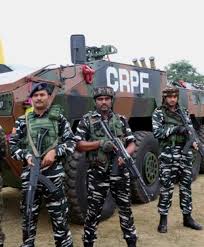
To thunderous applause, Union home minister Amit Shah extolled the dedication and efficiency of CRPF personnel in maintaining law and order across the country without caring for their personal comforts in difficult areas. He was addressing CRPF personnel on the occasion of the force’s 87th anniversary in February this year. Recounting their sacrifices, he noted that over 2,270 personnel were killed in the course of duty since its raising in July 1939. From just two battalions, it has grown to 248 battalions with a massive strength of 3,25,000 personnel, he noted, adding that it emphasised its efficacy, versatility, high operational efficiency and capability. Such encomiums are liberally showered not only on the CRPF but also other Central Armed Police Forces (CAPF), including the Border Security Force, Indo-Tibetan Border Police, Central Industrial Security Force and the Sashastra Seema Bal. The Assam Rifles, the Centre’s oldest armed police force, in manned by Army officers for operational purposes though administratively under the Union home ministry.
It is the CAPFs who were instrumental in exterminating the Maoists once and for all. But sadly, the services rendered by these forces recede into oblivion when it comes to looking into their welfare. Nothing is more demoralising than depriving thousands of officers and other ranks of promotions. More so in the uniformed services, where the ranks on the shoulder straps or the chevrons on the upper sleeves of uniforms matter the most. Officers who join the CAPFs as assistant commandants languish in the same rank for over 15 years while those in the defence services earn at least three ranks and IPS officers sport the rank of DIG within that period. Disheartened, the officers of the CAPFs have knocked on the doors of the high courts and the Supreme Court.
Some favourable court decisions raised their hopes of better days ahead. After prolonged hearings for over a decade, the apex court ruled that the deputation of IPS officers to the CAPFs be “progressively reduced” within two years. This was in conformity with the Organised Group A Service (OGAS) status granted to the CAPFs way back in 1986. But instead of abiding by the court’s decision, IPS officers continued to be placed there. While dismissing a review petition by the Centre in October last year, the apex court directed that cadre review of all CAPFs be carried out within six months.
To circumvent the ruling, the Centre brought in the Central Armed Police Forces (General Administration) Act 2026, under which the present quota of 50 per cent of posts of IG, 67 per cent of posts of additional DGP would continue to be held by IPS officers, leaving the rest for cadre officers. The Special DG and DG posts would be the exclusive preserve of the IPS cadre. Thankfully, the new law was silent on reserving posts for IPS officers in the rank of DIG, which was earlier fixed at 20 per cent. It was hoped that cadre officers could now be promoted to DIG. But in violation of the apex court verdict, IPS officers of DIG rank and commandants were indicted into the CAPFs even after the new law came into force.
A wave of despondency set in among CAPF personnel as the bill was introduced and retired officers held protests in New Delhi and elsewhere.
For their bravery, thousands of CAPF personnel have been awarded gallantry medals, including the Chakra series, except the Param Vir Chakra, and the President’s Police Medal for gallantry, the Police Medal and even Sena Medals. BSF and CRPF personnel acquitted themselves well in bravely repulsing Pakistani soldiers. No IPS officer ever led them in the field.
While the Centre may claim IPS officers are competent to take up the leadership role at higher posts, the cadre officers are in no way less competent. They are in fact better suited for the leadership role in higher ranks for their better understanding of the nature of duties and ethos of the organisation, by way of commanding the men from the grassroots level as company commanders and then serving in different capacities on getting promoted to higher ranks. The kind of leadership that can be provided by CAPF officers by virtue of having been with them in all operations and living among them cannot ever be given by IPS officers parachuted into these forces at the top echelons.
IPS officers claim they can be channels of better coordination with the state police to carry out operations. Nothing could be farther from the truth. If it was so, they should have been deputed to the Army and Assam Rifles which are engaged in counter-insurgency operations and even in the highly sensitive areas of Jammu and Kashmir and in the Northeast. CAPF battalions carry out operations under the command of battalion commanders in coordination with superintendents of police and there are instances galore where CAPF personnel have carried out operations independently and successfully. The deputation of CAPF officers as SP (Operations) in states like Punjab and Jharkhand proved to be very successful. The number of gallantry medals awarded to CAPF personnel vis a vis IPS officers speaks volumes of the competence of the former. The present lot of IGs from the CAPFs, who constitute 50 per cent, are already coordinating admirably with the state police forces, leaving no room for any debate.
The over 10-lakh CAPF personnel look to the Centre to ease their hardships, not add to them. A conference of senior CAPF officers, likely to be chaired by the Prime Minister, is reportedly being planned in view of concerns over the promotion prospects of cadre officers. This has raised hopes for better days ahead, as every CAPF officer aspires to lead the organisation one day.
The writer is a retired CRPF IGP
Disclaimer : This story is auto aggregated by a computer programme and has not been created or edited by DOWNTHENEWS. Publisher: deccanchronicle.com