
In four decades, Sydney’s nightlife has decayed from its golden pub-rock era into a ‘spaces-for-hire’ city. These are the people trying to revive it.
When travellers asked Yağmur Ilkyaz what her home city was like during a solo trip through Europe last year, she found herself repeating the same melancholic line. “I love Sydney. The beaches are great, but there’s just nothing on.”
“Every time I would come back to Sydney from travelling, I would be so depressed,” the 27-year-old marketing specialist and social media content creator says. “I’d be like, ‘Oh my God. I’m back here. Nightlife is dead. People aren’t outside.’ I just wanted to get over that feeling.”
So to ease “that feeling”, Ilkyaz began uploading weekly gig guide videos to a social media account in January and used her own refrain as inspiration for its name: Nothing on in Sydney.

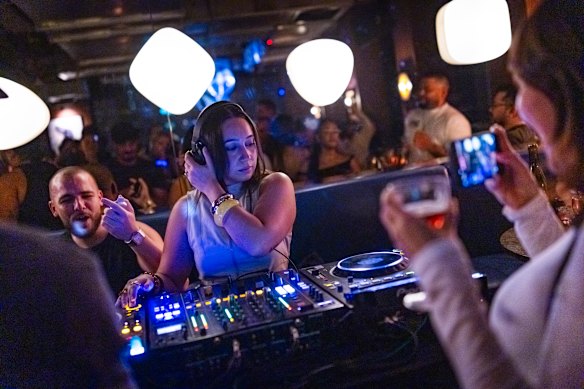
On a warm autumn Saturday night, the Herald went to a gig with Ilkyaz that she listed at the top of her guide. “Someone once told me that all my events are baddie events,” the 27-year-old says en route to an SES Radio event at Disco Pantera in Circular Quay. She wears an effortlessly cool plunging black camisole and leather knee-high boots. Her bangles clink like chimes each time she moves.
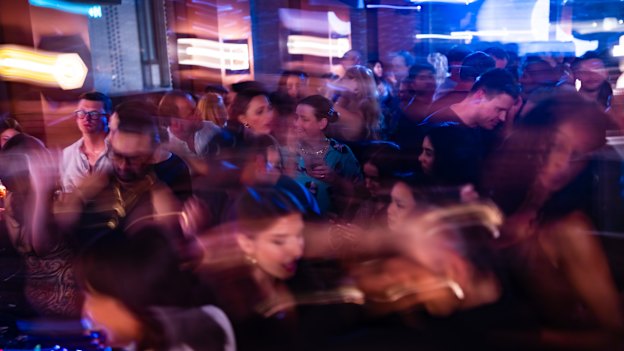
From inside a sea of swaying shoulders dancing to R&B and Hip Hop, it’s difficult to conceive of Sydney as a no-party city. But on the trek to the club two weekends ago, the city exposed only its bones. Tourists holding Louis Vuitton shopping bags explored mostly barren CBD streets, while buskers and religious preachers filled the downtown with noise. Its heart remained hidden.
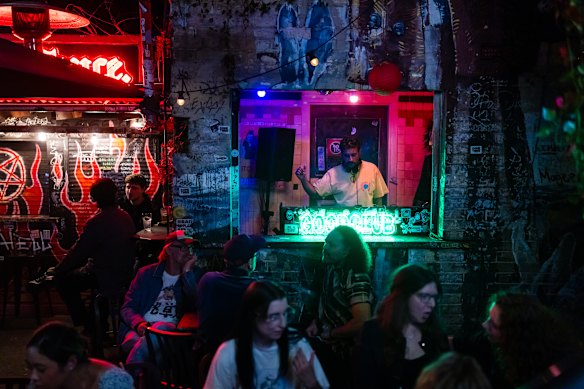
Across Sydney, hundreds of live music events ranging from techno to R&B, punk and reggaeton are relished by thousands in warehouses, pubs, bars and clubs. The problem? Only people in the “know” know what’s happening and where to find it.
Lockout laws in 2014 shattered the messy (and sometimes red-hot) nightclub strips in Kings Cross that came to define Sydney’s nightlife. Despite the abolition of those laws, the mechanics behind our city’s nightlife remain fundamentally rewired – much has moved underground, gigs are often at sporadic events rather than established venues, and they get little mainstream attention.
‘Sydney has been thirsting for something to do’
There’s no shortage of gig guides. If you search “what’s on in Sydney”, you will see dozens of lists compiled by government agencies, media organisations and creative bodies. This is in addition to the plethora of newsletters offering guides curated by record labels, event organisations, and venues.
But these online listings, predominantly curated by institutions and algorithms, feel “strangled”, rock journalist Mark Mordue says.
Mordue, 66, began writing for the magazine On the Street in the thick of Sydney’s pub-rock golden era when free “street press” magazines contained pages of gig listings for the week, spanning the whole city. In the 90s, he was working for Drum Media.
“In the 80s and 90s, and it carried on well into the 2000s … there was a kind of random sensibility going on,” he says.
“Where when you stare at a page or a couple of pages, things jump out at you that have nothing to do with bands that you’re interested in, but have to do with artwork, that have that to do with the way a name is written, that have to do with the name itself, and venue, and venue character as much as the bands too – because certain venues had certain characteristics to them.”
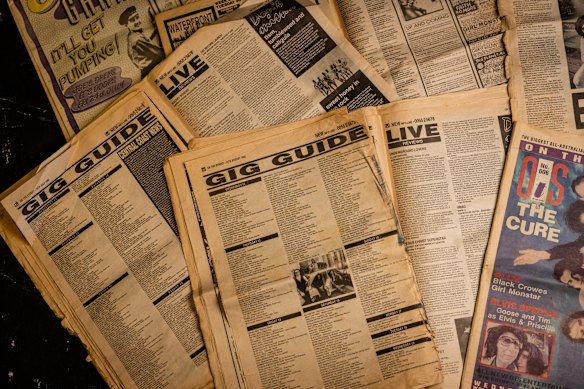
Those highly influential print guides are gone. But community-led online gig guides are a new and growing front, collated by passionate individuals operating independently, listing events that host local, budding artists that commercial guides might miss.
Ilkyaz, who has gained thousands of followers across platforms in the last five months, says she feels “like Sydney has been thirsting … for something to do”.
“It’s almost like we’ve been in a drought … and I mean this in the least condescending way possible … I’ve come in with a little bit of water, and all of a sudden, people are like, ‘Oh, my God, give me that water’.”
Mordue is not surprised audiences are engaging with online and social media guides created by people like Ilkyaz. “It’s the same principle [as the street press] that people directly involved in the culture, that people who care … about events, they’re the people who know what’s going on,” he says.
In late 2023, technology consultant Karan Dwivedi started an online website called Gigged Out after feeling overwhelmed seeing 40 hyperlinks to gigs pasted straight into a Facebook group called HATS (House and Techno Music Sydney) every week with no themes or guidance.
Dwivedi was soon contacted by a software engineer, Ata Bal, who offered to create a mobile application for the guide. On it, Gigged Out’s royal blue logo flashes upon a black backdrop, giving it a sleek, futuristic vibe. Events are categorised as “fresh [and] new”, held in “open air” settings, and there’s a “for you” curation for members based on their artist and genre preferences. Now, their guide has 1000 monthly viewers, and nearly 4000 users have signed up.
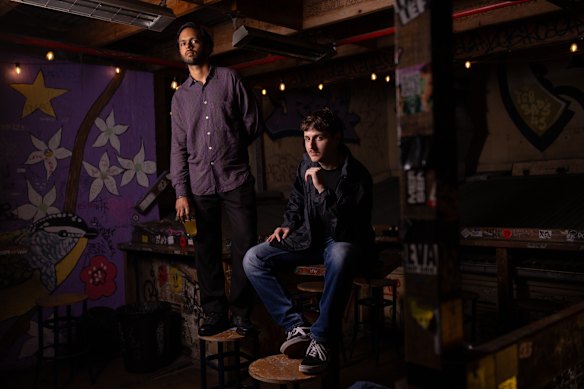
Bal says Gigged Out’s growth is accelerating each day from word of mouth. “We are a trusted source of underground electronic music in this huge city,” Dwivedi says.
For this article, the Herald tagged along to a gig each with the creators of three community-led guides. We meet Joe Hardy and Caitlin Welsh, who are two of the three co-founders of one of Sydney’s largest community-led gig guides, SydneyMusic.Net, at an Olivia’s World gig at Petersham Bowling Club.
At about 10pm, a small group of tipsy revellers at the gig approach the photographer and asks if she is there to shoot the band.
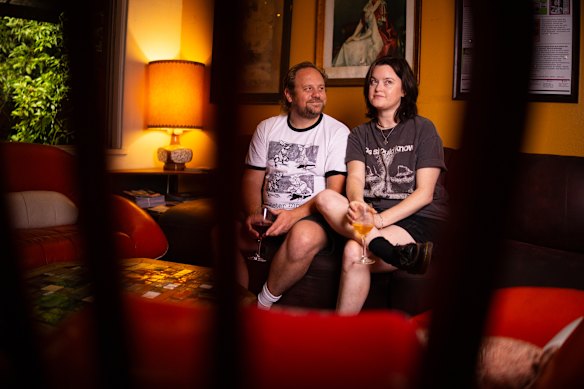
When they hear we are doing a story about gig guides, they tell us their favourite is SydneyMusic.Net, so we point over to Hardy and Walsh (who were a few metres away) and tell them they created it. “I love your guide, I tell everyone about it,” one woman gushes. “You always have the best events.”
Similarly, in the Circular Quay club, one patron approaches Ilkyaz every 10 minutes to tell her she is the reason they are here.
Community-led gig guides are becoming more popular because audiences are seeking thoughtfully produced lists, Hardy says. “It’s mostly about time – the time that it takes to actually discover and understand what’s going on with all of these events.”
Gigged Out selects a new artist each week from the electronic music community in Sydney to create its weekend guide for Instagram because “we wanted to avoid any favouritism or bias influencing our gigs,” Dwivedi says.
Ilkyaz says she only lists gigs she believes resonate with her audience from submissions received directly from artists and venues. A quarter of SydneyMusic.Net’s guide comes from submissions, while the team combs through a master list of venues to see what events are on every week for the bulk of the guide. SydneyMusic.Net also employs four casuals who attend gigs and gather information about where people are going and who they are seeing.
SydneyMusic.Net is a not-for-profit, which Hardy says is intentional as his team wanted to create something of value that cannot be sold. It has 35,000 readers each month and has grown organically 54 per cent year-on-year from word of mouth.
It launched in March 2022 because, Hardy says, the team was concerned about the direction music, media and arts journalism was headed.
“There was less and less [journalism], and in particular, a lot of market consolidation was actually reducing the opportunities for music writers to be commissioned and paid,” he says.
“The arts and media industry has become a lot more PR driven … there’s less active exploration and trying to uncover what’s happening out there.”
Sydney: ‘A spaces-for-hire city’
Sydney’s nightlife is bursting at the seams with exciting events and more venues are hosting live music. But it lacks established venues acting as consistent hubs for different subcultures, leading to artists playing sporadically across the city and news about gigs struggling to break into the mainstream.
And the event’s space is confusing to follow. When the Herald went to the event at Disco Pantera it was only the second time SES Radio – the name of DJ Buse Sagaga’s events company – had hosted at the Circular Quay club this year, after going between different clubs around Potts Point, Surry Hills and the CBD.
“When I was first coming up on the scene, you would gravitate towards a space,” Hardy says. “And then you would frequent that space, even if you didn’t know what was being put on there … now Sydney has become much more a spaces-for-hire kind of city, which means that you don’t actually get to develop an attachment to a venue.”
Sydney’s inner west and inner-city have experienced the highest growth in live music venues. Since March 2023, there has been a 320 per cent surge in venues accessing live music incentives, according to NSW government data.
While these reforms aim to revive Sydney’s live music venues, Hardy says the long-term effects of the lock-out laws and the pandemic have created a supply-and-demand issue.
“Sydney’s No.1 problem is that it has a demand problem,” he says. “We’re trying to fix that problem by making it so it isn’t exclusive – that the information is available to everyone. We’re trying to democratise that information.”
Ilkyaz says the exclusivity problem is locking people out of Sydney’s creative scene: “I think this gatekeeping of creativity and the music space is not helpful to anyone – it’s not helpful to the general population that wants to have a good time.”
Sydney is in a music ‘renaissance’
Mordue has mixed feelings about the phrase “there’s nothing on in Sydney”. “My impression is that the Sydney music scene is totally happening,” he says. “I’m older, and I’ve got loads of older friends online on Facebook, saying, ‘Blah, blah, music’s no good. It’s all f–ked now’ … I just think that’s totally wrong. I think there’s actually a renaissance happening now, but it’s mostly underground, and it’s partly because it has no airspace [helping it to become mainstream].”
Community radio stations, such as FBI Radio and 2SER-FM, hosted by mostly younger music enthusiasts who play lesser-known and local tracks, are partly fuelling this “renaissance”, Mordue says. “But they’re in trouble,” he adds, referring to their funding issues.
For Ilkyaz, starting her online gig guide has introduced her to a new world in Sydney – one she believes everyone should be able to access.
“Being on the dance floor is such a unique experience of socialising and meeting people,” she says. “I think humans are inherently very social. So, having a bustling nightlife where people are open and interested in dancing and meeting new people – I think it’s good for our mental health.
“When I have a good night out, when I meet new characters, unlock new characters in my world, I always feel super fulfilled. I feel inspired meeting new people in different worlds.”
Must-see movies, interviews and all the latest from the world of film delivered to your inbox. Sign up for our Screening Room newsletter.
Disclaimer : This story is auto aggregated by a computer programme and has not been created or edited by DOWNTHENEWS. Publisher: www.smh.com.au


