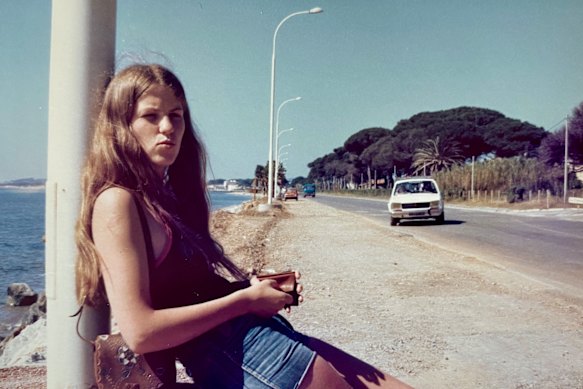
When I was a kid, I wanted a dad who wore a suit. I wanted a dad who liked the footy too, and who knew the shitty pop music the cool kids listened to, and about the inoffensive but manly celebrity who made films with car chases and explosions. My dad was cut from a different cloth. He listened to Mongolian throat singing in the car, he hated sport, he rented Delicatessen for my sisters and me to watch during the school holidays. He practised yoga, he went to a Buddhist group, he learnt sumi-e and a monk came to our house to buy one of his paintings.
When I was a kid, I wanted a mother with legible handwriting and neat hair, who would wrap our lunchbox sandwiches in tidy wax paper folds. I wanted a mother who named her children Amelia or Rachel rather than the hippyish but perfunctory four letters we were each gifted. But my mother, too, was from some other place where the women wore their hair long, where there was always study and books, ideas pouring forth, and where we were invited to make up our own minds about existence, spirituality, the universe.
This was in Geelong, in the 1980s, in a house that needed stumping, then replastering, then painting, and where a budgie called Sam hung in his cage from the Hills Hoist. There were heroin addicts in the house next door. They were loud and chaotic and wanted blankets. They cased our house and stole our picnic rug.
My parents didn’t have money, but they had both finished high school and gone on to further education. This had the unfortunate effect of cracking their worlds open so that their minds were flooded by new and unconventional ideas, the ideas that tend to drive a wedge between generations. We never discussed it directly, but I suspect they consciously raised us the opposite of how they had each been raised.
I wanted a mother with legible handwriting and neat hair, who would wrap our lunchbox sandwiches in tidy wax paper folds.
It was a house filled with creative frustrations. My dad painted, but also couldn’t paint because there wasn’t time, because he had a day job, because there were children, because there was noise. He played guitar in the room we weren’t meant to go into. He played with other musicians. He had a radio show. He got a studio to paint in.
My mother cared for us, and wrote, and burnt incense, and studied and worked and submitted my writing to competitions in magazines that don’t exist any more. She read me Oscar Wilde, T.S. Eliot and The Aeneid. She made vegetarian food for three vegetarian children. This was all that any child could have asked for. It was perfect, we were never wanting for anything – until we realised that we were different and craved the things other children had.
We asked our parents if we could go to the Gold Coast for a holiday. They looked repulsed but said, “Maybe one day.” I asked if I could change my name to Jennifer, and my mother said, “Yes, when you turn 18.”
I think the word that best describes my upbringing is bohemian – or maybe bohemian adjacent is better. In Geelong, before tofu and yoghurt were readily available, and when the idea of not submitting your children to religious education was unusual, their decisions raised eyebrows. But the philosophies they adopted were also utterly benign. Yes, we met eccentric, sometimes volatile personalities, and were the bored, tired children under the tables at the exhibition openings. Yes, there was life drawing and mental illness, but there was also a protective boundary around us, long before the concept of boundaries was mainstream.
In my adult life, in both professional and personal settings, I have had glimpses of how things could have turned out slightly different, slightly darker with similar, less alert parents; and I have reflected on some of the people my sisters and I encountered along the way, and how they may not have escaped unscathed.
I recall one weekend when the whole family went to visit a commune for a religious sect. We were shown their sleeping facilities (40 or so bunk beds in one room), we ate a vegetarian dinner, my dad got a free haircut. At the time, I thought of it as a pseudo utopia; now, having spent many years practising law and reading child protection reports, I see it differently.
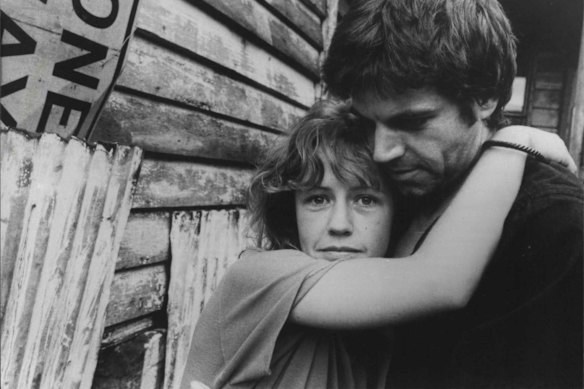
Shortly after I started working in family law, I read Monkey Grip for the first time. I remember talking to my mother about it, about my outrage at the choices of Nora; at her exposing her daughter to the feckless Javo and dragging her from party to party. I wanted Nora punished; I nurtured a visceral and intense hatred for her. My mother wasn’t going to defend the drugs that the daughter is exposed to, but she did remind me that my sisters and I spent any number of hours at parties or band nights or openings. “People did that back then.” Nonetheless, my righteous anger, my indignation at the choices of Nora, her friends, her lovers, stayed with me and eventually became the foundation for my second book, The Missing Mother.
My husband and I bought a house that needed restumping, replastering and repainting. There was a rooming house next door that became a squat. One night, a guy came past looking for it, and finding it demolished, left his drugs and a gun behind. “This house reminds me of McMillan Avenue,” my mother said in passing, and I thought, “Oh.”
My husband plays guitar and entertains our strangely named children, while I complain that I don’t have the time, or the space, or the headspace to write. I email teachers to advise that my boys are vegetarians, and that they are forbidden to have the jelly on offer when phonics lessons turn to “J”, and I read them Oscar Wilde at bedtime. My son asks if we can go to the Gold Coast and we say “maybe” in a way that means “never”. I have become my father, I have become my mother. I am forever grateful.
The Missing Mother is out now.
Disclaimer : This story is auto aggregated by a computer programme and has not been created or edited by DOWNTHENEWS. Publisher: www.smh.com.au