
When I was seven years old, my grandmother and I used to give each other language lessons after dinner.
We sat in the dimly lit outdoor area of our Sunshine Coast home that overlooked the canal.
I’d teach her a word in English, and she’d teach me one in Nepali. I only managed to learn a total of five words before she passed away.
My paternal grandmother, who we called Maa, was born and raised in Kathmandu.
She never held a professional job and was illiterate. Our lives couldn’t have been more different.
Despite that, we still felt connected. She had seven children, five surviving, one of them my father, who immigrated to Australia in 1988.
My father is among the 0.2 per cent of Nepalese immigrants who arrived in Australia before the ’90s.
He was the first in his family to make the journey, but in the decades since, 15 family members have immigrated to join him.
When Maa moved to Australia to be closer to my dad and uncle in 2006, she swapped bazaars for beaches.
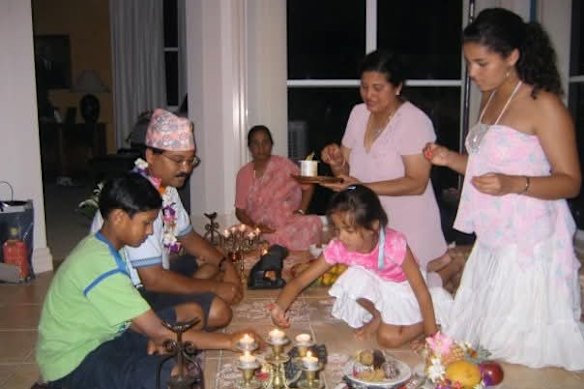
There were many things I didn’t understand about her – her words, why she wore a sari every day, or the Hindu gods she prayed to morning and night.
Yet people always noticed how similar she and I were.
Like so many others, my family’s journey to be mixed started with a love story.
My mother, an outgoing and friendly nurse from rural Queensland, met my father, a studious doctor from Kathmandu, Nepal, at Expo ’88. The rest is history.
I grew up somewhere in the middle, with my life so far removed from what half of my family experienced in Nepal, yet not at all the same as my white Australian family.
My sister and I were the only mixed-race kids on both sides of our family, putting us in a unique position.
For me, it seemed easier to try and do my best to fit in with my predominantly white Australian peers than to open up the Pandora’s box that was my Nepalese heritage side.
But I had Maa. She represented a clear link to Nepal, merging my two worlds while living with us.
She’d accompany my Mum to pick me up from school in her sari, cook traditional food like dhal bhat rich with cumin and turmeric (Nepal’s national dish of rice and lentils) and apply argan oil to her waist-length hair every night.
When she passed away suddenly in 2007, I no longer had that reference point for this huge, and now gaping, part of my identity. My Nepalese lessons came to an end.
Throughout my childhood, I avoided questions about race and feigned disinterest in anything Nepal-related.
My cultural identity wasn’t too much for Australia to understand; it was too much for me to understand.
When I tell people I’m half Nepalese, their eyes light up. They tell me how they love the food, the people, and how they’ve always wanted to see the Himalayas.
It’s taken me decades, but now, at 26 years old, I too am excited by my heritage.
I’ve journeyed to Nepal with my partner and friends, introducing them to my extended family, trekking through the Annapurna ranges and celebrating festivals together.
Despite all the grandeur we’ve seen, the most special place, to me, is the rooftop of my uncle’s house in Lalitpur.
From here, you can see the white-capped Himalayas framing the foggy city and red clay buildings as far as the eye can see.
It’s a spot where I’ve enjoyed countless cups of chai in the early morning, watching the neighbourhood come to life.
Small children with oversized backpacks wander to school, and market vendors pack rickety carts of fresh fruit to sell. The warm energy and lightheartedness of the Nepalese always remind me of the Australian way of life.
I love Nepal fiercely, but there’s always a voice inside my head that says I’m not Nepalese enough to claim this side of myself.
I still don’t understand the language besides those five words Maa taught me, and still haven’t perfected a Nepalese chicken curry.
But it’s the same feeling on my Australian side – at face value, with my dark hair and brown skin, I’m not totally white Australian.
When I started a new school at 12 years old and unpacked a pencil case covered with drawings of kangaroos and koalas, a student assumed I was an immigrant.
“I thought you weren’t going to be able to speak English,” she said, gesturing toward my pencil case as if I’d bought it recently to mark the beginning of my Australian journey.
Suddenly hyper-aware of how I looked different to my predominantly white peers, I felt like I wasn’t Australian enough to be accepted.
It felt as though my grandparents’ endeavours in central Queensland and my thick Australian accent weren’t enough to be a “serious” Aussie.
Though it was never said aloud, it became clear that to be viewed as an Australian, my skin needed to be white.
Throughout this process of figuring out my identity, I’ve learnt that who I am won’t fit neatly in a box.
It’s a complicated amalgamation of Nepalese traditions and memories with days spent at the beach smothered in Banana Boat sunscreen.
At times, it’s messy and confusing, but it’s wholly my own experience and it doesn’t need to make sense.
Nepalese immigration continues to boom – according to Australian government statistics, it increased by almost five times between 2014 and 2024 – which means more mixed families will inevitably begin to make their lives in Australia.
A lack of racial categories in the census makes for difficult reporting around the number of mixed-race couples and families.
However, one researcher estimates that 7 per cent of the population is made up of mixed race individuals.
Western Sydney University’s Challenging Racism Project notes that mixed-race people still remain on the margins when it comes to social cohesion and racism research.
Anecdotally, I know that other mixed kids have experienced feelings of loneliness, isolation and have struggled with their sense of identity.
I’ve always been a budding writer. My parents will be the first to share that I was always scribbling on any piece of paper I could get my hands on.
But there was always one story I came back to, and it’s this one: the story of my experience growing up feeling torn between two worlds.
After lots of scribbling and self-doubt, I ended up self-publishing my story as a children’s book called Neelam’s Heart.
Even though I’ve changed the protagonist’s name, Neelam is based on my own life. It’s what my Dad called me as a child, and still does to this day. The story is a simplified and neat version of what I’ve learnt over my 26 years.
On Neelam’s 10th birthday she receives a special locket that takes her on a journey to outback Queensland and to the bazaars of Kathmandu. It’s on this journey that she learns home is not a place but a feeling.
When I decided to publish Neelam’s Heart, I had family members on both sides confess that they never thought about my mixed experience.
To them, I was Neesha – just another member of the family. They had no idea about the challenges I faced, and I don’t blame them. I’m only just facing them myself as an adult.
If I could go back in time and give little Neesha some advice, here’s what I’d share: being mixed-race can be your superpower. You have family across the globe and a treasure chest full of traditions and stories to uncover.
Your most cherished family memories will include making mandalas out of multicoloured powders during Diwali, and birthday blessings with red tikkas and boiled eggs.
Being “half” of something doesn’t mean you’re not whole.
Start the day with a summary of the day’s most important and interesting stories, analysis and insights. Sign up for our Morning Edition newsletter.
From our partners
Disclaimer : This story is auto aggregated by a computer programme and has not been created or edited by DOWNTHENEWS. Publisher: www.smh.com.au