
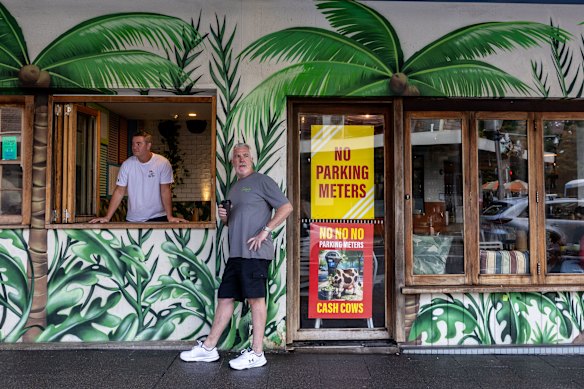
It was touted as a more equitable way to fund the upkeep of some of Sydney’s most popular stretches of sand, but furious residents say there’s nothing fair about a council plan to install paid parking meters at eastern suburbs beaches.
Randwick City Council is facing a backlash over plans to introduce parking meters for visitors to beaches at Coogee, Clovelly, Maroubra, Malabar, Little Bay, La Perouse and Yarra Bay, while issuing free permits to residents.
Clovelly resident Joe Hancock is among critics who believe the council has been hell-bent on introducing meters despite a wave of opposition from many ratepayers and small business owners.
“It’s so clearly a cash grab, even though they’re saying it’s not. Beaches should be free for everyone – not just a privileged few,” Hancock said.
Other than Coogee, the beaches are among the few with free visitor parking in Sydney. Parking spots at the city’s beaches have increasingly come under pressure from crowds, mostly at the height of summer.
Randwick Mayor Dylan Parker said there was strong community support for the meters, and more than half of residents who responded to a council survey backed the changes. But opponents have poured scorn on the consultation process, arguing that it was flawed and did not accurately represent residents’ views.
In March, the council proposed charging out-of-area beachgoers to help fund $23 million in yearly beach maintenance costs, and the plan was open for community feedback until mid-April.
Hancock was concerned that the results of the survey, which was online and letterboxed to more than 50,000 residents, had been “clearly designed to steer the outcome in favour of metered parking”.
He said the 11-question survey was accompanied by a glossy brochure “selling the idea”.
“It soon became very apparent to me – this is not a survey, this is a sales pitch,” he said.
Hancock, who said the survey asked leading questions and appeared vulnerable to duplicate entries, requested that Sydney polling expert Chris Lonergan look at the questionnaire material. Lonergan said community consultation was “a valuable process, and the council should be applauded for this”.
“However, the methodology used in this survey means that it should not be interpreted as representing the views of Randwick City Council residents,” Lonergan said.
Parker said the survey of 12,000 respondents found 54 per cent supported the proposal, 41 per cent were opposed and 5 per cent were neutral. He said that plenty of residents had stopped him in the street to quietly voice their support for the paid parking meters.
“Because there has been a lot of public discussion, there is a level of trepidation to expressing that support, but we are confident that the data reflects strong community support,” Parker said.
“Any conversation around parking evokes strong feelings in the community; however, it is reassuring to see that a majority recognise that the proposal is fairer and will make it easier to park.”
The council reported a phone survey of 600 residents showed 64 per cent were supportive and 28 per cent opposed. When visitors were asked about the proposal, their general feedback was that they would still visit with paid parking, but it would be for much shorter time periods, Parker said.
The council had initially suggested one free permit be granted for each household, but it said staff were preparing a new proposal with more than one permit per household after a backlash.
The parking meters were considered to manage demand for parking, boost turnover and generate a predicted $6 million a year from visitors to contribute to maintenance costs, the council said. This would help to fund new beachside amenities, buildings, walkways and surf clubs.
Hancock said that paid meters would heap costs and stress on beachgoers year-round, when parking was an acute problem only for a few weeks at the height of summer.
“We just don’t want them at all – they’re ugly, they disrupt the natural flow of people being able to go to the beach. We’re talking about seven public beaches and thousands of people and families.”
Coogee Courtyard cafe owner Dave Martin said the meters would hurt struggling small businesses.
“Having to pay to go to the beach is the last thing the community needs.”
Karon Lekeu, of Clovelly, said the “user pays” proposal was at odds with the council’s social inclusion and multiculturalism policy, which went on exhibition in April and emphasised the need to ensure free and equitable access to public spaces for people of all socioeconomic backgrounds.
“Parking will cost $10 or $20 an hour, and a low-income family can’t afford that, and they certainly can’t risk getting a parking fine.
“Randwick is a very affluent LGA. I think we really start to drive a wedge between the haves and the have-nots. It feels very much about othering people, and saying: ‘You’re not one of us’.”
South Maroubra Chamber of Commerce president Richard Walsh said a petition against the proposal, which he had left on his pharmacy counter, had garnered 1200 signatures in a few weeks.
“These people think after you put these machines in you get utopia, you’ll just be able to get a park; to think it means there’ll be multiple spaces available on a sunny weekend in January – it’s fanciful.”
Randwick would not be the first Sydney council to have one rule for visitors and another for residents. Waverley Council provides free permits for households with no off-street parking space, and paid permits for those with off-street parking.
Casual visitors without a permit pay up to $10 an hour to park at Manly or Balmoral beaches.
Randwick previously tried unsuccessfully to install paid parking meters at its beaches.
The council dumped similar plans in 2005 after a sustained campaign from residents, hundreds of whom gathered on Coogee Beach forming the word “no” to protest against the proposal.
Start the day with a summary of the day’s most important and interesting stories, analysis and insights. Sign up for our Morning Edition newsletter.
 Jessica McSweeney is a reporter at The Sydney Morning Herald covering state politics and urban affairs.Connect via email.
From our partners
Disclaimer : This story is auto aggregated by a computer programme and has not been created or edited by DOWNTHENEWS. Publisher: www.smh.com.au


