There is a kind of loneliness that outlasts death. In India, thousands of people die each year in bus stands, on railway tracks, outside temples and hospitals — their bodies unclaimed, their names unknown, their passing unremarked.
For them, the end is not just the loss of life, but the loss of any last rite of belonging.
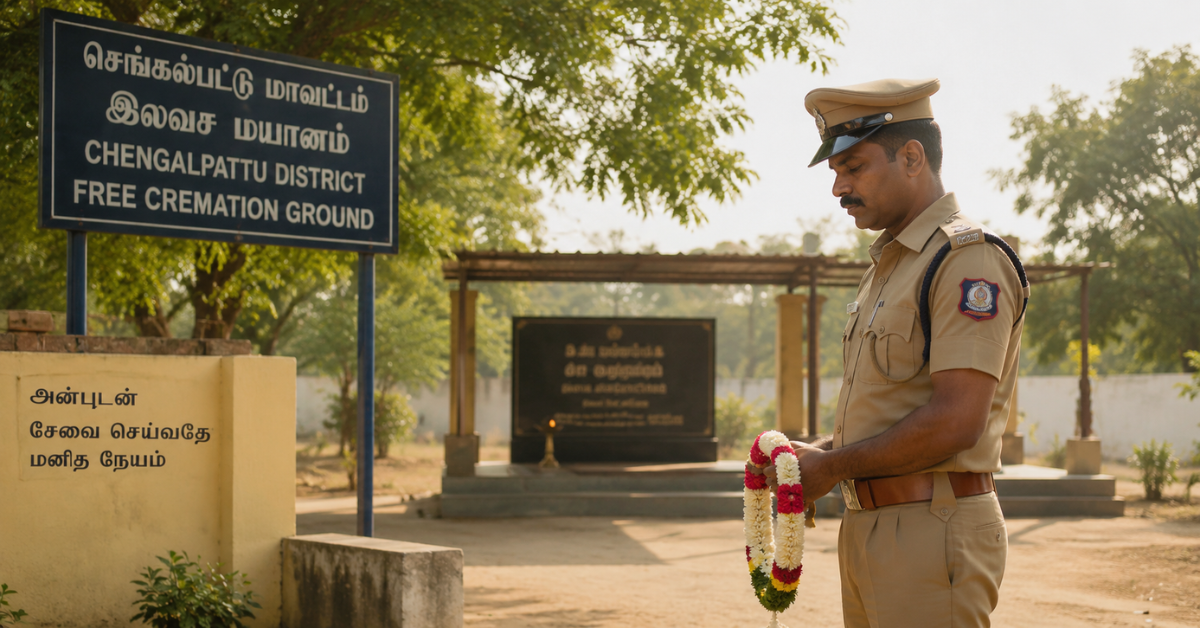
P Karthik, a constable posted at Chengalpattu Town Police Station in Tamil Nadu, has made it his mission to change that — one cremation at a time.
Over the past three years, Karthik has personally overseen the last rites of more than 70 unidentified or unclaimed bodies. He garlands them, arranges proper rituals and stands in as family — because, in that moment, he is the only family they have.
“I see them as my own,” he said simply. “Everyone deserves a respectful farewell.”
A first encounter that never left him
It began with an elderly woman found lying outside a church in Chengalpet, Chennai. Karthik recognised her — she had survived by begging in the area, a familiar, invisible face on a familiar street.
With no one to claim her, he took the body to the mortuary and spent nearly three months trying to trace her relatives. When all efforts failed and the body began to decompose, Karthik performed her last rites himself.
“That moment stayed with me,” he recalls.
It was not a dramatic revelation. There was no announcement, no formal initiative. He simply could not walk away from the idea that a person’s life — however marginal or forgotten — deserved a dignified end.
The scale of the problem
Karthik’s compassion exists against a sobering backdrop. Across India, the scale of unclaimed deaths is staggering. Tamil Nadu alone recorded over 5,000 unidentified bodies in a single year, placing it among the states with the highest such numbers in the country.
In Delhi, data shows that an average of five to eight unidentified bodies were found every single day between 2018 and 2021 — and only a fraction were ever identified.
Most of these are migrants, the homeless, accident victims, or elderly individuals who outlived their families and social ties. They die in railway stations, on roadsides, outside places of worship.
The law provides a framework — bodies unclaimed for 72 hours are to be disposed of by police, coordinating with municipal authorities — but the procedure is often clinical, rushed, and devoid of ritual.
What Karthik does is different. He treats each body not as a case file to be closed, but as a person deserving of care.
The work behind the farewell
After signing off for the day, Karthik continues working. He circulates photographs of unidentified bodies across police stations, cross-references records of missing persons, and follows every lead he can find.
He is, in these off-duty hours, a one-man identification unit — driven not by protocol but by conscience.
Most of the bodies he encounters are recovered from bus stands, railway tracks, and accident sites. When his searches yield nothing — no family, no name, no one to claim the person — he steps in without hesitation.
He ensures the body is garlanded, that the appropriate rituals are observed, and that the person is not consigned to anonymity without at least one human witness to their passing.
He is not alone in this spirit. Across Tamil Nadu, there are others quietly doing similar work. In Mettupalayam, constable M Amina has coordinated the cremation of over 100 unclaimed bodies over five years, working with volunteers and NGOs, splitting the costs with colleagues.
These are not outliers — they are a quiet tradition of conscience within a system that rarely makes space for it.
A badge worn differently
The uniform Karthik wears is the same one that carries, in the public imagination, connotations of authority and distance. What he has done is wear it differently — as a symbol of responsibility to those who no longer have any power at all.
India’s Supreme Court has held that the right to dignity extends to the deceased, affirming the state’s duty to ensure respectful burial or cremation for even the unclaimed and homeless.
Karthik, with or without knowing the legal language, lives by that principle every time he lights a funeral pyre for a stranger.
He does not seek recognition. He asks only that the forgotten be allowed to leave the world as they deserved to live in it — with someone who cares.
In a country where so many fall through every crack imaginable, P Karthik stands at the very last one — and refuses to let anyone fall through it alone.
Sources:
‘Chennai cop’s quiet mission: giving the unclaimed a dignified farewell‘: by unnamed author for The Times of India, published 2026
‘Delhi recorded an average of 5–8 unidentified bodies found daily between 2018 and 2021‘: by unnamed author for The Print, published 20 August 2022
‘India’s Supreme Court affirmed that the right to dignity extends to the deceased, recognising the state’s duty to ensure respectful cremation or burial‘: by Saurav C et al., published in PMC/National Institutes of Health
‘Constable M Amina of Mettupalayam coordinated the cremation of over 100 unclaimed bodies over five years‘: by The Hans India, published 3 August 2022
Disclaimer : This story is auto aggregated by a computer programme and has not been created or edited by DOWNTHENEWS. Publisher: thebetterindia.com