Mangaluru: The hijab controversy that dominated headlines in early 2022 has resurfaced after the Karnataka government issued a fresh order allowing students to wear hijab and other religious symbols along with prescribed uniforms in educational institutions.
While the Congress government maintains that the move is a fulfillment of its pre-election promise, critics see it as a politically timed decision aimed at consolidating support among minorities and other communities ahead of Assembly elections due in less than two years.
The controversy had erupted during the previous BJP government, in 2022, which had imposed restrictions on wearing hijab in classrooms. Though the Congress had promised to revoke the order after coming to power, the decision was implemented only now, nearly three years later.
From a classroom dispute to a statewide flashpoint
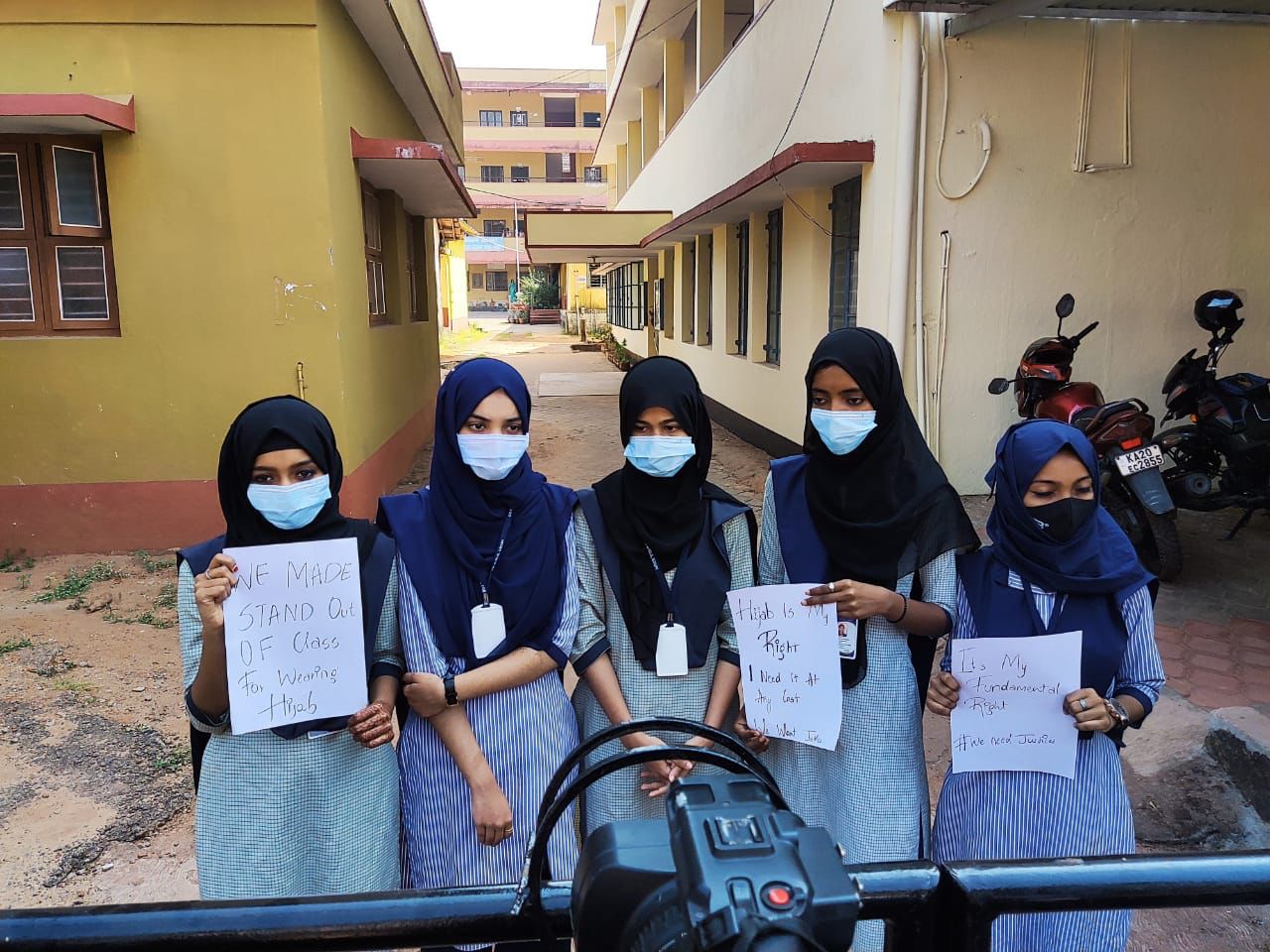
The hijab row traces its origins to December 2021, when six students of the Government PU College for Girls in Udupi were denied entry into classrooms for wearing hijab.
Despite repeated appeals to the principal, the Deputy Director of Pre-University Education (DDPU) and district authorities, the students were not allowed to attend classes wearing the headscarf. What initially appeared to be a local administrative issue soon turned into a controversy.
Television debates, social media campaigns and street protests rapidly transformed the Udupi incident into a national issue. The visuals of students waiting outside classrooms became symbolic of a larger debate over religious identity and constitutional rights.
The students and several activists accused then BJP MLA Raghupathi Bhat and BJP leader Yashpal Suvarna of fuelling the controversy. While Bhat did not get party ticket in the 2023 elections, Suvarna is now the sitting MLA of Udupi.
As protests intensified in Udupi and Kundapur, similar incidents began surfacing in colleges across coastal Karnataka. Soon, counter-protests emerged, with Hindu students in some institutions wearing saffron shawls and demanding equal treatment.
What began as a dispute over dress code soon evolved into a highly charged confrontation over religion, politics and identity. The issue spread beyond coastal Karnataka, triggering protests in several districts, taking serious turns, and drawing national attention.
BJP government’s order changed the course of the debate
Faced with growing unrest, the Basavaraj Bommai-led BJP government issued an order on February 5, 2022, effectively prohibiting religious attire, including hijab, in classrooms where uniforms were prescribed.
The order transformed a localised conflict into a bigger debate. Muslim organisations termed the decision discriminatory, while the BJP defended it as necessary to maintain uniformity and discipline in educational institutions.
The affected students approached the Karnataka High Court, arguing that wearing the hijab was protected under Constitution.
In March 2022, the Karnataka High Court upheld the government order and dismissed the petitions. The matter soon reached the Supreme Court, where a two-judge bench delivered a split verdict in October 2022 — one judge upheld the ban while the other struck it down. The case was subsequently referred to a larger bench, and a final verdict is still awaited.
Congress finally revokes restriction
On May 13, 2026, the Congress government formally withdrew the earlier order.
The fresh notification issued by the Department of School Education and Literacy allows students to wear faith-based symbols such as hijab, turban, sacred thread and rudraksha along with institutional uniforms, provided they do not affect discipline, safety or identification of students.
Relief, but also memories of lost years
For many of the students who fought the battle, the government’s decision has brought emotional closure, though not without bitterness over the years lost in the process.
Aliya Assadi, one of the six students who challenged the ban, responded emotionally on X soon after the order was announced.
“Alhamdulillah daiman wa abadan! All praise is due to Allah, always and forever,” she posted.
In a lengthy message, she recalled the emotional exhaustion, humiliation, struggle for admissions and disruption of education faced by students during the controversy.
“The years lost, the dropped studies, the struggle for admissions, the allegations, the humiliation, the mental pressure, and the emotional exhaustion none of it went unseen. Every pain is recorded by Allah, and every hardship will be compensated by Him, for you and for us all,” she stated.
She also thanked those who supported the movement and stood by the students during the legal and social battle.
For activists who supported the students from the beginning, the government’s decision is welcome but delayed.
Activist and legal campaigner Hussein Kodibengre termed the move “better late than never” but spoke about Congress government waiting for nearly three years after assuming power.
“The earlier government denied students their constitutional rights. But the present government too delayed corrective action for years,” he said.
Siddaramaiah vs Bommai: The political battle resumes
Chief Minister Siddaramaiah has defended the revised dress code, arguing that it reflects the constitutional principle of equal respect for all religions.
“It is only natural that those who seek to divide society on the basis of caste and religion are upset by this. They should first look within and introspect. The dress code implemented in the State’s educational institutions is in line with the dress code followed in Kendriya Vidyalayas under the control of the Union Government. Those who oppose the dress code issued by the State Government should also oppose the dress code of Kendriya Vidyalayas. Why this hypocrisy?” he questioned.
Replying to BJP’s allegations that the move was towards appeasement, Siddaramaiah questioned that if allowing the hijab amounts to appeasement of Muslims, does allowing the sacred thread, turban, or traditional headgear amount to appeasement of those respective religions.
“Our government has decided to allow students to wear limited traditional or faith-based symbols, provided they are supplementary to and compatible with the prescribed uniform,” he added.
Former Chief Minister Basavaraj Bommai, however, accused the Congress government of reviving communal divisions for political gains. He argued that there was no public demand for such a change and warned that the order could create fresh tensions among students.
Bommai also pointed out that the earlier government order had been upheld by the Karnataka High Court and that the matter remains pending before the Supreme Court.
Muslim organisations welcome decision, seek action on other promises
Muslim Okkuta state leader and former Mangaluru Mayor K Ashraf welcomed the government’s decision, describing it as a restoration of a right that existed before the BJP government imposed restrictions.
“Hijab was always our right. It was only during the BJP regime that restrictions were imposed. It is good that the Congress government has now corrected it,” Ashraf told Deccan Chronicle.
He said the move was in line with the assurance given by the Congress and noted that several Muslim organisations and community leaders had continued to pressure the government even after it came to power.
Ashraf indicated that the community expects the government to address other pending concerns as well. He referred to issues such as the anti-cow slaughter law and the removal of 2A reservation benefits introduced during the previous BJP government, saying the community would expect the Congress to take decisions on those matters too.
Demand to inform Supreme Court
Even as the government withdrew the earlier order, several leaders and organisations urged it to formally inform the Supreme Court and expedite the pending proceedings.
A Congress office-bearer said the government should pursue the matter seriously before the apex court, considering the issue had remained unresolved for nearly four years.
“We have seen some issues being followed up very fast. Then why unnecessary delay in this. The party and the government should take immediate step,” he added.
Women India Movement national general secretary Shahida Tasneem welcomed the decision of the state government but criticised the Congress for delaying action despite promising to revoke the ban in its very first Cabinet meeting after coming to power.
She said thousands of Muslim girls had suffered academically because of the restriction and urged the government to immediately inform the Supreme Court that the earlier order had been withdrawn.
Religious identity yes, political symbolism no
Even as the government has permitted faith-based symbols in educational institutions, voices within the Congress have stressed that political or organisation-linked symbols should not be allowed to enter campuses.
KPCC spokesperson and educationist MG Hegde said the revised order should be interpreted strictly within the framework of religion and tradition, and not be misused for political assertion.
“The government has allowed religious symbols, not political ones. Saffron shawls should not be permitted because they are associated with organisations and political mobilisation. Tomorrow, someone else may demand blue or yellow shawls. Educational institutions should not become spaces for political symbolism,” he said.
Hegde maintained that only genuine religious or festive symbols should be accommodated and warned that allowing politically loaded identifiers could once again trigger confrontation and polarisation inside campuses.
More than a policy decision?
While the Congress government has projected the withdrawal of the hijab restriction as the fulfillment of a key electoral promise, political observers also point at the timing of the decision.
Sections within the ruling party admit that there has been growing unease among parts of the Muslim community over delays in implementing several assurances made before the 2023 Assembly elections. The denial of a ticket to a Muslim aspirant in the Davangere South by-election, dissatisfaction among some minority leaders within the party and disciplinary action against a few outspoken voices are all said to have contributed to the perception that the community’s concerns were not receiving adequate attention.
“There was increasing frustration within sections of the community. The party could sense the mood on the ground. The hijab issue carried both emotional and political significance, and addressing it became important for the government,” a leader added.
Political insiders believe the Congress, already dealing with internal dissatisfaction on multiple fronts, is keen to consolidate its traditional support base ahead of the next Assembly elections, now less than two years away.
At the same time, it is said that the revised order appears carefully structured to avoid the impression of favouring a single community.
The inclusion of janivara in the order has also drawn attention, especially after recent controversies surrounding its removal during examinations. Political analysts say the government may be trying to reassure the move as one centred on religious inclusivity rather than identity politics alone.
Disclaimer : This story is auto aggregated by a computer programme and has not been created or edited by DOWNTHENEWS. Publisher: deccanchronicle.com