
A tiny beetle that led to the loss of 4000 trees in Perth could wipe out nearly half the tree canopy in Sydney, Melbourne and Brisbane, including iconic species such as Moreton Bay figs, if it makes its way to the east coast.
A stocktake of Sydney’s street trees and public parks revealed that 47 per cent of the urban tree canopy could be killed in the event of an invasion by the polyphagous shot-hole borer, a pest that originated in South-East Asia and was discovered in Western Australia in 2021.
In research published in Frontiers in Forests and Global Change last month, scientists calculated the toll if all trees at moderate to extreme risk from the beetle succumbed.
The trees at risk, based on Western Australia’s experience, included species such as Moreton Bay and Port Jackson figs, Illawarra flame trees, paperbarks and some eucalyptus species, and imports such as oak trees and plane trees.
“That’s the worst-case scenario,” says lead author Angus Carnegie, senior principal research scientist at the NSW Department of Primary Industries and Regional Development.
“Probably a more realistic scenario would be 10 to 15 per cent of Sydney’s trees could die within five years if we didn’t manage it, and if we did nothing at all, that might get up to about 30 per cent. The reality is that we’re likely going to manage it by removing dead branches.”
The potential impact to natural ecosystems outside the cities would also be devastating because keystone species such as she-oaks, broad-leaved paperbarks and tuckeroo were also at risk, Carnegie said. While there might be treatments to save urban trees or agricultural crops such as avocados, it would be impossible to do this at scale in native forests.
After removing 4000 infected trees in Perth, including at Government House and Kings Park, the West Australian government last year gave up eradication efforts in favour of containment.
Professor Kingsley Dixon, a botanist at the University of Western Australia, said the eucalyptus and banksia trees native to Perth had proven reasonably resilient to the borer, but it had devastated east coast imports such as figs and flame trees, and European deciduous trees.
Sydney, Melbourne and Brisbane would fare far worse because the climate was more favourable to the beetle, and the trees were more susceptible, Dixon said.
“[Perth has] a drier climate, so the borer struggles a little more, but in those environments with particularly moist summer conditions and higher humidity and a range of important and larger trees that will be vulnerable, it is imperative that the borer is kept out,” Dixon said.
“I would strongly urge it’s an experiment that shouldn’t be tried in Sydney and Melbourne [and Brisbane].”
The insect does not eat the wood directly but farms the Fusarium fungus as a food source, which causes branch dieback and often kills the host.
Invasive Species Council policy director Dr Carol Booth said a single female shot-hole borer could breed by laying unfertilised eggs that hatched only males, then mating with her own offspring.
The insect, which is just a couple of millimetres long and can fly only short distances, spreads because it can survive for months on small pieces of wood.
“It’s been hitching around the world now for about a quarter of a century, and it’s managed to get to four new continents – North America, South America, Africa, Australia,” Booth said. “More than 500 tree species have been identified as hosts, so it’s amazingly versatile.”
The research found the cost to natural trees, urban forest, commercial forestry and horticulture in South Africa was an estimated $US16 billion since 2012. The cost in Perth was estimated at $78 million so far, and $9.7 million a year ongoing.
In Sydney, the research paper says, lost canopy would increase the urban heat island effect; reduce amenity at a cost to human health; and damage property prices, while environmental harms include increased run-off, reduced air quality and loss of biodiversity.
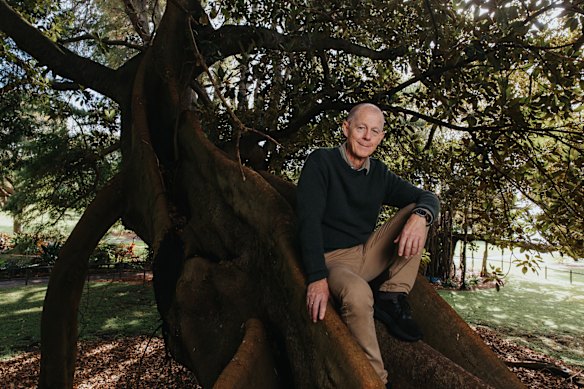
Royal Botanic Gardens and Domain Trust chief scientist Brett Summerell said Moreton Bay figs had been planted in public parks across Sydney from about 1850 to World War I, and were now “huge, magnificent” trees that defined the city.
“The Children’s Fig in the botanic gardens is one of the most spectacular trees with a huge cultural significance to generations upon generations of Sydneysiders,” Summerell said.
“Right across the whole of the city, the potential for the polyphagous shot-hole borer to cause huge changes to the look and feel of Sydney is really significant.”
Carnegie’s team started mapping Sydney’s trees using manual counting, then overlaid council data, and he now planned to add artificial intelligence analysis of satellite imagery.
Melbourne and Brisbane had less complete public data on tree species, but the available information suggests those cities are also at risk, the paper says.
Carnegie said the best way to boost resilience was to plant a variety of tree species, so a pest did not wipe out all the trees in an area.
It is illegal to take untreated wood, firewood, green waste, mulch, timber, or wood chips out of the Perth Metropolitan Quarantine Area, and NSW, Queensland and Victoria each have interstate biosecurity controls.
The NSW government is monitoring import shipments at ports, and working with councils, arborists, institutions such as the botanic gardens, and golf courses to aim for early detection.
The surveillance includes using “sentinel trees” – key trees across a range of species that are inspected regularly, including using pheromone trapping. Australia now has a mature network of sentinel trees in Sydney, Melbourne and Brisbane, the paper says.
The Invasive Species Council is calling for permanent environmental biosecurity units to be embedded within state environment departments.
“It makes so much economic sense, as well as environmental sense, to have a much stronger focus on stopping the next big invaders because we can’t keep dealing with this unceasing stream of devastating new environmental invaders,” Booth said.
Get to the heart of what’s happening with climate change and the environment. Sign up for our fortnightly Environment newsletter.
 Caitlin Fitzsimmons is the environment and climate reporter for The Sydney Morning Herald. She was previously the social affairs reporter and the Money editor.Connect via email.
From our partners
Disclaimer : This story is auto aggregated by a computer programme and has not been created or edited by DOWNTHENEWS. Publisher: www.smh.com.au