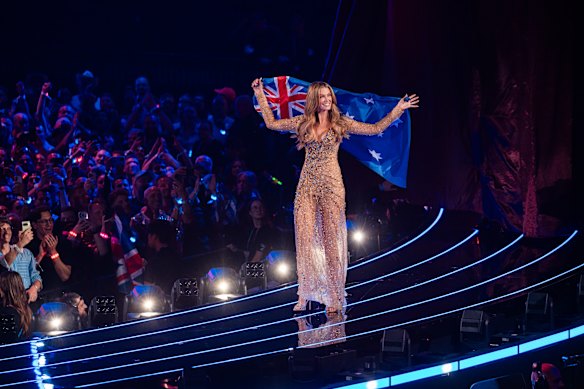

Soaring into the sky in a shower of fire and golden sunlight, Australian singer-songwriter Delta Goodrem delivered a career-defining performance that became the talk of Eurovision. To be fair, it was a tough field, but even competition-hardened Eurovision expert Graham Norton tipped it as this year’s competition-winning performance.
In the end, however, Goodrem walked away in fourth place, after Eurovision’s hectic TV audience-voting phase upended the scoreboard, burying favourites France, Italy and Greece, elevating Israel and Romania to second and third place, and catapulting Bulgaria into an unassailable lead that nobody, not even sun goddess Delta Goodrem, could match.
That is the nature of Eurovision. It’s as crazy and colourful on the scoreboard as it is on the stage. In 2015, Dami Im faced a similar battle. She delivered a stunning performance but the competition ended in a brutal twist that pushed her to second place. In 2019, Kate Miller-Heidke’s staging was equally breathtaking – she literally took flight – but she too was pushed into ninth place, after an unfairly harsh jury vote.
As the Australian delegation packs its bags tonight in Vienna preparing to head home, the mood is upbeat. Goodrem herself is thrilled with the outcome. And in truth, fourth place in a field of 35, is a noble outcome. But it does leave us with a lingering question. Just what do we have to do to win the Eurovision Song Contest?
The answer is not as simple as send an extraordinary singer and equip her with an extraordinary song. The Eurovision Song Contest is a Rubik’s Cube of diplomacy, old family ties and geopolitical ballet. You can spin it every which way but until you make the colours line up, you will never solve the puzzle.
Winning, of course, is a remote target in a busy shooting gallery. There are between 35 and 45 countries competing each year. This year the total was down because of a five-country boycott. The competition this year was tough. And in a less febrile political climate, the competition is even tougher.
In the process of brutal semi-finals, a dozen of those countries are culled. Only the biggest spenders in the European Broadcasting Union (EBU) – the UK, Spain, Germany, France and Italy – are guaranteed a berth in the grand final. (Spain was one of the five countries absent this year.) Even in the world of art, money talks a loud game.
On top of that Australia has some real competitive hurdles to overcome. The Eurovision scoring system is structured so that each country scores the others, and cannot vote for its own artist and song.
But in a 70-year-old competition, laid over centuries of European geopolitics, alliances have risen and fallen, some now so deep that they are impossible to shift. In all of that, Australia is a complete newcomer, even after a decade in the competition.
The “Nordic bloc” – Sweden, Norway, Denmark, Finland and Iceland – have similar musical subcultures, and are naturally inclined to vote their highest scores for one another. There is a “Baltic bloc”: Estonia, Latvia and Lithuania. The Balkans vote tightly, when they compete. (Not all of them do, every year.) And neighbours Greece and Cyprus almost invariably exchange their highest scores, the legendary “douze”, or 12, points.
An Australian victory is certainly a complicated idea for the Europeans to contemplate. The key element is this: Eurovision is not so much a song contest as it is a television broadcast, and the organising body, the European Broadcasting Union (EBU), is not so much a record label as it is an association of public broadcasters from Europe and around the world.
Which means that Eurovision should be thought of first and foremost as a TV broadcast, not a music competition. (Even though there is a lot of singing in it.) And even if Australia were to win, we would not be able to bring it to Australia. It would have to be co-hosted in Europe, in a European city. Which adds a question to the fine print: do we really want to win it anyway?
Perhaps then the notion of winning Eurovision is not so much a question of trying to cross the finish line first – natural enough, considering Australia’s almost unhealthy obsession with winning things – but rather understanding that Eurovision is not simply a race.
At Eurovision, you don’t win or lose. You win, or place. And fourth place is better than 24th place. With apologies to Austria, who finished today in 24th place. Can you imagine? Coming second last and having to foot the bill? That’s certainly a tougher mental hill to climb than Delta Goodrem’s stunning performance and fourth placing.
It matters too, that there is more going on at Eurovision than dancing grannies and heavy metal orcs. Geopolitics is a headline-worn word these days, but Eurovision is certainly one of the most potent soft diplomacy tools in the world.
And while a lot of attention is paid to thorny issues, such as Israel and the war in Gaza, the truth is the geopolitical aspect of Eurovision significantly puts Australia’s finest artists in the same room as their peers from a raft of countries, whose governments all have complex and often imperfect relationships.
That these singers can begin conversations where politicians cannot means something in a politically broken world. That Australia leads many of those artistic and cultural conversations matters enormously.
As does, of course, winning. Not that that’s the only reason we’re there. But we’re an extraordinary country in need of a voting bloc, and a couple of old family ties to play in our favour. And while placing in Eurovision is no dishonour – there are at least 20 European countries, including Iceland, Malta, Cyprus, Poland, Armenia, Romania and Lithuania who have never won – it doesn’t hurt that we still have our eyes on the prize.
Until today, Bulgaria had never won either. Which means one day, inevitably, that trophy is ours.
SBS will replay the Eurovision grand final tonight at 7.30pm AEST. Both semi-finals and the grand final are available via SBS on Demand.
Read more of our 2026 Eurovision coverage
 Michael Idato is the culture editor-at-large of The Sydney Morning Herald and The Age.Connect via X or email.
From our partners
Disclaimer : This story is auto aggregated by a computer programme and has not been created or edited by DOWNTHENEWS. Publisher: www.smh.com.au