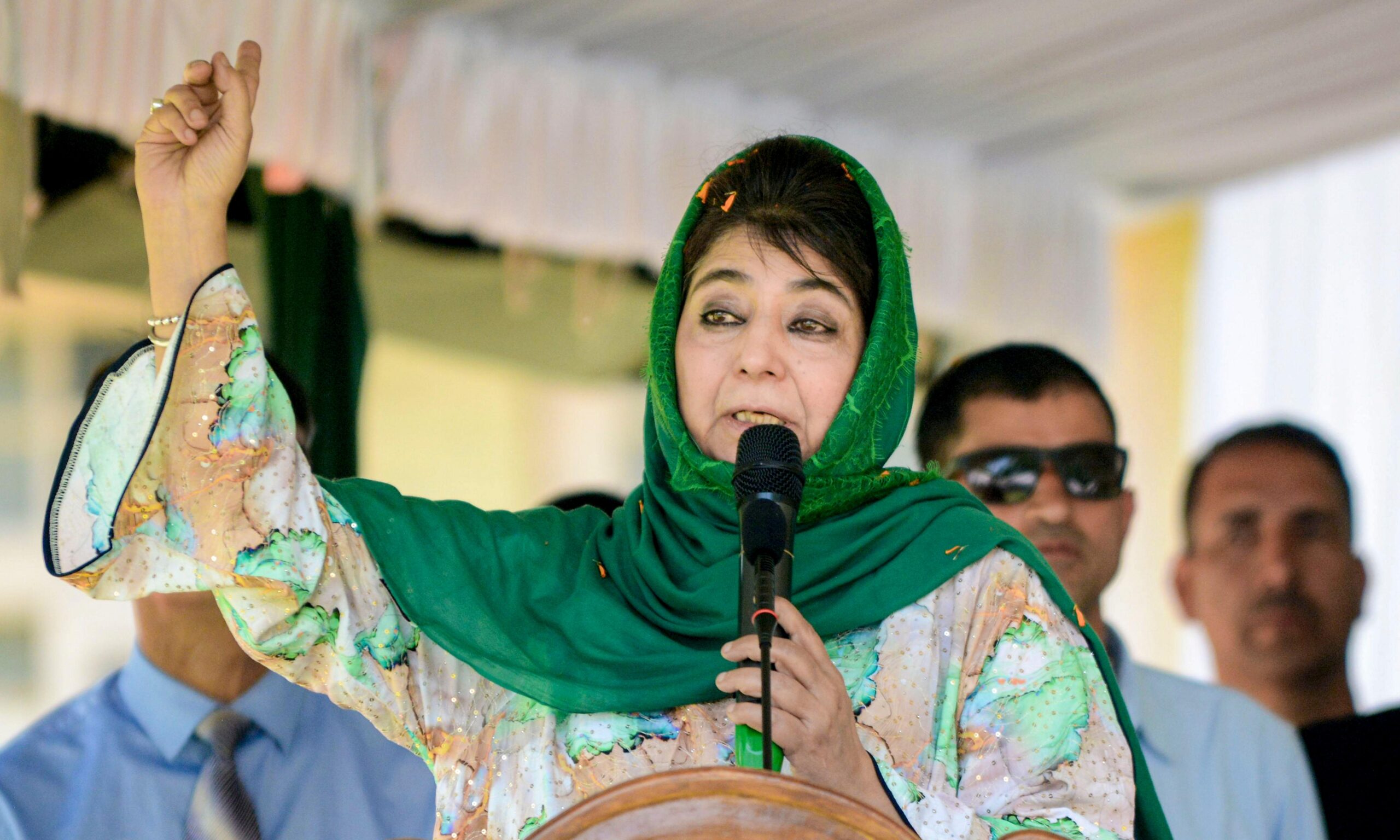
Srinagar: Former Jammu and Kashmir Chief Minister and People’s Democratic Party (PDP) president Mehbooba Mufti on Sunday asserted that the future of Kashmir lies not in force or fear, but in dialogue, trade, and the reopening of traditional routes that once connected the region with its neighbours. Addressing a gathering of party workers here, she stressed that sustainable peace can emerge only through engagement and reconciliation, not through repression or isolation.
Recalling the words of her father and PDP founder, Mufti Muhammad Sayeed, she said he often reminded people that even if Kashmir’s roads were paved with gold and its bridges built of silver, development would remain meaningless unless the core political issue of Kashmir was addressed. She pointed to the fragility of the region’s economy, noting how a single tragedy—such as the Pahalgam incident that claimed the lives of tourists—can collapse the entire tourism sector. “What will these roads and infrastructure achieve,” she asked, “if the fundamental issue remains unresolved?”
Mufti emphasised that her father viewed Kashmir not as a territorial dispute but as a human issue requiring empathy and political courage. She recalled how Mufti Sayeed had placed faith in former Prime Minister Atal Bihari Vajpayee’s outreach, which led to the opening of cross-LoC routes, dialogue with Pakistan, and a period of relative calm. She noted that Dr. Manmohan Singh continued that process, and that even Prime Minister Narendra Modi made gestures such as visiting Lahore. However, she argued that subsequent events—like the Pathankot attack—derailed the momentum, and that both India and Pakistan must reflect on how to revive meaningful engagement.
Referring to recent remarks by RSS leader Dattatreya Hosabale advocating people-to-people contact and keeping dialogue channels open, she urged the government to reopen the Srinagar–Muzaffarabad and Poonch–Rawalakote routes. She appealed directly to Prime Minister Modi, saying that resolving the Kashmir issue and ensuring lasting peace across the region would earn him a place of honour in history. She argued that the strict measures imposed in J&K after 2019 have created an atmosphere of fear, warning that prolonged fear eventually turns into anger and alienation. As a first step, she urged the release of detainees—especially those against whom no charges have been proven—many of whom, she said, come from poor families and have spent years in jail.
The PDP leader also highlighted the transformative potential of reopening trade and travel routes with banking facilities instead of barter. She contrasted the limited infrastructure in Pakistan-administered Kashmir with the extensive development in Jammu and Kashmir—medical colleges, engineering institutions, IITs, IIMs, and AIIMS—yet argued that despite this progress, people in the Valley lack peace of mind. She claimed that the absence of harsh laws like PSA, AFSPA, and UAPA across the border contributes to a sense of normalcy there, whereas in Jammu and Kashmir, fear persists. She called for withdrawing the Army from populated areas and returning it to the barracks to restore public confidence.
Clarifying her position, she said that resolving the Kashmir issue does not mean handing the region to Pakistan but dismantling the barriers that divide the two sides of Kashmir. She advocated opening the Kargil–Skardu route to revive access to Central Asia and the Leh–Zhejiang route to create an alternative path to Kailash–Manasarovar. “Why have you made Kashmir a prison?” she asked, urging the government to open the region and begin healing the wounds of its people, starting with Srinagar, which she described as the heart of Kashmir.
She criticised the demolition of homes in the name of anti-drug operations, arguing that punishing entire families is unjust. Acknowledging the suffering of Kashmiri Pandits, she said their wounds had been addressed to some extent, but the Sikh community—also victims of past violence—received little attention despite never speaking against their Muslim neighbours. She urged the government to consider their concerns as well.
Mufti reiterated her call for reopening Kashmir’s routes with Pakistan, China, and Central Asia, enabling young people to reach Iran or Uzbekistan by road and expand trade opportunities. She demanded the return of power projects operated by NHPC, reminding the audience that such a promise had been made to Mufti Sayeed. With tourism fluctuating unpredictably, she argued that J&K needs control over its resources to build a stable economy. She also urged an end to detentions under PSA and UAPA and proposed forming a consultative committee representing both sides of Kashmir to discuss trade, tourism, and shared interests. She appealed for the reopening of Sharda Peeth for Kashmiri Pandits as a gesture of goodwill.
As Eid approaches, the former chief minister urged the Centre to release detainees as a confidence-building measure. Addressing the people of Srinagar directly, she described them as the torchbearers of Kashmir and called on them to lead the region out of its current turmoil, confront rising unemployment, and resist what she described as an era of mass arrests and aggressive crackdowns.
Disclaimer : This story is auto aggregated by a computer programme and has not been created or edited by DOWNTHENEWS. Publisher: deccanchronicle.com