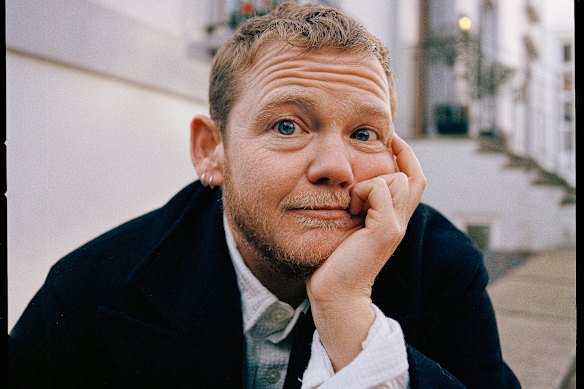

Each week, Benjamin Law asks public figures to discuss the subjects we’re told to keep private by getting them to roll a die. The numbers they land on are the topics they’re given. This week, he talks with Kae Tempest. The British writer and performer, 40, has won the Ted Hughes Award for poetry and the Silver Lion in Venice for playwriting. His latest album is Self Titled; his latest novel is Having Spent Life Seeking.
RELIGION
Were you raised in a religious household? I wasn’t. My dad’s side of the family was Jewish; my mum’s side was Christian, but neither of them practised. Still, for me, creativity and religion are closely linked.
It’s common for your performances to feel like spiritual experiences from an audience’s perspective. Does it feel like that for you on stage? For me, the practice of performing in public – with music, rhyme, lyricism, singing, vocalising, playing – is profound. The words are like bridges. Somehow, I get from my original meaning to your reception of the meaning, and this connection between us transforms the nature of what I’m saying. I can’t pretend that it’s always a deep, spiritual experience: sometimes, it’s more just going through the motions. But there’s always an element of it that I find beautiful and mysterious. And that links me to this feeling of the deep forever, of the present tense.
What are your personal commandments for making good art? When I was writing this latest novel, I had three commandments written on my studio wall. One was: “Nobody should be condemned.” I’m creating characters, so it’s important for me to remind myself that I want to create full, real, deeply felt characters. I don’t want to fall into narrative traps and start forgetting to constantly cultivate empathy. Another one was, “You are what you do repeatedly.” There’s so much work in asking, “How do I become the person that I want to be?” The other thing was, “Write what you can’t bear to admit.”
Oh, wow. Attributed to Ted Hughes, but I can’t find where he said it. My friend gave me that one. I found it useful because it was a reminder to be brave and courageous: to go to the wound and draw from it. To be as truthful as I possibly can be in the process of making fiction.
DEATH
Recently, you said, “There’s a part of me that mourns for the years I didn’t know.” What did you mean by that? I imagine that I was probably talking about pre-transition life [last year, Tempest came out as a trans man]. There was a numbness that I was experiencing because I’d been shutting myself off from my body. It’s like a living death, in a way. But I felt once I was able to be [myself], I was suddenly so much more aware of what I hadn’t known life could feel like. In saying that I mourned for those years, I think it’s more powerful to say, “How wonderful to have arrived here.” All of us in life, we go through a lot. But how wonderful that no matter what we’ve been through, no matter what we’ve seen, no matter what the day throws at us, we can still arrive in a place where something can feel pleasurable.
Do you have any funeral requests? Actually, the rituals around death are very important. The idea that we don’t even know where we’re going to be buried is a new thing. For hundreds of thousands of years, our deaths were as important as our lives. We don’t really have that any more. In fact, we can be quite flippant. I was talking the other day to a friend, who has another friend who makes ancient death masks. My friend had had a cancer scare and wasn’t very well. He was saying he’d been looking into these ancient practices, which incorporate grief into our lives. So maybe I’d get this friend of a friend who makes death masks to come down and we can hold a wake in a pub. I don’t know. But I would like there to be an expression of deep feeling and big joy.
How would you like to die – ideally? When it’s time.
BODIES
When someone lands on this subject, I like to ask how them how their relationship with their body has changed over time, but I acknowledge that’s a loaded question for a trans person. Yeah, I feel OK about answering that. It’s incredible to feel my body now – the same body that I’d felt such deep disconnection from. It really had been my enemy, ever since I was a kid.
It sounds like a pretty hostile relationship. Yeah, it was. It felt like I was living in my enemy. When I was a kid – maybe six or seven – I remember feeling joy in my body, then puberty hit and I don’t know … What I can say is, bodies are complicated and I’m really enjoying this one now.
What are you enjoying? How can I explain it? I’m alive. I’m alive in my body. I’m enjoying being in the world and the way my body helps me interact with people, the way that I can just hold myself and not feel fear, panic and pain. Now, it’s not vibrating with terror: it’s vibrating in a more peaceful and excitable register, so I’m having more peaceful and exciting encounters.
Talking about “register” makes me think of your voice and how it has changed through transition. How has it been, finding your masculine voice? For all of us, not just performers, changes in the voice are particularly confronting. I was so terrified about what would happen to my voice. What if it broke in a way that meant I couldn’t use it? I was catastrophising and so terrified. But as soon as I stopped being inactive through fear and started to be active through love, I realised how abundantly beautiful the process of transition is. We’re in a state of movement, a fluctuation of betweens. We occupy this very beautiful space.
Kae Tempest’s week-long national tour (Perth, Melbourne, Brisbane and Sydney) starts June 4.
From our partners
Disclaimer : This story is auto aggregated by a computer programme and has not been created or edited by DOWNTHENEWS. Publisher: www.smh.com.au