

From a rampaging Godzilla to Studio Ghibli’s My Neighbor Totoro to Kurosawa’s epic Seven Samurai, Japan’s movie industry has given rise to a cast of memorable characters.
And then there’s Tora-san, a goofy vagabond – part Seinfeld’s Kramer, part Mr Bean – star of It’s tough being a man that Japan is even more devoted to. It ran from 1969 to 1995, earning a Guinness World Record as the longest running movie series with the same lead actor (Kiyoshi Atsumi). The show-stopping part? This was not a television series, but a box-office juggernaut of 48 stand-alone movies released over 26 years.
Intrigued by this national icon, I take the 40-minute train journey from Tokyo Station to Shibamata, the real-life neighbourhood within the Katsushika ward where the movies were shot. Tora-san’s silhouette – complete with signature hat, coat and suitcase – directs me from the platform and across the tracks. There’s a bronze statue of him at the north exit and the pedestrian crossing sign displays his shadow.
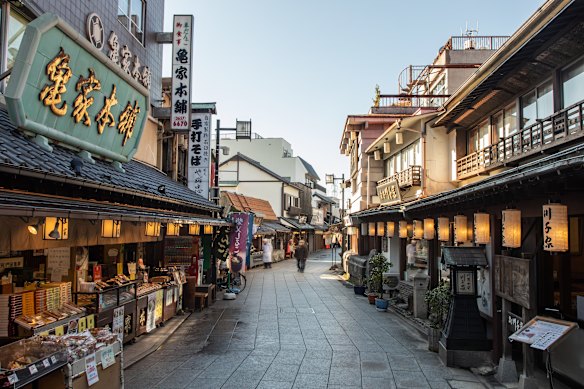
Founded in 1629, Shibamata grew as a temple town on the Edogawa River, drawing pilgrims and traders who created a distinctive street market culture. Today, the short walk along Taishakuten Sando (approach road) to Taishakuten Daikyoji Temple is a 400-year walk back in time.
Sign up for the Traveller Deals newsletter
Get exclusive travel deals delivered straight to your inbox. Sign up now.
I wander past wooden shopfronts, where vendors flip rice crackers over hot ovens and sweet sellers arrange their colourful treats in tidy rows. Known as Kusa-dango, these rice dumplings are flavoured with mugwort, a weed that used to grow alongside the river. Threaded four to a skewer they taste like grass and are dangerously addictive.
The other Shibamata speciality is Unaju, grilled river eel, usually served over rice in a lacquered box. Look for the aged signboards and bubbling water tanks out front. I opt for lunch at Toraya, a family-style restaurant that was used in the series, where black and white photos of a chubby-faced Tora-san gaze down like family portraits.
Adored by generations of Japanese, this lovable layabout represents the cinematic version of everyone’s favourite uncle; short on cash (and common sense) but with a heart of gold. A counterpoint to Tokyo’s culture of progress and perfection, he stirs a sense of nostalgia, or natsukashii, for simpler times. And it still lives on; it’s in the small ferry that crosses the river and in the easy banter of shopkeepers with their regulars. But mostly, it’s in the warmth and friendliness of the people who live here.
Nostalgia lingers inside the serene tatami room of the Yamamoto-tei residence where I enjoy a traditional matcha overlooking the gardens. True to Japan’s devotion to detail, my orange-tinted, maple-shaped sweet reflects the autumn leaves outside.
On the approach to the Nitenmon Gate shops sell hajiki-zaru (jumping monkey), a folk toy associated with Taishakuten Daikyoji Temple, said to bring good luck. To see this, rather than kitschy, movie-themed nick-knacks, reflects the town’s deep respect for tradition. It’s just one of the many reasons Shibamata was named an “Important Cultural Landscape” in 2018, by the national government of Japan.
Inside the temple grounds the noise fades as I follow the ritual hand-washing at the tsukubai basin before moving towards the main hall, famous for its external gallery of timber carvings showing scenes from the Buddhist Lotus Sutra. Established in 1629, the temple continues to serve as a pilgrimage site as well as the spiritual heart of the neighbourhood.
The Tora-san museum shows how Director Yoji Yamada used everyday locations to capture the town’s rhythm. The film props and costumes are a delight, but the best part is watching families laughing and saying, “I remember those”.
Nowhere does nostalgia run deeper than Haikara Yokocho, an old-school dagashi (lolly) shop. From ramune candy in mini soda bottles to corn puff umaibo sticks, this is Japan’s candy-coloured childhood. I buy a few packets, plus a black and white photo of Tora-san, perfect mementos from this time-capsule of a town that few people outside of Japan have ever heard of.
THE DETAILS
FLY
Qantas flies daily direct from Sydney and Melbourne to Tokyo. See qantas.com
CRUISE
Experience autumn on Seabourn’s 12-day Harvest Horizons: Japan’s Coastal Charms from Osaka to Tokyo. Priced from $16,198 a person, based on double occupancy.
MORE
gotokyo.org
The writer was a guest of Seabourn and Tokyo Convention and Visitors Bureau.
 Kerry van der Jagt is a Sydney-based freelance writer with expertise in Australia’s Indigenous cultures, sustainable travel and wildlife conservation, and a descendant of the Awabakal people of the mid-north coast of NSW.
From our partners
Disclaimer : This story is auto aggregated by a computer programme and has not been created or edited by DOWNTHENEWS. Publisher: www.smh.com.au


