
Peter McCallum
MUSICAL THEATRE
Sonder
Old Fitz Theatre, May 16
Until May 23
Reviewed by JOHN SHAND
★★½
Coined by writer John Koenig, “sonder” is the profound realisation that everyone you see is the protagonist in their own life story. As Romeo puts it in this experimental piece of musical theatre, “The story you live is the one you pass down – your very own legend.”
Sonder is a brave idea: musical theatre with one performer, no live musicians, and story-telling that flits between conventional narrative, myth, ritual and song, the latter being ballads laced with electronic dance music.
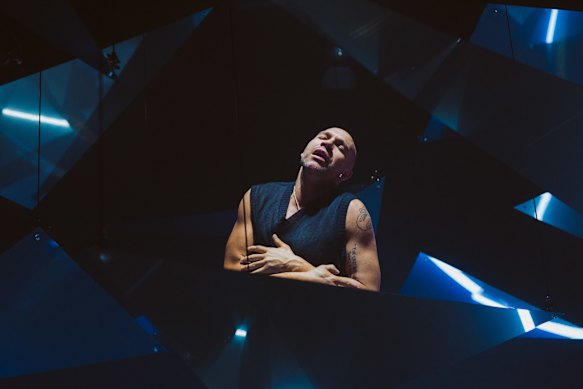
The lone performer is Riki Lindsey, who also wrote the book and lyrics, while Mitchell Sloan crafted the music and Alexander Berlage directed, designed and lit the show, aided by movement director Fetu Taku.
Lindsey mostly has the voice and presence to hold the stage for an hour, but the same can’t be said of his writing. He has his protagonist, Romeo, coming of age in New Zealand, studying Mau Rakau (a Maori martial art) and wanting to be a warrior to gain the approval of a father whose violence and depravity result in a broken home. Lobbing in Berlin, Romeo falls in love with Toby in a nightclub. After a brief, blissful cohabitation, he’s dumped, and, heartbroken, ponders the nature of love and what went wrong.
The problem is that it’s too bald. We know all that Romeo knows and Romeo knows all we know, and without any discrepancy we merely observe him, rather than becoming engaged.
Both story and character are enormously flattered by this world premiere production. Berlage is among our most accomplished directors, responsible for the Hayes Theatre’s 2019 American Psycho and the Old Fitz’s 2023 A Streetcar Named Desire, among many others. Here he places Lindsey on a reflective black floor in a ring of bright light, with reflective triangles flying in and out around him. These catch and fragment the light, like memories distorting our pasts.
Add some pleasant songs and a likeable performer, and the show’s visual and aural aspects are strong enough. So are parts of the text, as when Romeo tells us of a caterpillar whose cocoon is smashed in a storm before it has completed metamorphosis. Then we share his sense of wonder, rather than struggling to sympathise with a character who is often too one-dimensional to win it. Singing about the power of love and love’s capacity to hurt doesn’t cut it.
Yet, you have to admire the sheer audacity of the whole project: of daring to imagine a musical that conforms to none of the conventions (other than overuse of the word “love” in the lyrics). It adds up to bold art, but compromised theatre. Even when Lindsey performs some Mau Rakau stances and motions (tutored by Herb Ratahi), one senses a level of physical commitment is missing. Nonetheless, if we gave out stars for daring to dream a different dream, this would have the box set.
MUSIC
Australian Chamber Orchestra – Schubert’s Fantasy & Octet
Sydney Opera House, May 17
Reviewed by PETER MCCALLUM
★★★★
I confess to being apprehensive when ACO leader and violinist Richard Tognetti programmed an ensemble arrangement of Schubert’s Fantasy in C major, D 934 (1827), originally written for violin and piano, and based on his harmonically remarkable song Sei mir gegrusst!.
It is not that Schubert’s original piano part is quintessential piano music. Quite the reverse. When Schubert set out to write virtuosic piano music, it was often clumsy and the piano part of this piece is notoriously so. As in other works of his final years, such as the G Major String Quartet, Schubert used tremolos and complex figuration in the Fantasy to create Romantic awe and mystery, and one sometimes feels it needed a master of pianistic imagination like Liszt to realise his vision.
But in the event, Tognetti’s arrangement was captivating and illuminating, aided in no small part by the excellence of the players who delivered it. The arrangement used the same instrumentation as Schubert’s Octet in F Major, D. 803 (1824) which was played in the second half. Effective use of clarinet (David Griffiths) added light clarity to the interchange of the solo violinist (Tognetti) and upper part, while the horn writing (Carla Blackwood) mixed sonorities of smooth glowing resonance into the fabric.
Discreet bassoon lines (Todd Gibson-Cornish) gave edge and definition to often complex, sometimes disarming string textures (Helena Rathbone, Stefanie Farrands, Johannes Rostamo and Maxime Bibeau). Tognetti’s performance of the violin part had light sweetness and, in virtuosic passages, the agility was mixed with the teased string and bow noise of gut strings. Above all, it was the close listening of all players that added colour and illumination to a work that is always fascinating.
The second half was given over to a superb performance of the Octet itself, its expansive paragraphs shaping an idyllic world in which time is measured only by the distance between each carefully nuanced phrase. There were moments, like the simple horn call that initiated the Coda of the first movement, and the hushed violin sounds from Tognetti and Rathbone opening out to a perfectly placed cadence in Coda of the second, where it seemed to stand still altogether.
Reality intervened in the fifth movement, when one of those gut strings finally gave up the ghost. This must have been due to the workout it received in the Fantasy, since it occurred as the gentle Trio section was working its way back to the Menuetto, and could scarcely be blamed on excess pressure at that most serene of moments.
MUSIC
Sydney Philharmonia Choirs – Durufle’s Requiem and Poulenc’s Gloria
Sydney Opera House, May 16
Reviewed by PETER MCCALLUM
★★★½
Maurice Durufle’s Requiem was written in the dark years of World War II but harks back to the distinctly French sensibility of the beginning of the twentieth century.
It is a notable fruit of French reverence for Gregorian chant as the fount and model for all melody. Sydney Philharmonia under conductor Elizabeth Scott performed its original version (1947) for choir, orchestra and organ with a large chorus and produced a sound of blazing splendour at the words “Hosanna in excelsis in the Sanctus” and in moments which call for a full sound.
Scott established an unhurried demeanour and, even with such large soprano and alto sections, balanced the choir well, nurturing a rounded unforced tone. There were moments, such as the opening Kyrie where the rhythmic approach and shape of each line didn’t quite reach the floating Gregorian ideal. As in Faure’s Requiem, Durufle gives a prominent role to the Baritone soloist in the Libera me, and Samuel Dale Johnson sang this part and the Hostias with an attractively focused tone and a natural sense of expressive accent.
Singing with generous vibrato, mezzo-soprano Helen Sherman was strongest in the upper register, the lower notes penetrating less well. Led by Fiona Ziegler the Sydney Philharmonia Orchestra created a warm string sound in the Pie Jesu, tempestuousness in the Libera me and delicacy in the closing In Paradisum.
In his new work, Time’s Fell Hand, a setting of Shakespeare’s Sonnet 64, composer Carl Vine created a sense of immediate narrative connection combined with poetic depth by giving lines of resigned, determined expressiveness to the baritone soloist, echoed by an aura of choral commentary.
With succinctly balanced form, the work lays bare the structure and resonances of the text with simple clarity. Dale Johnson conjured a sense of striving directness which led persuasively to the work’s central moment “time will come and take my love away.”
The program concluded with another major French choral work of the mid-twentieth century, Poulenc’s Gloria which, in complete contrast to Durufle, celebrates its piety with strongly chiselled rhythmic outline, bright ideas and what could pass for cheekiness if one wasn’t aware of the sincerity of Poulenc’s faith.
With her large choral forces, Scott took the opening at a judicious stately speed, and the choir responded with a strong sound though occasionally struggled to achieve strict precision in the spiky rhythmic irregularity. Soprano Meechot Marrero brought warmth and a full-bodied tone to the clean-cut outlines of Poulenc’s modernist lines, closing this confident assertion of faith with a soft amen.
Get the day’s breaking news, entertainment ideas and a long read to enjoy. Sign up to receive our Evening Edition newsletter.
From our partners
Disclaimer : This story is auto aggregated by a computer programme and has not been created or edited by DOWNTHENEWS. Publisher: www.smh.com.au


