Gay comedian Sam Oh peered over to his roastee, Julian Stern, and prepared his first stream of jabs at his straight counterpart. After whipping through a few jokes about his appearance and occupation, he paused and looked to the audience at Beaches Tropicana nightclub in West Hollywood.
“Oh wow, I actually learned right now that I really love roasting,” he remarked. “I’ve never been happier.”
He quickly returned his gaze to Stern for another quip.
At “Queer Roast for the Straight Hosts,” this dynamic is common. The monthly comedy show invites queer comics to roast straight comics in between stand-up sets and dares ranging from re-creating “Heated Rivalry” to dressing up (or down) in outlandish seasonal outfits. It’s a very gay time that challenges queer comics to test their skills in roasting (a straight-dominated style of comedy) and welcomes straight comics into a community of artists and audiences outside of their primary demographic.
Avery Merrifield and Brandon Chau on stage at “Queer Roast for the Straight Hosts.”
(Rob Flo)
After celebrating its first anniversary in November, “Queer Roast for the Straight Hosts” has successfully brought together a powerhouse of comedians, including Jenny Yang, Brendan Scannell, Liz Blanc, Guy Branum and Paige Gallagher, among others. Andrew Stier created the event to build community as a gay comedian trying to find his footing in Los Angeles. As the show progressed, he recognized that “Queer Roast for the Straight Hosts” had become an opportunity for LGBTQ+ comedians to grow artistically and build their audience one roast at a time.
“I wanted something that was going to help unite us with other stand-up comics and not separate us, so that someone who’s growing through my show is growing in the actual stand-up scene, not just in the secluded corner of queer stand-up that they’re allowed to perform in,” Stier said.
“Queer Roast” was inspired by advice Stier received from Zach Zimmerman, a gay comedian he looked up to. After one of his shows in Seattle (where Stier previously lived), Zimmerman told him that he should start a show with his peers, because that’s how most comedians build their network and artistry. He pocketed the idea. Shortly after, he came across a clip on social media of Carson Olshansky, a New York-based trans comic, roasting. It was the first time Stier witnessed a queer person roast.
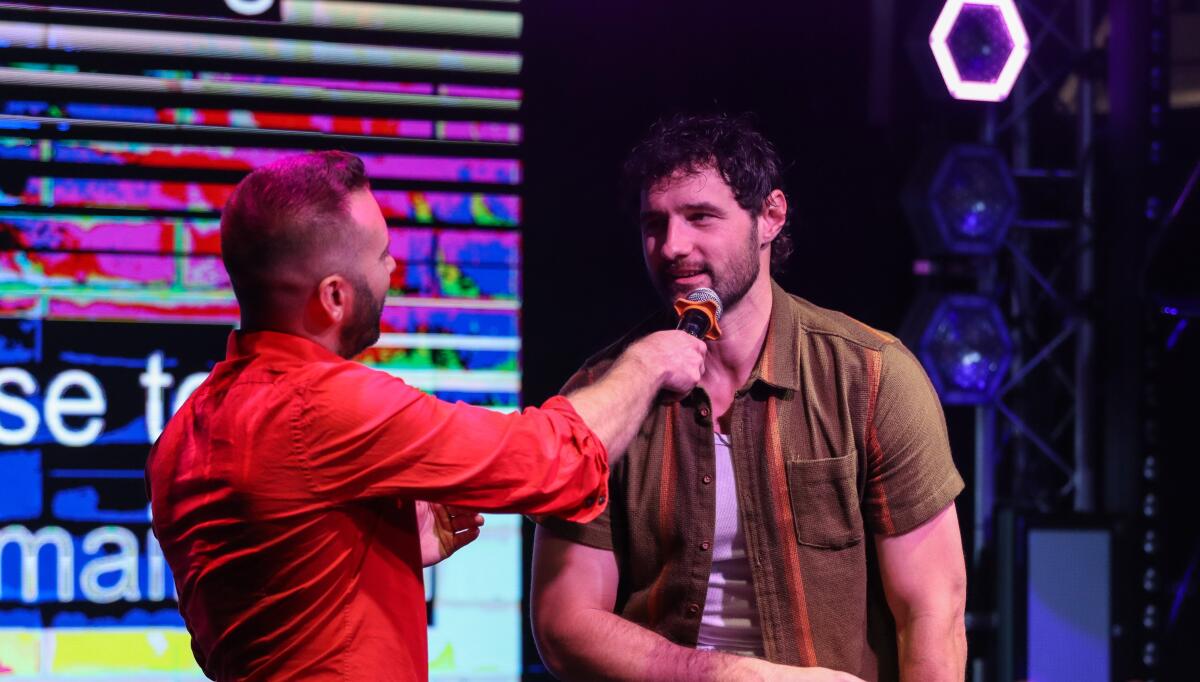
Stier and Merrifield on stage at “Queer Roast for the Straight Hosts.”
(Rob Flo)
By nature, roasting tends to be unwelcoming to queer people. Traditionally, the style focuses on making jabs at someone’s appearance or identity, welcoming hurtful comments that punch down on someone when done without thoughtfulness.
“Other places might be like, ‘Oh, you’re gay,’” Stier said. “It’s like, OK, well, it’s not a flaw.”
When Stier watches queer comics roast, there is a stronger sense of empathy and playfulness. As a marginalized community, they’ve dealt with the punches and discriminatory language. Therefore, they have a better idea of what boundaries not to cross. As a result, “Queer Roast for the Straight Hosts” makes roasting a safer, more relaxed environment because “we’re still able to punch and we’re still able to have fun, but we’re not saying anything that’s truly cruel,” he said.
The first show was one giant experiment. Once he had the idea, he just needed the venue. He turned to his college friend, Bryan Philip Cruz, one of the Pack Theater’s artistic directors, to use the venue.
“Our goal is to find more diverse voices, to give them a platform, an opportunity to be their creative outlet,” Cruz said. “So if people want to put on a queer roast, we’re a hundred percent supportive of it, and I wanted to do whatever I could to make the show as successful as possible because, I mean, it’s a great idea.”
The rundown of the show was still unknown. Stier wanted there to be six stand-up sets, mirroring other comedy shows like Shannon Cloud’s, but he wanted to mix up the flow with breaks between the sets. He felt “Queer Roast for the Straight Hosts” naturally sounded like “Queer Eye for the Straight Guy,” so he decided to roast with mock makeovers in the true “Queer Eye” fashion. For example, Kyle Prue’s social media followers often comment on his tiny ears, so in his makeover, Stier gave him a wig to cover them up. The short break for hilarious antics evolved into more elaborate dares that are now essential to “Queer Roast.” In their January show, Cruz and Stern had to re-create the entirety of “Heated Rivalry” from memory, even though Cruz had only seen a few episodes and Stern had seen none. The result was comedic chaos.
“It was the most fun I’d had doing comedy in a while,” Stier said. “Often, improv comedy feels like play, and stand-up comedy feels like work. It’s very rare for me to do a stand-up show where I get the same high as I get from doing an improv show, but this show, I get that same high.”
Roasts are often conflated with competition, but that’s not what “Queer Roast” is. Stier took inspiration from the “Tech Roast Show” in Seattle. In the show, tech professionals who also do comedy turn the roastee into a guest of honor. It’s easy to think of shows like “Comedy Central Roast” when it comes to roasting, considering the style a battle. However, it doesn’t have to be.

Comedian Kimberly Clark at “Queer Roast For the Straight Hosts.”
(Rob Flo)
“I had one friend who came to a show, and he said he really liked it because it’s not a competition,” Stier said. “It made it so that you get more of an honest reaction of when people think something’s funny, because otherwise, the person getting roasted is afraid to admit that it’s funny because of the competition element.”
To keep this element alive, Stier introduced a volunteer audience member who could sign up ahead of time to get roasted on stage alongside the professional comedians. They become a guest of honor. “Where else are you going to be able to go somewhere and watch your friend get roasted on stage by a bunch of gay people?” Stier said.
Since “Queer Roast’s” start at the Pack, shows have ventured to the Elysian Theater, Fallout Theater in Austin, Texas, and are slowly making a home at Beaches Tropicana. The show is Stier’s passion project that has evolved into something bigger. During the day, he works in tech. Having a set schedule made this evening endeavor more plausible. He fully funds the shows, and, like many business ventures, “Queer Roast” is still in the red financially. However, the arrangement at Beaches, where he gets 10% of ticket sales while the venue pays comics and comps the venue fee, makes “Queer Roasts’” future brighter.
He attributes the growing success to the help he’s received from friends and peers. When “Queer Roast” started, his friend Ben Kaplan took videos for social media. Then, his friend Jessica Ramirez offered her copywriting skills to help with social media and email blasts. Now, Beaches produces the fliers for each show.
“I’m not making money off this, and so it’s nice when other people step forward and are like, ‘Hey, I want to help you out,’” Stier said. “I think that’s how a lot of comedy shows end up gathering people because people see the effort you’re making.”
During the January show, comics Oh, Shannon Hardy and River Butcher roasted their straight counterparts Stern, Blanc and Martin Rizo. For many, this was the first time they had ever met, but the environment created by “Queer Roast” helped bridge the worlds of these comics who most likely wouldn’t have met otherwise.

Comedian Dylan Adler performs at “Queer Roast for the Straight Hosts.”
(Rob Flo)
“As a woman in comedy, it is still a boys’ club,” Hardy said. “You go into a green room, and it’s not a lot of space. It’s kind of sticky. To go into a green room [here] and be like, ‘I’m gonna put my curlers in and vent about the fact that my hair feels like hay today because I’m blond and need a filter for my shower head,’ it’s a very welcoming environment, and everyone is so normal and chill and just down to earth.”
Stier not only achieved his goal to connect with comedians he looked up to, but he also curated a new environment in comedy. For Rizo, he seldom travels from East L.A. to West Hollywood. Through the show he‘s immersed himself in a community he rarely encountered at his shows, and as a result, he witnessed a new sensibility of humor honed by the LGBTQ+ community.
The comics who participate range from newcomers to talent with credits on “Saturday Night Live” and late-night shows. Cruz explained that “Queer Roast” enhances the art landscape in L.A. by representing an instance of someone taking a leap of faith to make something new with the local comedy scene.
“People are expecting a really small, dinky, unprofessional show, and they get comedy gold,” he said. “This is raw talent that’s coming from real people here in Los Angeles.”
More to Read
Disclaimer : This story is auto aggregated by a computer programme and has not been created or edited by DOWNTHENEWS. Publisher: latimes.com