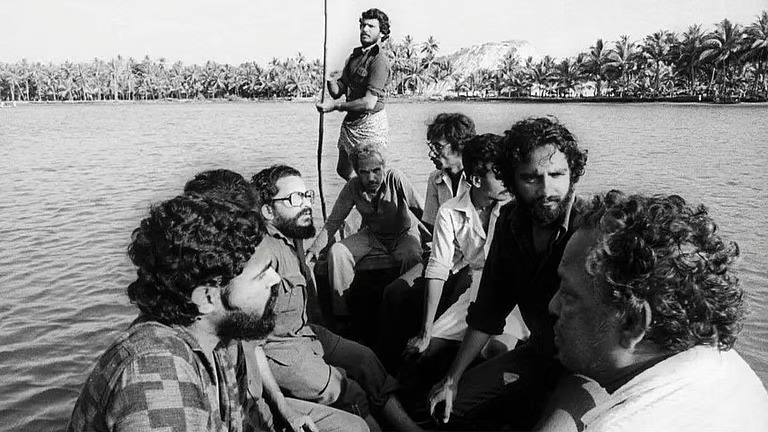
Not-for-profit organisation Film Heritage Foundation returned to the Cannes Film Festival for the fifth consecutive year, this time with the 4K restoration of Amma Ariyan (1986) a Malayalam-language experimental film directed by John Abraham. The cult Malayalam masterpiece is the only Indian feature film to be selected this year for a world premiere at the prestigious festival marking a momentous moment for the Indian film and entertainment industry.
Widely regarded as one of the most radical voices in Indian cinema, Abraham defied conventional storytelling, polished aesthetics and commercial frameworks to create films that were raw and politically charged. In 2001, the British Film Institute included Amma Ariyan in its list of the ten greatest Indian films of all time. Writer K.M. Seethi described his work: “John Abraham belonged to a rare breed for whom cinema was not just an art, but a public act of resistance, thought and love.”
Film Heritage Foundation’s earlier restorations, including Thamp (Aravindan Govindan), Ishanou (Aribam Syam Sharma), Manthan (Shyam Benegal), Aranyer Din Ratri (Satyajit Ray) and Gehenu Lamai (Sumitra Peries), have all had red-carpet world premieres at Cannes between 2022 and 2025.
Shivendra Singh Dungarpur, Director, Film Heritage Foundation states, “The selection of Film Heritage Foundation’s restoration of John Abraham’s ‘Amma Ariyan’ for a world premiere at the Cannes Film Festival is a strong validation of the work we’ve been doing. This marks our fifth consecutive year at Cannes with a restored film. This year, we’ve brought back a rare gem of Indian cinema that was in danger of being lost. With no original camera negative and only a single surviving unsubtitled print, the restoration was particularly challenging. John Abraham was a true original, with a cult following among film students when I was at the Film Institute in Pune. We had all heard stories about this maverick filmmaker, and ‘Amma Ariyan’ left a lasting impression on us. Shot in a cinéma vérité style by Venu, the film blurs the boundaries between documentary and fiction. We’re excited to introduce contemporary global audiences to John Abraham’s iconoclastic cinematic vision.”
Shivendra Singh Dungarpur, Director of Film Heritage Foundation, said the selection “is a strong validation of the work we’ve been doing”. He described Amma Ariyan as a rare work that was in danger of being lost, with no original camera negative and only a single surviving unsubtitled print, making the restoration particularly challenging.
The renewed attention to restored cinema is also reflected in the reception of In Which Annie Gives It Those Ones, the indie movie directed by Pradip Krishen and written by Arundhati Roy. Recently screened in theatres across India, the 1989-released film drew significant interest despite disappearing after a round of screening in Doordarshan.
Released 37 years ago, and moreover freely available to watch on Youtube at your leisure at home, what pulls the audience to watch such films in a theater?
‘In Which Annie Gives It Those Ones’ was partly inspired from Roy’s own experiences of studying at the School of Planning and Architecture, in Delhi. Aside from writing its screenplay, she also played a major role in the TV movie.
At a time multiplexes prefer to remember movies by box office numbers, why are indie movies making a comeback?
“Why does this small, scrappy little film, made 38 years ago, keep surfacing from its life underground? It’s what certain films and books and songs do. And we’ll never really know why,” Roy herself said in a recent statement.
In her recent book Mother Mary Comes To Me, Roy writes “It was never meant to be anything more than fun, fringe fringe cinema. But when it finally showed on Doordarshan, it reached an audience of millions, which would otherwise have been impossible for a film like Annie ”
The film was also screened at the Berlinale Classics 2026, where it was among ten restored films from nine countries. Its restoration was undertaken by Film Heritage Foundation, which described it as a cult classic in a social media post.
The growing interest in restored films is not limited to one title. At a feminist film festival organised by Anweshi Research Centre in Hyderabad, filmmaker Deepa Dhanraj noted the strong audience response to older works. Her 1983 film Idhi Katha Matramena, which deals with domestic violence, was screened at the event. Like Annie, it had been restored by L’Immagine Ritrovata, though the original Telugu audio was lost and the film had to be screened with Hindi-dubbed dialogue.
The restoration process for Annie involved recovering the best surviving elements, including the original 16mm camera and sound negatives preserved at the National Film Archive of India, and repairing extensive damage. The work was completed at L’Immagine Ritrovata in Bologna after more than a year of manual repair, digital restoration, colour grading and sound reconstruction.
L’Immagine Ritrovata, developed by the Cineteca di Bologna, is a specialised laboratory dedicated to film restoration. With advanced equipment spanning photochemical and 4K workflows, and multiple international branches, it remains one of the leading institutions in the preservation and restoration of global film heritage.
Disclaimer : This story is auto aggregated by a computer programme and has not been created or edited by DOWNTHENEWS. Publisher: deccanchronicle.com