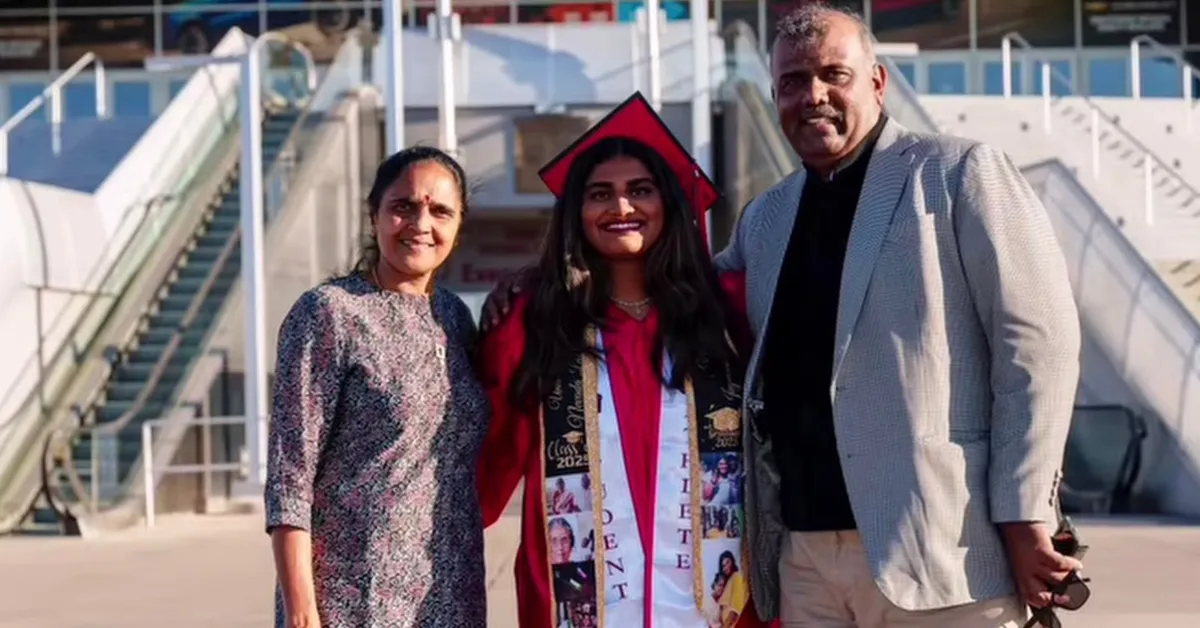
“The moment I released the shot put for the first time, something within me unlocked,” Krishna Jayasankar Menon (23) says, describing a memory that still feels vivid years later.
At the time, she was just a schoolgirl in Chennai who had stumbled into athletics almost accidentally after a physical education teacher spotted her during lunch break and suggested she try throwing. Krishna herself did not yet realise how far that simple yet poignant moment inside a throwing circle would carry her.
But before the national records and the international recognition came years of early morning commutes across the city, exhausting training sessions before and after school, the loneliness of moving abroad at 18, and the repeated heartbreak of coming painfully close to wearing the India jersey.
Today, Krishna is the first Indian woman to cross the 16-metre mark in indoor shot put, the first Indian female thrower to receive an NCAA Division I scholarship, and one of the country’s most compelling field athletes.
Yet the story of how she arrived there is less about sudden triumph and more about the slow accumulation of resilience through sacrifice, reinvention, discipline, and stubborn belief.
Tracing her beginnings
Long before anyone outside athletics knew her name, there were already signs that Krishna possessed an unusual kind of mental toughness.
Her father, former India basketball player C Jayasankar Menon, remembers an incident from when she was barely three or four years old, when she injured her palm badly enough for blood to begin “oozing out”, yet somehow remained smiling through it all.
Years later, that same stubbornness would become one of the defining qualities of her athletic career.
Sport was never treated as an extracurricular activity in the Menon household. Krishna grew up in a family where basketball shaped the rhythm of everyday life.
Her father captained the Indian men’s national basketball team, while her mother, Prasanna, captained the Indian women’s team before later coaching Southern Railways and serving as a national selector.
Their home regularly hosted some of Indian basketball’s most respected names, and conversations about training, competition, discipline, and sacrifice formed the background music of Krishna’s childhood.
“Sport was seen as a celebration in our house,” Krishna tells The Better India. “It wasn’t optional. It was normal.”
Ironically, her first attraction to sport had little to do with dreams of medals or records. “One reason I took up sports was that it got me out of class,” she says with a laugh. “If you told me I didn’t have to attend math class, that was a win for me.”
But everything changed for her in Class 5 at SBOA School and Junior College, when a physical education teacher named Thirumala Jyoti spotted Krishna during lunch break and immediately saw the makings of a thrower in the tall, broad-shouldered child crossing the campus.
Krishna still laughs at how casually life-changing that moment turned out to be. “The scouting is so funny,” she says. “She just looked at me and said, ‘You’re tall, you’re built for this.’”
The first time Krishna stepped into the throwing circle and released the shot put, something clicked in a way she still struggles to fully explain. “When I went to the track, I felt like there was a calling,” she says. “The moment I released the shot put for the first time, something within me unlocked.”
Building an identity beyond inheritance
As she grew older, throwing became the first space where Krishna could exist entirely on her own terms, outside the shadow of an already celebrated sporting family. “Basketball belonged to my parents,” Krishna says. “Throwing felt like something I discovered for myself.”
Carrying the Menon name in Indian basketball circles came with its own expectations and assumptions, but shot put offered her something different: anonymity, autonomy, and eventually identity.
/filters:format(webp)/english-betterindia/media/media_files/2026/05/15/6-2026-05-15-11-40-04.png)
Her parents recognised quickly that this was not a temporary fascination, but they also understood the seriousness of the path she was beginning to choose. “Sports is something totally different,” her father says. “You have to sacrifice yourself. You need a lot of patience.”
His conditions were clear and uncompromising. Practice began at 5:30 am every morning, and if Krishna arrived even one minute late, he would refuse to take her. The next morning, she was ready at 5:21 am. The routine that followed was demanding even by elite sporting standards.
The family lived in Anna Nagar while Krishna trained in Tambaram, which meant navigating long commutes through Chennai before sunrise, training before school, sitting through classes all day, and returning for another session in the evening, six days a week.
It was a demanding routine, but the results began to show quickly. Within six months of starting structured training, Krishna finished third at the junior nationals, offering the first real indication that her talent could take her far beyond local competitions.
Growing up as a thrower in India also meant learning how to exist inside a body shaped for power in a society that often struggled to understand women athletes outside conventional ideas of femininity.
Krishna has spoken openly about how difficult it was at times to reconcile her athletic identity with the expectations surrounding her, and it was only after she moved abroad that her relationship with herself began to shift in a meaningful way.
In Jamaica and later in the United States, she encountered women who looked like her competing unapologetically at the highest level. Their physical strength was treated as an asset worthy of admiration.
“I want younger girls to embrace uniqueness instead of chasing unrealistic beauty standards,” Krishna says now. “Different appearances are not flaws. They are normal.”
Today, she hopes her journey can show young girls who look like her that strength deserves to be seen, celebrated, and represented.
The flight to Jamaica that became a turning point
In 2021, during the uncertainty of the pandemic, Krishna boarded a flight to Jamaica at 18. Her parents describe the decision as one of the hardest they had made in more than three decades of marriage.
“Jamaica is a place where children and girls are not always safe,” her father says, recalling the fear that accompanied the decision to let their daughter leave home alone.
But Krishna had already decided that Jamaica was where she needed to be.
/filters:format(webp)/english-betterindia/media/media_files/2026/05/15/4-2026-05-15-11-40-46.png)
Her reasoning revealed how seriously she had always approached the architecture of her career. American college coaches frequently travelled to Jamaica to scout throwing talent, and Krishna believed that if she could establish herself there, she would eventually open the door to the NCAA system in the United States, a highly competitive college sports circuit that allows athletes to train, compete, and study at American universities.
“I was very clear,” she says. “I knew this was the pathway.”
Her mother travelled with her initially and stayed for a month before returning to India. “As a mother, of course you worry,” Prasanna says. “But we also knew she was very clear about what she wanted. Once Krishna decides something, she commits fully.”
Before leaving, her parents gave her practical instructions shaped by equal parts fear and protectiveness. “I used to tell her, ‘Don’t go to the same bus stand every day. Change routes. Don’t let people track your movement,’” her father says.
Krishna travelled daily on two buses to reach training and learned almost overnight how to build an entirely independent life in a country she barely knew. “We landed in Jamaica during COVID, wearing masks. We didn’t know anything about the country at the time,” she says.
The only familiar presence she had there was renowned Jamaican coach Michael Vassell, whose mentorship and technical guidance became central to both her development as a thrower and her ability to navigate an unfamiliar world so far from home.
Until then, responsibilities such as cooking, laundry, cleaning, and managing finances had remained largely invisible because family had always absorbed them quietly in the background. “In India, I never had to think about cooking or laundry or cleaning,” Krishna says. “In Jamaica, all of that hit me really hard.”
Jamaica became the place where she learned how to train at an elite level and how to survive loneliness, homesickness, fear, and the exhausting reality of building a life from scratch. “Life begins at the end of your comfort zone,” she says. “My comfort was my family, my home and my people.”
The cost of chasing a dream
The move eventually led her to the United States, where she earned the first NCAA Division I scholarship awarded to an Indian female thrower. But the transition remained emotionally difficult in ways that achievements alone could never erase.
/filters:format(webp)/english-betterindia/media/media_files/2026/05/15/2-2026-05-15-11-41-12.png)
She missed her sister Archana’s engagement while training abroad, along with birthdays, anniversaries, and countless ordinary family moments that could never be repeated. “These are sacrifices,” she says simply. “There’s no room for distraction if you want to compete at this level.”
Her parents watched much of this journey unfold from Chennai, supporting her from a distance while deliberately refusing to interfere with her training or coaching.
At a recent event at Hindustan University, Krishna attended as chief guest while her parents sat in the audience watching her address the room. For them, the moment carried a strange sense of time folding in on itself. “I was recollecting how small she was,” her father says as he beams with pride, “and now she’s become a chief guest.”
Before the records and recognition, however, came years of disappointment. Krishna failed to make Team India eight separate times, each rejection arriving close enough to feel painfully real before slipping away again.
“The most devastating came in the lead-up to the 2021 World Under-20 Championships, when Krishna’s personal best of 48.27 metres metres in the discus sat tantalisingly close to the 49-metre qualifying standard — but just short. That gap, less than a metre, felt enormous. “That hurt so much,” she says. “Missing the team by so little.”
But over time, the disappointments became fuel. Krishna says, “At some point, disappointment either breaks you or becomes motivation. I wanted to convert all of it into something bigger.”
The throw that changed everything
Then came another major heartbreak in the lead-up to the Paris 2024 Olympics, a campaign she had spent years building toward before injuries and coaching transitions disrupted everything at precisely the wrong moment.
What followed became one of the defining periods of her life.
Krishna began working closely with sports psychologists to rebuild her confidence and strengthen her mental approach to competition. “Any sport is 80% mental and 20% physical,” she says. “If your brain decides you’re going to be a champion, your body starts behaving like one.”
/filters:format(webp)/english-betterindia/media/media_files/2026/05/15/5-2026-05-15-11-42-25.png)
On the hardest days, she thought about the younger version of herself travelling across Chennai before sunrise simply to reach training. She decided that girl deserved better than to be abandoned when things became difficult. “That is the drive,” she says. “That is resilience.”
In March 2025, Krishna entered the Mountain West Indoor Track and Field Championships in Albuquerque — a conference-level meet that serves as a stepping stone to the NCAA system — with few people expecting her to medal.
Going into the final round, she was in fourth place. Her last throw vaulted her past Makayla Long and into third, winning her the bronze medal. Before her final attempt, she remembers telling herself, “This is it. Your last throw.”
The moment the shot left her hand, she knew something significant had happened. “I knew it was big,” she says. “I didn’t know how big. But I knew.”
The throw crossed 16 metres, breaking the Indian indoor national record and making her the first Indian woman ever to breach the barrier indoors. “For a second, everything felt unreal,” she says. “All I could think about was how long I had waited for a moment like that.”
She looked around at her coach and teammates in disbelief. “I kept looking at my coach and teammates,” she says. “Like, somebody tell me what just happened.”
What had happened was the convergence of everything that came before it: the early morning commutes, the loneliness in Jamaica, the missed family milestones, the repeated rejections, and the years of invisible labour that had led to one extraordinary moment.
Dreaming beyond the record books
Since that legendary throw, Krishna has pushed the indoor national record further to 17.09 metres, become the first Indian woman to qualify for the NCAA Indoor Championships in shot put, earned All-Mountain West honours and a national Honorable Mention, broken a 26-year-old university discus record, and maintained a place on the Dean’s List three times while doing it all.
Today, she continues to train at the Reliance Foundation in Mumbai under Coach Steve, the Olympic gold medal-winning coach who is now helping refine her technique.
/filters:format(webp)/english-betterindia/media/media_files/2026/05/15/avantika-featured-image-template-5-2026-05-15-11-51-42.png)
Krishna’s ambitions have always extended beyond records, but her family shares one dream with her unequivocally. They want to hear the Indian national anthem play while she stands on a podium. “She’s waiting to represent India,” her father says. “Very passionate. Very hungry.”
Having experienced that moment himself as an athlete, he says there is something indescribable about hearing the anthem while standing beneath the flag. “When the Indian national anthem plays, you feel that pride differently.”
For Krishna, the road ahead stretches toward the Asian Games, the Commonwealth Games, the World Championships, and ultimately Los Angeles 2028.
The outdoor national record remains within reach, and the distances she is throwing suggest the gap between where she is and where she wants to be is narrowing steadily.
“Why not?” she says about her biggest dreams. “I can dream big, because it’s my dream.”
Beyond medals and podiums, Krishna also wants her journey to change how young athletes, especially young girls, see themselves and their possibilities. Growing up, she rarely saw athletes who looked like her being visibly represented or celebrated. She hopes that changes for the next generation.
“I want younger girls to look at athletes like me and understand that they do not have to shrink themselves to fit somebody else’s idea of what they should be,” Krishna says. “You can take up space, you can be ambitious, and you can dream very big.”
She describes herself in three words: fearless, rebel, fighter.
But perhaps the quality that matters most is the one she never explicitly names: the stubborn refusal to stop after rejection, loneliness, heartbreak, and disappointment.
It is this refusal that carried Krishna across continents and through years of setbacks toward the biggest stages of her sport. Long before the records arrived, that refusal was already there. The difference now is that the rest of the world can finally see it too.
Disclaimer : This story is auto aggregated by a computer programme and has not been created or edited by DOWNTHENEWS. Publisher: thebetterindia.com