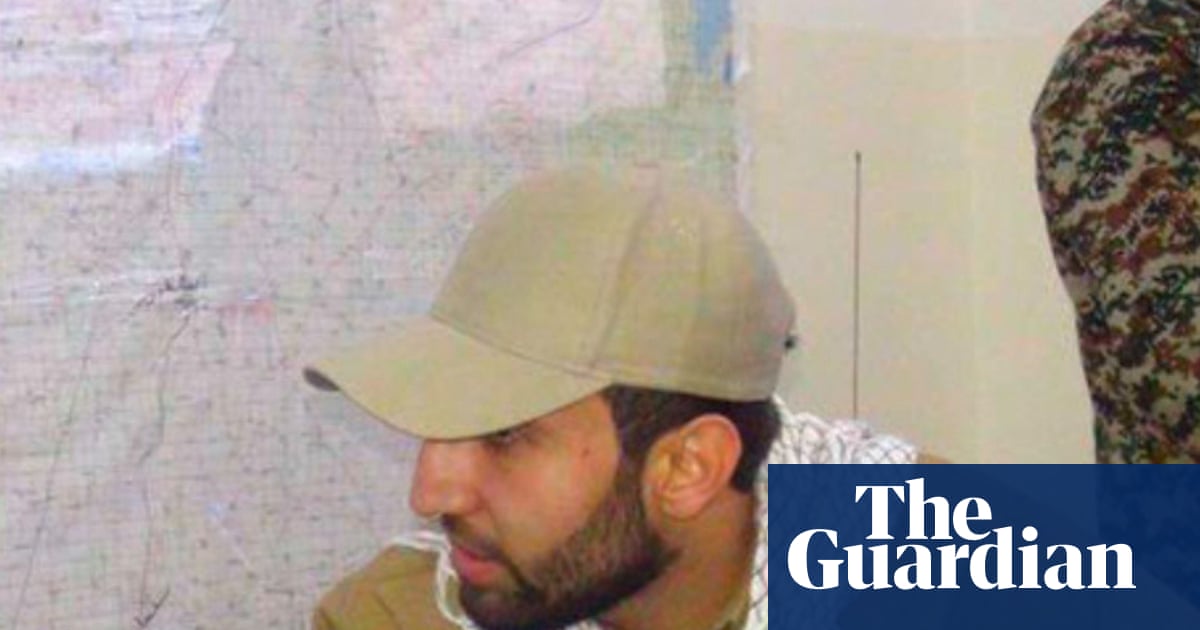
When on Friday a 32-year-old Iraqi was brought before a court in New York to be charged with planning to attack Jewish community sites in the US, a curtain was suddenly lifted on a corner of a shadowy world.
The detention of Mohammed Saad Baqer al-Saadi in Turkey last week revealed rare details of Iran’s efforts to use terrorism to sow discord among communities in Europe, the UK and the US – but also the outlines of an uncertain and threatening future.
Al-Saadi is a senior commander of the Baghdad-based Kataib Hezbollah, a powerful militia with close links to Iran’s Islamic Revolutionary Guard Corps (IRGC). He is accused of being connected to 18 separate attacks including firebombings of synagogues and community centres in Belgium, the Netherlands and the UK. Among them also is the stabbing in Golders Green, which left two Jewish men badly injured last month.
The criminal complaint against al-Saadi, who has not yet entered a plea and whose lawyer says is a political prisoner, describes a new form of long-distance instigation of violent terrorist acts that has left western states scrambling.
Once, a hostile secret service had to send a skilled and experienced operative to commit assassination, sabotage or terrorism thousands of miles away, or activate networks of sleeper agents, or find and train ideologically committed recruits ready to betray their country. Such schemes took years to prepare.
Now spymasters can use a series of proxies, each thousands of miles apart, to find candidates for recruitment. Their new operatives might be less capable than their predecessors but are easier to find in significant numbers.
“You don’t have to be in even the same time zone as your agents … They are disposable … They are cannon fodder, useful idiots in the genuine sense of the word,” said Tom Keatinge, director of the Centre for Finance and Security at London’s Royal United Services Institute.
Though there have been some notorious examples of terrorists for hire before – such as the notorious Illich Ramírez Sánchez, better known as Carlos the Jackal, in the 1970s or Sabri Khalil al-Banna, better known as Abu Nidal a decade later – such mercenaries have long been the exception not the norm.
Spies – or their preferred proxies – can now just put out a call on social media and recruit – for a few hundred pounds, euros or dollars – someone who may not even have any sympathy whatsoever with their cause.
Encrypted messaging platforms, social media and virtual currencies have created new ways such recruits can be directed and given vital resources. In recent Iranian attacks in Europe paltry payments have been offered for crimes that could earn a convicted offender decades in prison. Al-Saadi is alleged to have used cryptocurrency to pay an FBI undercover agent $3,000 as an advance. Another $7,000 was to follow if attacks on a synagogue and two Jewish community centres in the US had gone ahead – and been recorded.
“There have been discussions in recent years about hiring criminals who provide a service … so we are now entering an era of terrorism as a service,” said Peter Neumann, a leading expert in terrorism at King’s College London.
Recruitment has occurred on Snapchat and Telegram, frequently in groups or channels where people trade drugs or organise other criminal activity. Sometimes, individuals involved in organised crime are enlisted to recruit low-level operatives who often appear to have little or no idea of what they are getting themselves into.
“It is still terrorism, it still has a political agenda and is an attack meant to terrorise a particularly community, whether that is the Jewish community or an entire nation but the perpetrator is not necessarily radicalised as such. One big question is whether it still makes sense to talk about radicalisation of a perpetrator if they are just interested in getting paid,” said Neumann.
Outside western Europe and the US, Iranian secret services or their proxies often look for recruits in communities where some “baseline sympathy” might exist.
Last month, the United Arab Emirates said it had broken up a network dedicated to sabotage and terrorism that was linked to Iran. Saudi Arabia and Qatar have made arrests too. Frequently, those detained are from Persian-speaking or Shia Muslim communities.
In western Europe and the US, this is harder. The FBI informant that al-Saadi hired to commit attacks was posing as a Mexican drug cartel boss. According to the criminal complaint, al-Saadi told him that the campaign in Europe was “going well”.
Russia is the principal pioneer of such tactics in recent years, even if unconventional proxy warfare has been part of the armoury of Iran since the immediate aftermath of the revolution in 1979.
Experts talk of Moscow’s campaign of “hybrid warfare” in Europe, which has included arson attacks on warehouses, strikes on railways carrying aid to Ukraine, and vandalism designed to foment social unrest. Like the Iranian campaign, the aim here too is to disorientate, distract and divide.
Neither Moscow nor Tehran expect that such acts alone will bring total victory but this is not a world where anything is as clear as winning or losing. Every burning synagogue, bombed kosher restaurant or midnight alarm at a US bank is a low-cost win. It is the targeted communities – and the willing idiots – who pay the price.
Disclaimer : This story is auto aggregated by a computer programme and has not been created or edited by DOWNTHENEWS. Publisher: theguardian.com