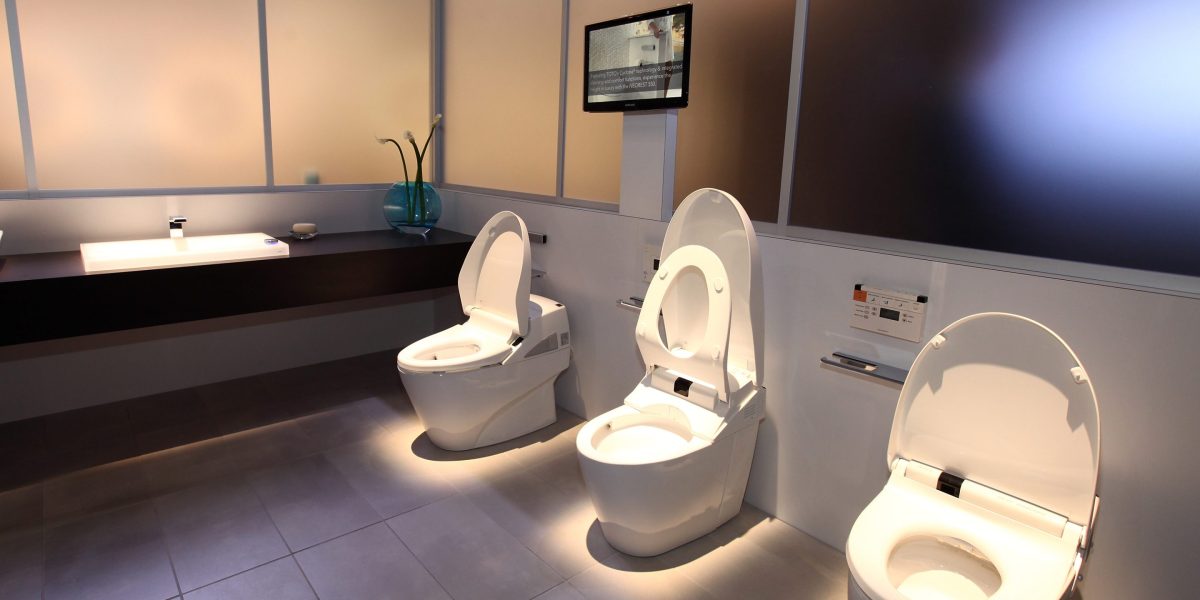
Whenever someone visits Japan, they mention the sights, the food, the impeccable transportation. Oftentimes, they mention futuristic toilets: the ubiquity of bidets, their sound effects, and the turbo-powered jets that keep you clean.
Now Japan’s largest bidet maker, Toto, is doubling down on AI chips.
The announcement followed Allbirds’ pivot to become a chipmaker. But unlike the one-time shoe company’s switch from comfort to compute, Toto didn’t just flush its old business to make chips: it’s been making the same components to power the world’s AI infrastructure for years.
The ‘Allbirds’ effect
Last month, Allbirds, the sustainable shoe company that IPO’d in 2021 at $4.1 billion, watched sales halve, lost 99% of its stock value, and sold its brand for $39 million—then rebranded as NewBird AI.
It raised $50 million to buy GPUs, declared itself a “fully integrated GPU-as-a-Service provider,” asked shareholders to strip out its founding environmental mission, and surged 582% in a single session. Retail investors set a single-day purchase record, but saw the stock to drop over 20% the next day.
There wasn’t a technical team or any cloud experience—it was simply a shoe company with a Nasdaq listing, and it surged $100 million in market cap after adding two magic letters in a press release. That’s the Allbirds Effect: in this market, anything that says “AI” gets a bid. But the Allbirds Effect has a legitimate cousin, and it makes toilets.
Two weeks later, Toto, the century-old Japanese company famous for heated bidet seats and self-cleaning bowls, surged 18% on record annual earnings. Operating profit hit ¥53.8 billion ($338 million), and net sales reached ¥737.4 billion ($4.6 billion), both all-time highs.
Toto also has an advanced ceramics division that manufactures electrostatic chucks, which are precision components that hold silicon wafers in place during memory chip fabrication. That division delivered ¥28.9 billion ($181 million) in operating profit—now more than half the company’s total.
As a result, Toto announced it’s investing ¥30 billion ($188 million) through fiscal year 2028 in capacity expansion and R&D for semiconductor ceramics, and is projecting another record year driven by AI chip demand.
London-based activist investor Palliser Capital, which took a stake in the company in February, called Toto “the most undervalued and overlooked AI memory beneficiary,” framing the ceramics segment as a multi-year AI infrastructure play with 30%+ annual growth potential.
And unlike Allbirds, Toto isn’t rebranding itself: it’s been building chip components for 40 years.
AI chip supply chain
The AI chip supply chain is full of tiny component and material makers that completely fly under the radar, with companies whose semiconductor relevance grew from expertise in totally unrelated fields. As Fortune noted, the chip supply chain “is filled with near-monopolies.”
Ajinomoto, best known for making the ingredient MSG, discovered in the 1970s that co-products of its umami seasoning had excellent electronics properties. By 1999, Ajinomoto Build-up Film was the standard insulating substrate in processors and still maintains a strangle hold on the market.
Then there’s Lasertec. It commands over 90% global share of EUV photomask inspection, without which TSMC, Samsung, and Intel can’t manufacture AI chips at minute amounts (7nm and below). Meanwhile, SCREEN Holdings, originally a printing company, is the leading maker of wafer cleaning equipment.
And that’s just Japan; Korea has its own ecosystem of back-end packaging specialists like Hanmi Semiconductor, while China is aggressively building domestic capacity in mature-node fabrication and semiconductor-grade materials.
Shareholder value at the cost of investors
A disproportionate number of these “monopolies” are from Japan. While Japan has done a lot over the past decade to improve shareholder value, it’s still not an easy market for foreign investors, and there are real worries it’s about to backslide.
Japan’s Corporate Governance Code, introduced in 2015, drove genuine reform: higher return on equity, board independence, and cross-shareholding unwinding. But Japanese companies still hold cash-to-asset ratios of 16%–18%, far above U.S. or European levels. And while 73% of investors see reviewing balance sheet structure as an issue, only around 20% of companies have actually done it.
Now a quiet revision to Japan’s Corporate Governance Code is emerging as Prime Minister Sanae Takaichi has signaled clearly she wants corporate cash reinvested in the economy: wages and capex, not buybacks and dividends.
Disclaimer : This story is auto aggregated by a computer programme and has not been created or edited by DOWNTHENEWS. Publisher: fortune.com